


doi: 10.1126/science.1089769.
Control of pancreas and liver gene expression by HNF transcription factors
Affiliations
- PMID: 14988562
- PMCID: PMC3012624
- DOI: 10.1126/science.1089769
Item in Clipboard
Control of pancreas and liver gene expression by HNF transcription factors
Science.
.
Abstract
The transcriptional regulatory networks that specify and maintain human tissue diversity are largely uncharted. To gain insight into this circuitry, we used chromatin immunoprecipitation combined with promoter microarrays to identify systematically the genes occupied by the transcriptional regulators HNF1alpha, HNF4alpha, and HNF6, together with RNA polymerase II, in human liver and pancreatic islets. We identified tissue-specific regulatory circuits formed by HNF1alpha, HNF4alpha, and HNF6 with other transcription factors, revealing how these factors function as master regulators of hepatocyte and islet transcription. Our results suggest how misregulation of HNF4alpha can contribute to type 2 diabetes.
Figures
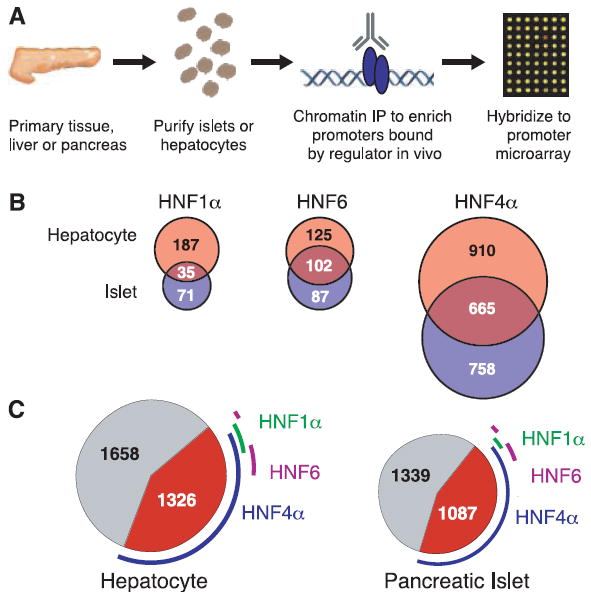
Genome-scale location analysis of HNF regulators in human tissues. (A) Hepatocytes and pancreatic islets were obtained from tissue distribution programs. These cells were treated with formaldehyde to covalently link transcription factors to DNA sites of interaction. Cells were harvested, and chromatin in cell lysates was sheared by sonication. The regulator-DNA complexes were enriched by ChIP with specific antibodies, the cross-links were reversed, and enriched DNA fragments and control genomic DNA fragments were amplified with ligation-mediated polymerase chain reaction. The amplified DNA preparations, labeled with distinct fluorophores, were mixed and hybridized onto a promoter array. (B) Venn diagram showing the overlap of HNF1α-, HNF6-, and HNF4α-bound promoters in hepatocytes (top, red circles) and pancreatic islets (bottom, blue circles). (C) The collection of genes occupied by RNA polymerase II in hepatocytes is displayed as a circle, with the genes bound by HNF1α, HNF6, and/or HNF4α outlined collectively in red as a fraction of the chart. The relative contributions of HNF1α (green), HNF6 (purple), and HNF4α (blue) are shown as framing arcs.
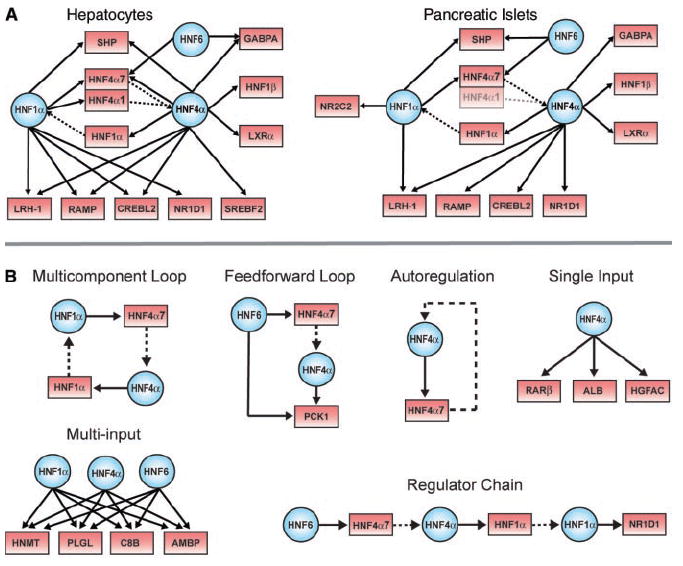
Transcriptional regulatory networks and motifs. (A) HNF1α, HNF6, and HNF4α are at the center of tissue-specific transcriptional regulatory networks. In these examples selected for illustration, regulatory proteins and their gene targets are represented as blue circles and red boxes, respectively. Solid arrows indicate protein-DNA interactions, and genes encoding regulators are linked to their protein products by dashed lines. The HNF4α1 promoter is poorly expressed in pancreatic islets and is thus shaded to reflect this. The HNF4α7 promoter, also known as the P2 promoter (23, 24), is the predominant promoter in pancreatic islets and was recently implicated as a major human diabetes susceptibility locus. For clarity, some gene promoters have been designated by the names of their protein products (e.g., HNF1α for TCF1, SHP for NR0B2, HNF4α7 for HNF4A P2, and HNF1β for TCF2). (B) Examples of regulatory network motifs in hepatocytes. For instance, in the multicomponent loop, HNF1α protein binds to the promoter of the HNF4α gene, and the HNF4α protein binds to the promoter of the HNF1α gene. These network motifs were uncovered by searching binding data with various algorithms; details on the algorithms used and a full list of motifs found are available in (20).
Comment in
-
Molecular biology. HNFs--linking the liver and pancreatic islets in diabetes.Science. 2004 Feb 27;303(5662):1311-2. doi: 10.1126/science.1095486. Science. 2004. PMID: 14988544 No abstract available.
References
Publication types
MeSH terms
Substances
Grants and funding
LinkOut - more resources
Full Text Sources
Other Literature Sources
Molecular Biology Databases
