


Molecular dynamics simulation of a palmitoyl-oleoyl phosphatidylserine bilayer with Na+ counterions and NaCl
- PMID: 14990486
- PMCID: PMC1303994
- DOI: 10.1016/S0006-3495(04)74227-7
Molecular dynamics simulation of a palmitoyl-oleoyl phosphatidylserine bilayer with Na+ counterions and NaCl
Abstract
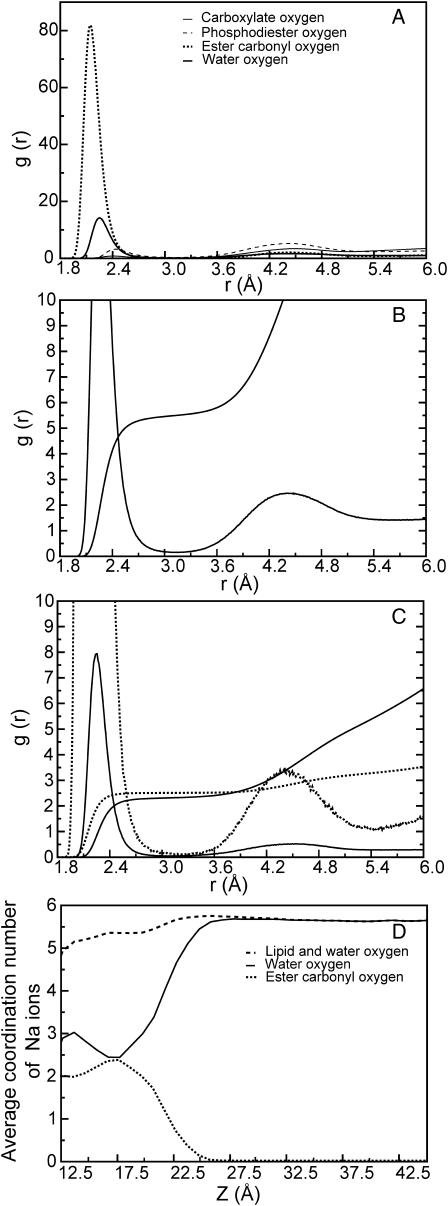
Two 40 ns molecular dynamics simulations of a palmitoyl-oleoyl phosphatidylserine (POPS) lipid bilayer in the liquid crystalline phase with Na(+) counterions and NaCl were carried out to investigate the structure of the negatively charged lipid bilayer and the effect of salt (NaCl) on the lipid bilayer structure. Na(+) ions were found to penetrate deep into the ester region of the water/lipid interface of the bilayer. Interaction of the Na(+) ions with the lipid bilayer is accompanied by a loss of water molecules around the ion and a simultaneous increase in the number of ester carbonyl oxygen atoms binding the ion, which define an octahedral and square pyramidal geometry. The amine group of the lipid molecule is involved in the formation of inter- and intramolecular hydrogen bonds with the carboxylate and the phosphodiester groups of the lipid molecule. The area per lipid of the POPS bilayer is unaffected by the presence of 0.15M NaCl. There is a small increase in the order parameter of carbon atoms in the beginning of the alkyl chain in the presence of NaCl. This is due to a greater number of Na(+) ions being coordinated by the ester carbonyl oxygen atoms in the water/lipid interface region of the POPS bilayer.
Figures




References
-
- Anézo, C., A. H. de Vries, H.-D. Höltje, D. P. Tieleman, and S. J. Marrink. 2003. Methodological issues in lipid bilayer simulations. J. Phys. Chem. B. 107:9424–9433.
-
- Berendsen, H. J. C., J. P. M. Postma, W. F. van Gunsteren, A. DiNola, and J. R. Haak. 1984. Molecular dynamics with coupling to an external bath. J. Chem. Phys. 81:3684–3690.
-
- Berendsen, H. J. C., J. P. M. Postma, W. F. van Gunsteren, and J. Hermans. 1981. Interaction models for water in relation to protein hydration. In Intermolecular Forces. B. Pullman, editor. Reidel, Dordrecht. 331–342.
-
- Berendsen, H. J. C., D. van der Spoel, and R. van Drunen. 1995. GROMACS—a message-passing parallel molecular-dynamics implementation. Comput. Phys. Commun. 91:43–56.
Publication types
MeSH terms
Substances
LinkOut - more resources
Full Text Sources
Other Literature Sources
Miscellaneous
