


Review
doi: 10.1124/mi.3.3.131.
LQT4 gene: the "missing" ankyrin
Affiliations
- PMID: 14993420
- PMCID: PMC1618879
- DOI: 10.1124/mi.3.3.131
Item in Clipboard
Review
LQT4 gene: the "missing" ankyrin
Mol Interv.
2003 May.
Abstract
Mutations in ion channels have been implicated in the formation of long QT syndrome (LQTS). However, Mohler et al. have recently uncovered a role for ankyrin-B, a non-ion channel protein, in type IV LQTS. Calcium signalling is altered, and the functions of several channels and pumps that normally interact with wild-type ankyrin-B are impaired in the presence of mutant ankyrin-B. The authors suggest that by disrupting the functions of these channels, a new mechanism has been uncovered that can lead to cardiac myopathy.
Figures

A. In LQTS, mutations cause either a gain- or a loss-of-function in INa or IK currents, respectively, that results in prolongation of the cardiac action potential. B. Representative ECG traces in relation to normal atrial and ventricular action potentials. PR and QT intervals, respectively, correspond to the atrial and ventricular activation and repolarization times. Prolongation of the cardiac action potential is reflected as lengthening of the QT interval (blue), an increased vulnerability for the development of early afterdepolarization (EAD), “triggered activity,” and ultimately cardiac arrhythmias [torsade de pointes (TdP) or ventricular fibrillation (VF)]. IKr, rapidly activating delayed-rectifier potassium channel current; IKUR, ultrarapid delayed rectifier potassium current; ITO, transient outward potassium channel current; IK1, inward rectifier potassium channel current.

Topological maps of the voltage-gated α-subunit for INa (SCN5A) and α/β-subunits that make up IKr (HERG–KCNE2) and IKs (KCNQ1–KCNE1) are shown in relation to a typical ventricular action potential. Genetic mutations in these subunits are responsible for types 1, 2, 3, 5, and 6 of LQTS.
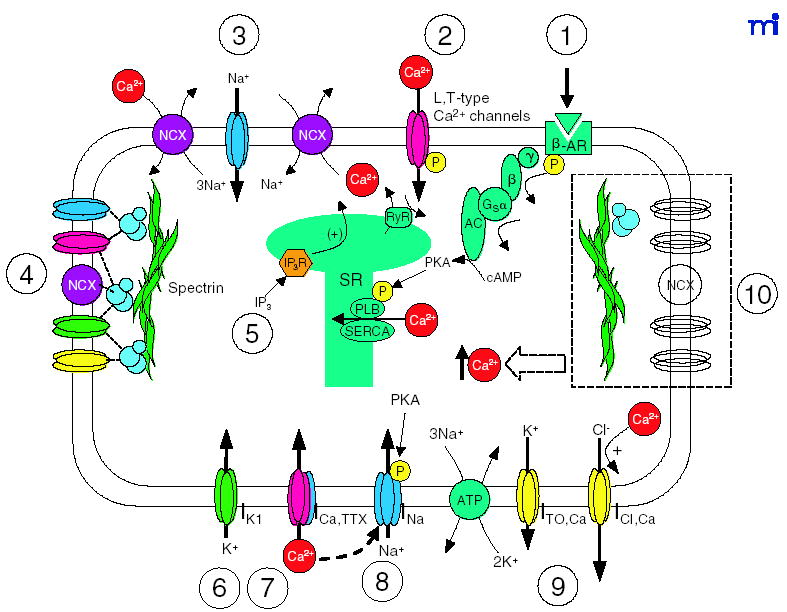
The proposed mechanisms are as follows: (1) β-adrenergic receptor (β-AR) stimulation, via Gs-mediated activation of adenylate cyclase (AC) and protein kinase A (PKA), phosphorylates phospholamban (PLB) to relieve PLB’s inhibition of the Ca2+-ATPase pump (SERCA) and, thereby, to enhance Ca2+ uptake by the sarcoplasmic reticulum (SR). (2) Ca2+-induced Ca2+-release (CICR) through the ryanodine receptor (RyR) is mediated by L-(or T-) type Ca2+ channel activation. (3) CICR via activation of voltage-dependent INa and the dual roles of the Na+/Ca2+ exchanger (NCX). (4) Ankyrin-mediated (blue spheres) localization of ion transport proteins via spectrin binding. (5) Ca2+ release triggered by inositol -1,4,5-trisphosphate (IP3) through IP3 receptors (IP3R). (6) Inward rectifying K+ current (IK1) maintains resting membrane potential and is sensitive to changes in [Ca2+]i homeostasis. (7) CICR triggered by Ca2+ entry through tetrodotoxin (TTX)-sensitive Ca2+ channel. (8) Ca2+ release mediated by “slip mode conductance”, in which PKA-dependent phosphorylation of TTX-sensitive INa have altered permeability for Ca2+. (9) Ca2+-insensitve (ITO,Ca) and Ca2+ -sensitive (ICl,Ca) transient outward potassium channels, the latter of which is carried by Cl− rather than K+ ions. (10) Reduced Ca2+-handling proteins due to a deficiency of ankyrin (blue spheres).
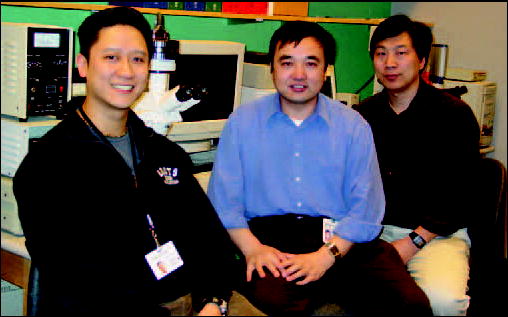
Sandro Yong, PhD, (left) is a Postdoctoral Fellow in the laboratory of Dr. Wang in the Department of Molecular Cardiology, Lerner Research Institute and Center for Cardiovascular Genetics, Department of Cardiovascular Medicine at the Cleveland Clinic Foundation. Qing Wang, PhD, (center) is Associate Staff/Associate Professor of Molecular Genetics, Molecular Cardiology, and Cardiovascular Medicine and Director of Center for Cardiovascular Genetics at the Cleveland Clinic Foundation. QW is supported by NIH grants R01 HL65630 and HL66251, and a Doris Duke Innovation in Clinical Research Award. Please address correspondence to QW. E-mail wangq2@ccf.org ; fax 216-444-2682. Xiaoli Tian, PhD, (right) is a Postdoctoral Fellow in the Wang lab Department of Molecular Cardiology, Lerner Research Institute and Center for Cardiovascular Genetics, Department of Cardiovascular Medicine at the Cleveland Clinic Foundation. XL is supported by an American Heart Association Ohio-Valley Postdoctoral Fellowship.
References
-
- Wang Q, Chen Q, Towbin JA. Genetics, molecular mechanisms and management of long QT syndrome. Ann Med. 1998;30:58–65. - PubMed
-
- Wang Q, Shen J, Li Z, Timothy K, Vincent GM, Priori SG, Schwartz PJ, Keating MT. Cardiac sodium channel mutations in patients with long QT syndrome, an inherited cardiac arrhythmia. Hum Mol Genet. 1995;4:1603–1607. - PubMed
-
- Vincent GM. The molecular genetics of the long QT syndrome: Genes causing fainting and sudden death. Annu Rev Med. 1998;49:263–274. - PubMed
-
- Curran ME, Splawski I, Timothy KW, Vincent GM, Green ED, Keating MT.A molecular basis for cardiac arrhythmia: HERG mutations cause long QT syndrome Cell 80795–803.1995A key publication on identification of a cardiac potassium channel a-subunit geneHERG(KCNH2) as the chromosome 7q35-36-linked LQTS gene (LQT2). - PubMed
-
- Wang Q, Shen J, Splawski I, Atkinson D, Li Z, Robinson JL, Moss AJ, Towbin JA, Keating MT.SCN5A mutations associated with an inherited cardiac arrhythmia, long QT syndrome Cell 80805–811.1995A key publication on identification of the cardiac sodium channel geneSCN5Aas the chromosome 3p21-linked LQTS gene (LQT3). - PubMed
Publication types
MeSH terms
Substances
Grants and funding
LinkOut - more resources
Full Text Sources