. 2004 Mar 9;101(10):3504-9.
doi: 10.1073/pnas.0400182101. Epub 2004 Mar 1.

A variable dinucleotide repeat in the CFTR gene contributes to phenotype diversity by forming RNA secondary structures that alter splicing

Affiliations

A variable dinucleotide repeat in the CFTR gene contributes to phenotype diversity by forming RNA secondary structures that alter splicing

Timothy W Hefferon et al. Proc Natl Acad Sci U S A. .

Abstract

Dinucleotide repeats are ubiquitous features of eukaryotic genomes that are not generally considered to have functional roles in gene expression. However, the highly variable nature of dinucleotide repeats makes them particularly interesting candidates for modifiers of RNA splicing when they are found near splicing signals. An example of a variable dinucleotide repeat that affects splicing is a TG repeat located in the splice acceptor of exon 9 of the cystic fibrosis transmembrane conductance regulator (CFTR) gene. Higher repeat numbers result in reduced exon 9 splicing efficiency and, in some instances, the reduction in full-length transcript is sufficient to cause male infertility due to congenital bilateral absence of the vas deferens or nonclassic cystic fibrosis. Using a CFTR minigene system, we studied TG tract variation and observed the same correlation between dinucleotide repeat number and exon 9 splicing efficiency seen in vivo. Replacement of the TG dinucleotide tract in the minigene with random sequence abolished splicing of exon 9. Replacements of the TG tract with sequences that can self-base-pair suggested that the formation of an RNA secondary structure was associated with efficient splicing. However, splicing efficiency was inversely correlated with the predicted thermodynamic stability of such structures, demonstrating that intermediate stability was optimal. Finally, substitution with TA repeats of differing length confirmed that stability of the RNA secondary structure, not sequence content, correlated with splicing efficiency. Taken together, these data indicate that dinucleotide repeats can form secondary structures that have variable effects on RNA splicing efficiency and clinical phenotype.


Figures
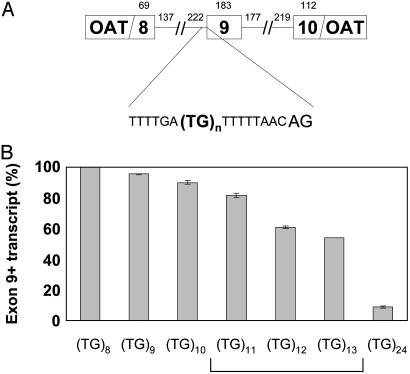
Fig. 1.
Fig. 1.
Minigene design and splicing of TG tract variants. (A) The CFTR locus in humans has a variable number (–13) of TG repeats followed by a polythymidine tract of 5, 7, or 9 Ts. All minigenes in this study contained 5 Ts because this allele is associated with the highest levels of exon-skipping in vivo and is associated with clinical phenotypes. (TG)9 and (TG)10 have only been observed with 9T or 7T. The minigene consists of portions of CFTR exons 8, 9, and 10 and flanking intronic sequences fused in-frame to an OAT cDNA construct in a mammalian expression vector. (B) Exon 9 splicing efficiency decreases as the number of TG repeats increases. The bracket indicates TG alleles that are found in cis with 5T in humans.
Fig. 2.
Fig. 2.
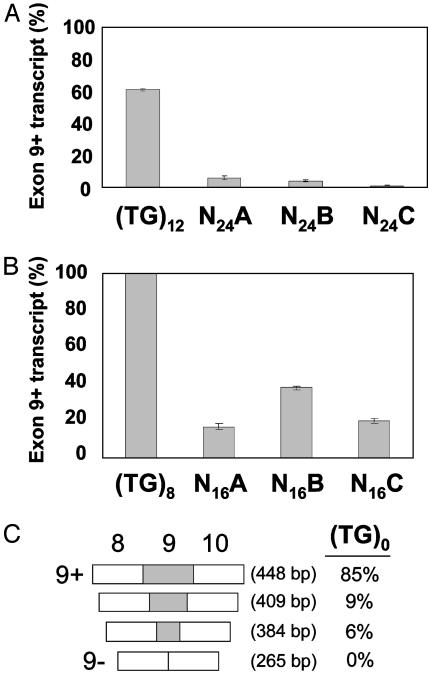
Replacement of (TG)n tract with randomized tracts of the same total length results in drastically reduced splicing efficiency. (A) Splicing results from (TG)12 and three different random tracts of 24 nucleotides (for randomization, see Materials and Methods). (B) A TG tract of eight dinucleotides, which does not skip exon 9 at all, was replaced with three random-nucleotide stretches of equal length to the (TG)8 tract. (C) Content and relative proportions of splice products derived from the (TG)0 construct. An intermediate number of TGs (between 0 and 9) are optimal for exon 9 splicing.
Fig. 3.
Fig. 3.
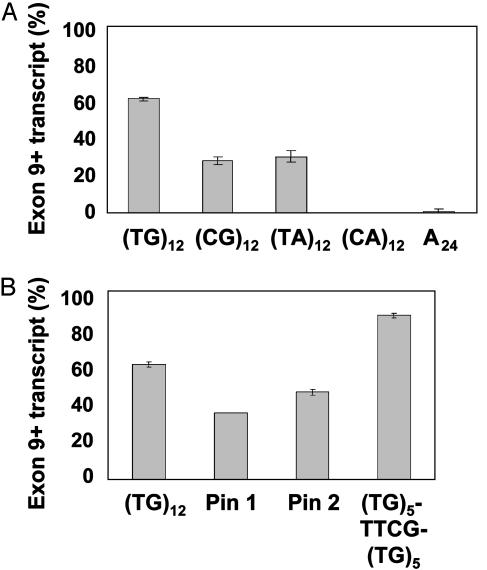
Tracts capable of self-base-pairing splice exon 9 more efficiently. (A)Replacing the TG tract with dinucleotide repeats of different composition resulted in an inverse correlation between the ability to self-pair and exon 9 skipping. (CG)12 and (TA)12 tracts showed a level of skipping intermediate between (TG)12 and random sequences, whereas (CA)12 and A24 tracts skipped exon 9 100% of the time. The fact that sequences capable of intratract base-pairing spliced more efficiently than those which were not suggested a role for RNA secondary structure in the influence of these sequences on splicing. (B) Effect of replacing (TG)12 with artificial, thermostable hairpin elements of the same length as (TG)12. (TG)12 is shown for reference. Two artificially created hairpins, pin 1 and pin 2, contained the loop-forming motif TTCG flanked by randomized but complementary sequences (see Table 1 for sequences). (TG)5-TTCG-(TG)5 was generated by a 2-bp mutation in the (TG)12 construct.
Fig. 4.
Fig. 4.
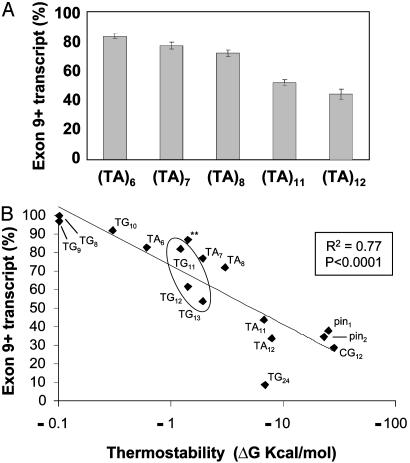
Splicing efficiency inversely correlated with stem loop thermostability across a broad range of minigene constructs. (A) Changes in repeat number of a TA dinucleotide tract produced the same trend seen with a TG tract. (B) Structures and thermodynamic stabilities of all tracts expected to form hairpin secondary structures, as predicted by the RNA structure-predicting program mfold (34). The oval indicates alleles seen in cis with 5T in humans. **, Construct (TG)5TTCG(TG)5, shown here for visual clarity. (CA)12, A24, and randomized tracts (N24 and N16) were not predicted to form hairpins or were predicted to form alternative structures and are not included in the plot.

References

    1. Gabellini, N. (2001) Eur. J. Biochem. 268, 1076-1083. - PubMed
    1. Hui, J., Stangl, K., Lane, W. S. & Bindereif, A. (2003) Nat. Struct. Biol. 10, 33-37. - PubMed
    1. Stangl, K., Cascorbi, I., Laule, M., Klein, T., Stangl, V., Rost, S., Wernecke, K. D., Felix, S. B., Bindereif, A., Baumann, G., et al. (2000) Pharmacogenetics 10, 133-140. - PubMed
    1. Shelley, C. S. & Baralle, F. E. (1987) Nucleic Acids Res. 15, 3787-3799. - PMC - PubMed
    1. Hui, J., Reither, G. & Bindereif, A. (2003) RNA 9, 931-936. - PMC - PubMed

Publication types