Effects of training on quality of peer review: randomised controlled trial
- PMID: 14996698
- PMCID: PMC381220
- DOI: 10.1136/bmj.38023.700775.AE
Effects of training on quality of peer review: randomised controlled trial
Abstract
Objective: To determine the effects of training on the quality of peer review.
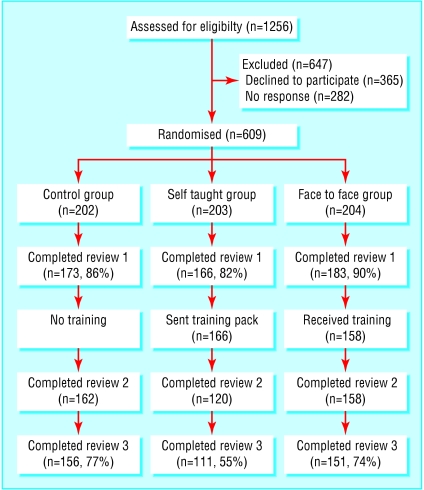
Design: Single blind randomised controlled trial with two intervention groups receiving different types of training plus a control group.
Setting and participants: Reviewers at a general medical journal. Interventions Attendance at a training workshop or reception of a self taught training package focusing on what editors want from reviewers and how to critically appraise randomised controlled trials.
Main outcome measures: Quality of reviews of three manuscripts sent to reviewers at four to six monthly intervals, evaluated using the validated review quality instrument; number of deliberate major errors identified; time taken to review the manuscripts; proportion recommending rejection of the manuscripts.
Results: Reviewers in the self taught group scored higher in review quality after training than did the control group (score 2.85 v 2.56; difference 0.29, 95% confidence interval 0.14 to 0.44; P = 0.001), but the difference was not of editorial significance and was not maintained in the long term. Both intervention groups identified significantly more major errors after training than did the control group (3.14 and 2.96 v 2.13; P < 0.001), and this remained significant after the reviewers' performance at baseline assessment was taken into account. The evidence for benefit of training was no longer apparent on further testing six months after the interventions. Training had no impact on the time taken to review the papers but was associated with an increased likelihood of recommending rejection (92% and 84% v 76%; P = 0.002).
Conclusions: Short training packages have only a slight impact on the quality of peer review. The value of longer interventions needs to be assessed.
Figures
Comment in
-
Improving peer review: who's responsible?BMJ. 2004 Mar 20;328(7441):657-8. doi: 10.1136/bmj.328.7441.657. BMJ. 2004. PMID: 15031216 Free PMC article. No abstract available.
References
-
- Rennie D. Editorial peer review: its development and rationale. In: Godlee F, Jefferson T, eds. Peer review in health sciences. London: BMJ Books, 1999.
-
- Callaham ML, Knopp RK, Gallagher EJ. Effect of written feedback by editors on quality of reviews. JAMA 2002;287: 2781-3. - PubMed
-
- Callaham ML, Wears RL, Waeckerle JF. Effect of attendance at a training session on peer reviewer quality and performance. Ann Emerg Med 1998;32: 318-22. - PubMed
-
- Thomson O'Brien MA, Freemantle N, Oxman AD, Wolf F, David DA, Herrin J. Continuing education meetings and workshops: effects on professional practice and health care outcomes. Cochrane Database Syst Rev 2003;(4): CD003030. - PubMed
Publication types
MeSH terms
LinkOut - more resources
Full Text Sources