


Antibiotic-sensitive TolC mutants and their suppressors
- PMID: 14996816
- PMCID: PMC355985
- DOI: 10.1128/JB.186.6.1851-1860.2004
Antibiotic-sensitive TolC mutants and their suppressors
Abstract
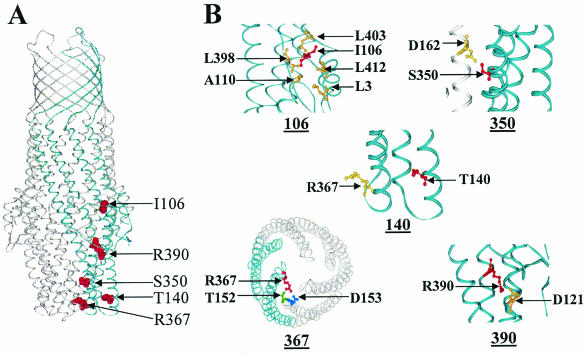
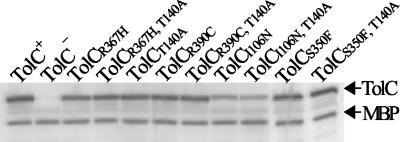
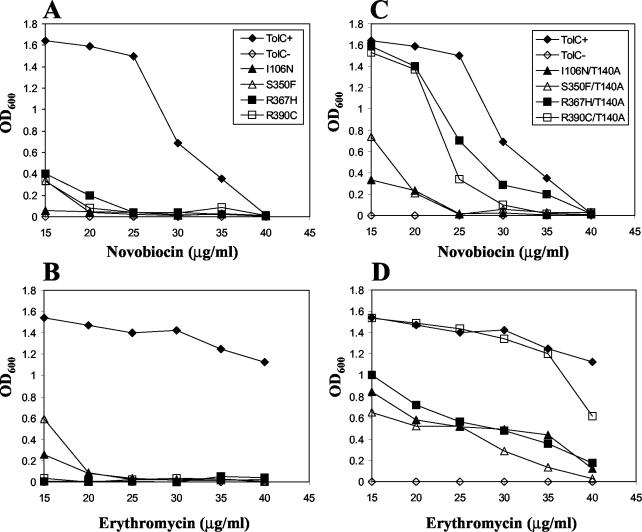
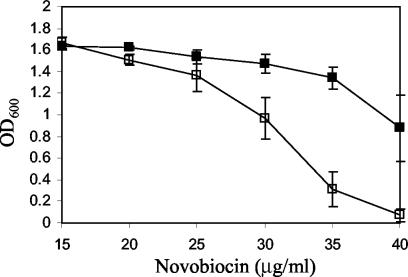
The TolC protein of Escherichia coli, through its interaction with AcrA and AcrB, is thought to form a continuous protein channel that expels inhibitors from the cell. Consequently, tolC null mutations display a hypersensitive phenotype. Here we report the isolation and characterization of tolC missense mutations that direct the synthesis of mutant TolC proteins partially disabled in their efflux role. All alterations, consisting of single amino acid substitutions, were localized within the periplasmic alpha-helical domain. In two mutants carrying an I106N or S350F substitution, the hypersensitivity phenotype may be in part due to aberrant TolC assembly. However, two other alterations, R367H and R390C, disrupted efflux function by affecting interactions among the helices surrounding TolC's periplasmic tunnel. Curiously, these two TolC mutants were sensitive to a large antibiotic, vancomycin, and exhibited a Dex(+) phenotype. These novel phenotypes of TolC(R367H) and TolC(R390C) were likely the result of a general influx of molecules through a constitutively open tunnel aperture, which normally widens only when TolC interacts with other proteins during substrate translocation. An intragenic suppressor alteration (T140A) was isolated from antibiotic-resistant revertants of the hypersensitive TolC(R367H) mutant. T140A also reversed, either fully (R390C) or partially (I106N and S350F), the hypersensitivity phenotype of other TolC mutants. Our data suggest that this global suppressor phenotype of T140A is the result of impeded antibiotic influx caused by tapering of the tunnel passage rather than by correcting individual mutational defects. Two extragenic suppressors of TolC(R367H), mapping in the regulatory region of acrAB, uncoupled the AcrR-mediated repression of the acrAB genes. The resulting overexpression of AcrAB reduced the hypersensitivity phenotype of all the TolC mutants. Similar results were obtained when the chromosomal acrR gene was deleted or the acrAB genes were expressed from a plasmid. Unlike the case for the intragenic suppressor T140A, the overexpression of AcrAB diminished hypersensitivity towards only erythromycin and novobiocin, which are substrates of the TolC-AcrAB efflux pump, but not towards vancomycin, which is not a substrate of this pump. This showed that the two types of suppressors produced their effects by fundamentally different means, as the intragenic suppressor decreased the general influx while extragenic suppressors increased the efflux of TolC-AcrAB pump-specific antibiotics.
Figures
References
-
- Benson, S. A., J. L. Occi, and B. A. Sampson. 1988. Mutations that alter the pore function of the OmpF porin of Escherichia coli K12. J. Mol. Biol. 203:961-970. - PubMed
-
- Blight, M. A., A. L. Pimenta, J. C. Lazzaroni, C. Dando, L. Kotelevets, S. J. Seror, and I. B. Holland. 1994. Identification and preliminary characterization of temperature-sensitive mutations affecting HlyB, the translocator required for the secretion of haemolysin (HlyA) from Escherichia coli. Mol. Gen. Genet. 245:431-440. - PubMed
-
- Buchanan, S. K., B. S. Smith, L. Venkatramani, D. Xia, L. Esser, M. Palnitkar, R. Chakraborty, D. van der Helm, and J. Deisenhofer. 1999. Crystal structure of the outer membrane active transporter FepA from Escherichia coli. Nat. Struct. Biol. 6:56-63. - PubMed
-
- Casadaban, M. J. 1976. Transposition and fusion of the lac genes to selected promoters in Escherichia coli using bacteriophage lambda and Mu. J. Mol. Biol. 141:541-555. - PubMed
Publication types
MeSH terms
Substances
Grants and funding
LinkOut - more resources
Full Text Sources
Medical
Molecular Biology Databases
