


Reduced total energy expenditure and physical activity in cachectic patients with pancreatic cancer can be modulated by an energy and protein dense oral supplement enriched with n-3 fatty acids
- PMID: 14997196
- PMCID: PMC2409623
- DOI: 10.1038/sj.bjc.6601620
Reduced total energy expenditure and physical activity in cachectic patients with pancreatic cancer can be modulated by an energy and protein dense oral supplement enriched with n-3 fatty acids
Abstract
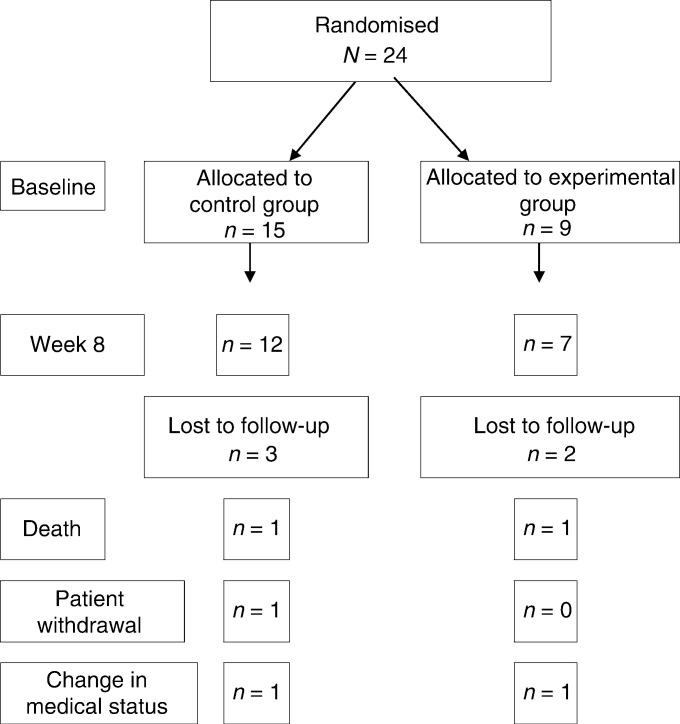
The aim of the study was to assess the total energy expenditure (TEE), resting energy expenditure (REE) and physical activity level (PAL) in home-living cachectic patients with advanced pancreatic cancer. The influence of an energy and protein dense oral supplement either enriched with or without the n-3 fatty acid eicosapentaenoic acid (EPA) and administered over an 8-week period was also determined. In total, 24 patients were studied at baseline. The total energy expenditure was measured using doubly labelled water and REE determined by indirect calorimetry. Patients were studied at baseline and then randomised to either oral nutritional supplement. Measurements were repeated at 8 weeks. At baseline, REE was increased compared with predicted values for healthy individuals (1387(42) vs 1268(32) kcal day(-1), P=0.001), but TEE (1732(82) vs 1903(48) kcal day(-1), P=0.023) and PAL (1.24(0.04) vs 1.50) were reduced. After 8 weeks, the REE, TEE and PAL of patients who received the control supplement did not change significantly. In contrast, although REE did not change, TEE and PAL increased significantly in those who received the n-3 (EPA) enriched supplement. In summary, patients with advanced pancreatic cancer were hypermetabolic. However, TEE was reduced and this was secondary to a reduction in physical activity. The control energy and protein dense oral supplement did not influence the physical activity component of TEE. In contrast, administration of the supplement enriched with EPA was associated with an increase in physical activity, which may reflect improved quality of life.
Figures
References
-
- Black AE, Coward WA, Cole TJ, Prentice AM (1996) Human energy expenditure in affluent societies: an analysis of 574 doubly-labelled water measurements. Eur J Clin Nutr 50: 72–92 - PubMed
-
- Dempsey DT, Knox LS, Mullen JL, Miller C, Feurer ID, Buzby GP (1986) Energy expenditure in malnourished patients with colorectal cancer. Arch Surg 121: 789–795 - PubMed
-
- Endres S, Ghorbani R, Kelley VE, Georgilis K, Lonnemann G, van der Meer JW, Cannon JG, Rogers TS, Klempner MS, Weber PC, Schaffer EJ, Wolff SM, Dinorelle CA (1989) The effect of dietary supplementation with n-3 polyunsaturated fatty acids on the synthesis of interleukin-1 and tumor necrosis factor by mononuclear cells. N Engl J Med 320: 265–271 - PubMed
Publication types
MeSH terms
Substances
LinkOut - more resources
Full Text Sources
Other Literature Sources
Medical
Research Materials
