. 2004 Mar 16;101(11):3770-4.
doi: 10.1073/pnas.0307713101. Epub 2004 Mar 3.

A single amino acid difference in the host APOBEC3G protein controls the primate species specificity of HIV type 1 virion infectivity factor

Affiliations

A single amino acid difference in the host APOBEC3G protein controls the primate species specificity of HIV type 1 virion infectivity factor

Hal P Bogerd et al. Proc Natl Acad Sci U S A. .

Abstract

The HIV type 1 (HIV-1) virion infectivity factor (Vif) protein blocks the action of the host defense factor APOBEC3G in human cells, thereby allowing release of infectious virions, but fails to inhibit similar APOBEC3G proteins present in some simian cells. Conversely, the Vif protein encoded by the African green monkey (agm) simian immunodeficiency virus (SIV) can block agm APOBEC3G function but fails to inhibit human APOBEC3G. This difference plays a key role in determining the primate species tropism of HIV-1 and SIV agm. Here, we demonstrate that a single APOBEC3G residue, which is an aspartic acid in human APOBEC3G and a lysine in agm APOBEC3G, controls the ability of the HIV-1 Vif protein to bind and inactivate these host defense factors. These data identify a critical charged residue that plays a key role in mediating the formation of the distinct Vif:APOBEC3G complexes formed in human and simian cells. Moreover, these results suggest that the biological barrier preventing the entry of additional SIV into the human population as zoonotic infections is potentially quite fragile.


Figures
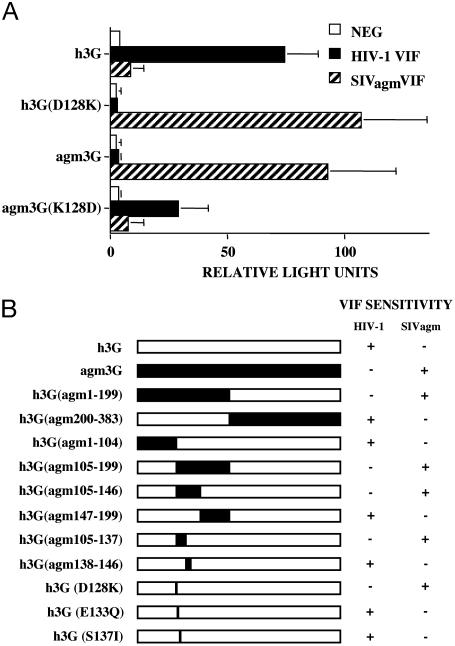
Fig. 1.
Fig. 1.
Mapping the viral tropism determinant in APOBEC3G. (A) 293T cells were cotransfected with the pNL-Luc-HXBΔVif proviral indicator construct together with the HIV-1 Vif expression plasmid pgVif or the SIVagm Vif expression pSIVagmVif, or a control plasmid, and finally with plasmids expressing wild-type or mutant forms of h3G or agm3G. At 44 h after transfection, the supernatant media were harvested and used to infect CD4+, CXCR4+ 293T cells. A further 28 h later, the infected cells were lysed and the level of virus-encoded Luc activity was quantified. Data are expressed relative to the level of Luc activity induced by virus derived from a culture transfected with pNL-Luc-HXBΔVif in the absence of any APOBEC3G or Vif expression plasmid, which was arbitrarily set at 100. The average of three independent experiments with SD is indicated. (B) Schematic representation of chimeric APOBEC3G proteins derived by substitution of agm3G segments in place of h3G segments. The name indicates which segment of agm3G has been inserted into h3G, e.g., h3G(agm200-383) contains agm3G residues 200-383 substituted for h3G residues 200-384. Each chimeric protein responded fully to one viral Vif protein (indicated by “+”) but not to the other viral protein (indicated by “-”). Representative data from this analysis are shown in Fig. 9.
Fig. 2.
Fig. 2.
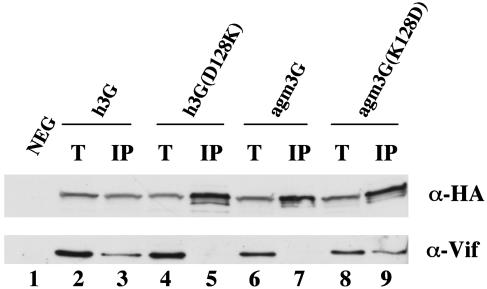
Binding of HIV-1 Vif by primate APOBEC3G proteins is specific. We transfected 293T cells with the HIV-1 Vif expression plasmid pgVif and a plasmid encoding the indicated HA-tagged APOBEC3G protein. At 48 h after transfection, the cells were lysed and subjected to immunoprecipitation by using a mouse anti-HA mAb. Proteins present in the total lysate (T) or immunoprecipitate (IP) were then separated by gel electrophoresis, transferred to a nitrocellulose filter, and analyzed by Western blot analysis by using rabbit polyclonal antisera specific for the HA tag (Upper) or the HIV-1 Vif protein (Lower). The negative (Neg) control lane was transfected with the control pcDNA3 plasmid. This experiment used 2% of the total lysate and 10% of the immunoprecipitate in each lane.
Fig. 3.
Fig. 3.
Specific repression of APOBEC3G expression by HIV-1 or SIVagm Vif. 293T cells were transfected as described in Fig. 1A. At the same time that the virus containing supernatant was harvested for analysis, the transfected cell cultures were lysed and the level of expression of the indicated APOBEC3G proteins was determined by Western blot analysis by using a mouse mAb specific for the HA epitope tag. A parallel Western blot analysis measuring Gag protein expression is shown in Fig. 7.
Fig. 4.
Fig. 4.
Primate immunodeficiency virus Vif proteins can selectively block virion incorporation of APOBEC3G. This assay was performed as described in Fig. 1, except that the proviral expression plasmid pNL-Luc-HXBΔVif was replaced with the similar plasmid pNL4-3ΔEnvΔVif. At 44 h, the supernatant media were harvested and the released virions were collected by ultracentrifugation. After lysis, the level of the indicated HA-tagged APOBEC3G proteins incorporated into the virions was determined by Western blot analysis by using a HA-specific mouse mAb. Virion p24 Gag protein levels were measured in parallel.
Fig. 5.
Fig. 5.
Mutagenesis of residue 128 in h3G and agm3G. This determination of the ability of point mutants of h3G (A) or agm3G (B) to inhibit the infectivity of Vif-defective HIV-1 and to respond to the HIV-1 Vif or SIVagm Vif protein was performed as described in Fig. 1. Data are expressed relative to the level of Luc activity induced by virus derived from a culture cotransfected with pNL-Luc-HXBΔVif and either h3G and HIV-1 Vif (A) or agm3G and SIVagm Vif (B), which was set at 100. The average of three independent experiments with SD is indicated.

Comment in

References

    1. Fisher, A. G., Ensoli, B., Ivanoff, L., Chamberlain, M., Petteway, S., Ratner, L., Gallo, R. C. & Wong-Staal, F. (1987) Science 237, 888-893. - PubMed
    1. Strebel, K., Daugherty, D., Clouse, K., Cohen, D., Folks, T. & Martin, M. A. (1987) Nature 328, 728-730. - PubMed
    1. Goncalves, J., Korin, Y., Zack, J. & Gabuzda, D. (1996) J. Virol. 70, 8701-8709. - PMC - PubMed
    1. Simon, J. H. M. & Malim, M. H. (1996) J. Virol. 70, 5297-5305. - PMC - PubMed
    1. von Schwedler, U., Song, J., Aiken, C. & Trono, D. (1993) J. Virol. 67, 4945-4955. - PMC - PubMed