


Effects of ageing and exercise training on endothelium-dependent vasodilatation and structure of rat skeletal muscle arterioles
- PMID: 15004211
- PMCID: PMC1665008
- DOI: 10.1113/jphysiol.2003.060301
Effects of ageing and exercise training on endothelium-dependent vasodilatation and structure of rat skeletal muscle arterioles
Abstract
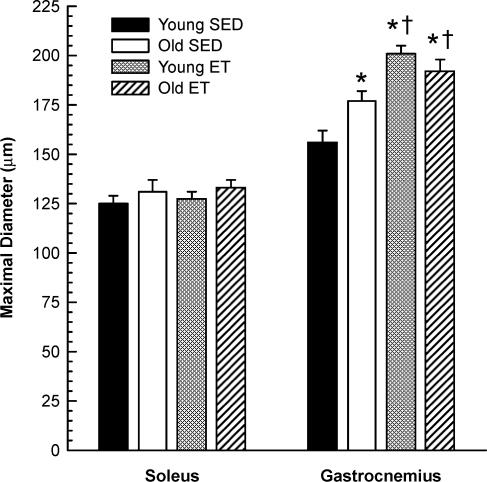
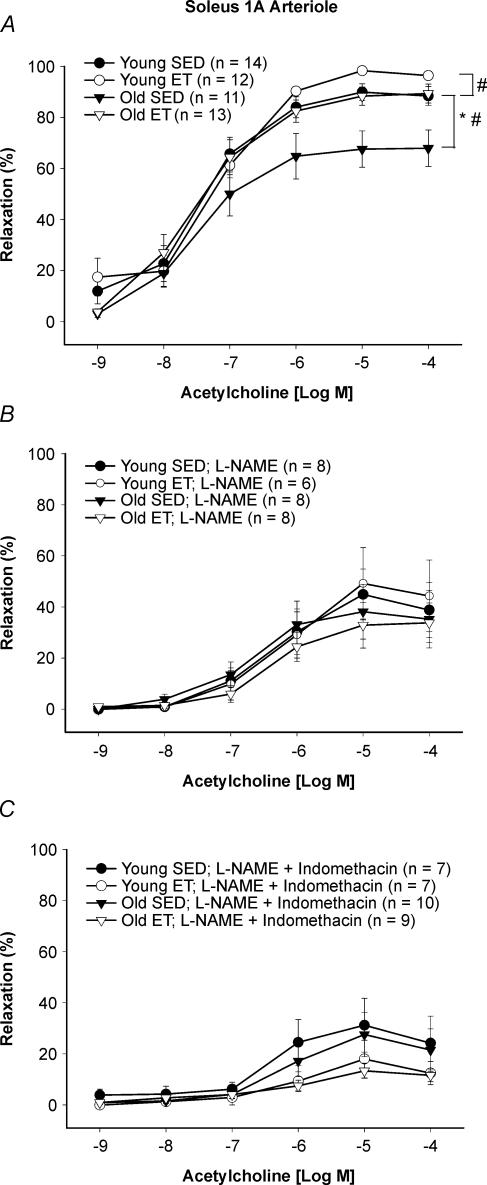
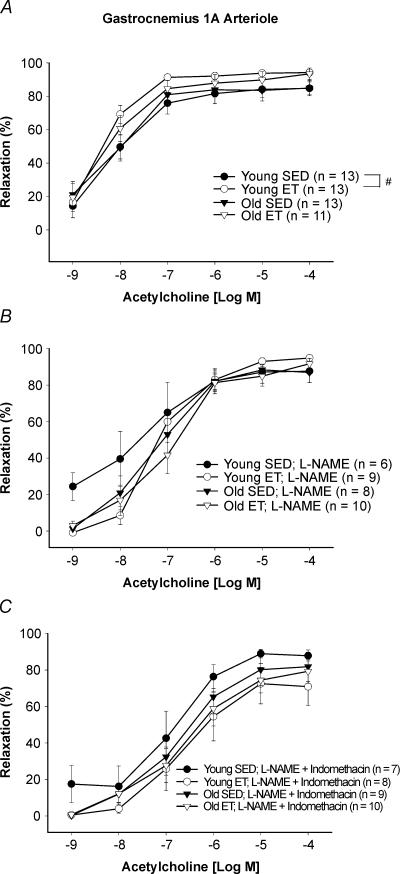
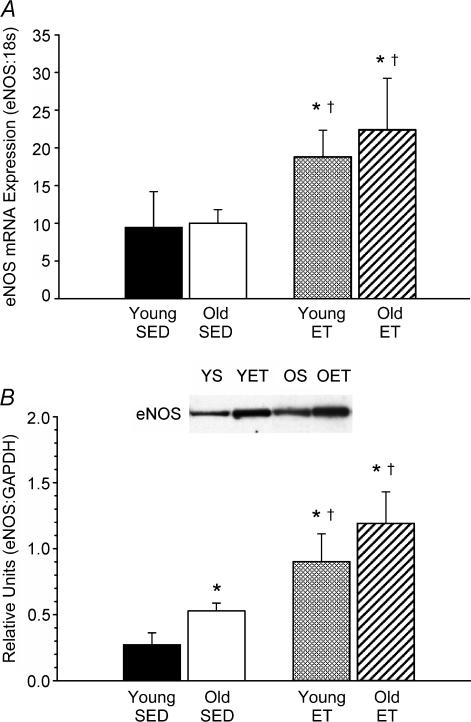
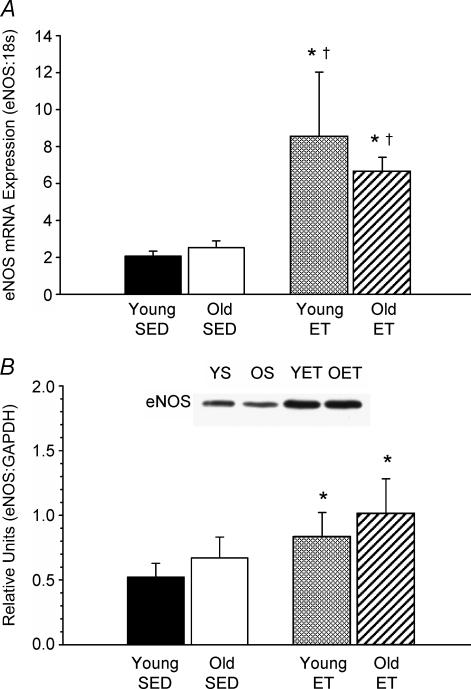
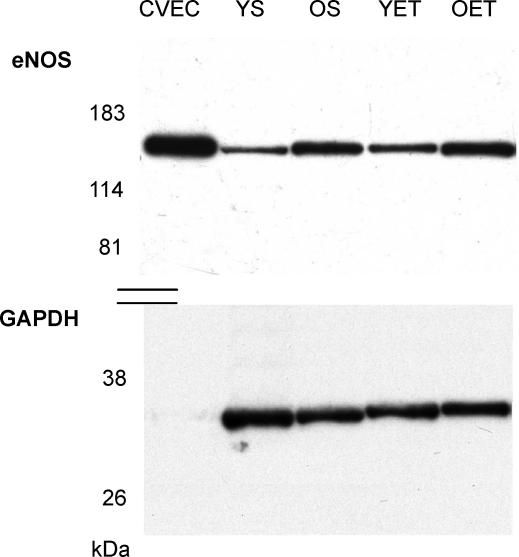
Ageing reduces endothelium-dependent vasodilatation in humans and animals, and in humans, exercise training reverses the ageing-associated reduction in endothelium-dependent vasodilatation. The purpose of this study was to determine the mechanism(s) by which 10-12 weeks of treadmill exercise enhances endothelium-dependent vasodilatation in muscles of differing fibre composition from young and old rats. Three- and 22-month-old male Fischer 344 rats were assigned to young sedentary, young exercise-trained, old sedentary, or old exercise-trained groups. Arterioles were isolated from the soleus and gastrocnemius muscles; luminal diameter changes were determined in response to the endothelium-dependent vasodilator acetylcholine (ACh, 10(-9)-10(-4) mol l(-1)) alone and in the presence of the nitric oxide synthase (NOS) inhibitor l-NAME (10(-5) mol l(-1)) or the combination of l-NAME and the cyclooxygenase inhibitor indomethacin (10(-5) mol l(-1)). Training ameliorated the ageing-induced reduction in endothelium-dependent vasodilatation in soleus muscle arterioles. Treatment with l-NAME alone and in combination with indomethacin abolished differences in ACh vasodilatation occurring with ageing and training. Expression of endothelial NOS (eNOS) mRNA in soleus arterioles was unaltered by ageing, whereas eNOS protein was increased with age; training elevated both eNOS mRNA and protein. In gastrocnemius muscle arterioles, ageing did not alter maximal vasodilatation, but ageing and training increased maximal arteriolar diameter. These results demonstrate that ageing-induced reductions and training-induced enhancement of endothelial vasodilatation both occur through the nitric oxide signalling mechanism in highly oxidative skeletal muscle, but ageing and training do not appear to act on the same portion of the signalling cascade.
Figures
Comment in
-
Ageing, exercise training, and resistance vessels: more than just no NO?J Physiol. 2004 May 1;556(Pt 3):673. doi: 10.1113/jphysiol.2004.063990. Epub 2004 Mar 19. J Physiol. 2004. PMID: 15034121 Free PMC article. No abstract available.
Similar articles
-
Ageing and exercise training alter adrenergic vasomotor responses of rat skeletal muscle arterioles.J Physiol. 2007 Feb 15;579(Pt 1):115-25. doi: 10.1113/jphysiol.2006.120055. Epub 2006 Nov 2. J Physiol. 2007. PMID: 17082231 Free PMC article.
-
Exercise training enhances flow-induced vasodilation in skeletal muscle resistance arteries of aged rats: role of PGI2 and nitric oxide.Am J Physiol Heart Circ Physiol. 2007 Jun;292(6):H3119-27. doi: 10.1152/ajpheart.00588.2006. Epub 2007 Mar 2. Am J Physiol Heart Circ Physiol. 2007. PMID: 17337602
-
Ageing diminishes endothelium-dependent vasodilatation and tetrahydrobiopterin content in rat skeletal muscle arterioles.J Physiol. 2008 Feb 15;586(4):1161-8. doi: 10.1113/jphysiol.2007.147686. Epub 2007 Dec 6. J Physiol. 2008. PMID: 18063659 Free PMC article.
-
The effect of different training modes on skeletal muscle microvascular density and endothelial enzymes controlling NO availability.J Physiol. 2016 Apr 15;594(8):2245-57. doi: 10.1113/JP270329. Epub 2015 Apr 16. J Physiol. 2016. PMID: 25809076 Free PMC article. Review.
-
Vascular cell transcriptomic changes to exercise training differ directionally along and between skeletal muscle arteriolar trees.Microcirculation. 2017 Feb;24(2). doi: 10.1111/micc.12336. Microcirculation. 2017. PMID: 27889934 Review.
Cited by
-
Aging and estrogen status: a possible endothelium-dependent vascular coupling mechanism in bone remodeling.PLoS One. 2012;7(11):e48564. doi: 10.1371/journal.pone.0048564. Epub 2012 Nov 20. PLoS One. 2012. PMID: 23185266 Free PMC article.
-
Short-term exercise training enhances functional sympatholysis through a nitric oxide-dependent mechanism.J Physiol. 2013 Mar 15;591(6):1535-49. doi: 10.1113/jphysiol.2012.238998. Epub 2013 Jan 7. J Physiol. 2013. PMID: 23297301 Free PMC article.
-
Exercise training reverses aging-induced impairment of myogenic constriction in skeletal muscle arterioles.J Appl Physiol (1985). 2015 Apr 1;118(7):904-11. doi: 10.1152/japplphysiol.00277.2014. Epub 2015 Jan 29. J Appl Physiol (1985). 2015. PMID: 25634999 Free PMC article.
-
NAD(P)H oxidase-derived reactive oxygen species contribute to age-related impairments of endothelium-dependent dilation in rat soleus feed arteries.J Appl Physiol (1985). 2011 May;110(5):1171-80. doi: 10.1152/japplphysiol.01037.2010. Epub 2011 Jan 13. J Appl Physiol (1985). 2011. PMID: 21233343 Free PMC article.
-
Diffusion MRI for Assessment of Bone Quality; A Review of Findings in Healthy Aging and Osteoporosis.J Magn Reson Imaging. 2020 Apr;51(4):975-992. doi: 10.1002/jmri.26973. Epub 2019 Nov 11. J Magn Reson Imaging. 2020. PMID: 31709670 Free PMC article. Review.
References
-
- Armstrong RB, Laughlin MH. Metabolic indicators of fibre recruitment in mammalian muscles during locomotion. J Exp Biol. 1985;115:201–213. - PubMed
-
- Baldwin KM, Haddad F. Effects of different activity and inactivity paradigms on myosin heavy chain gene expression in striated muscle. J Appl Physiol. 2001;90:345–357. - PubMed
-
- Beere PA, Russell SD, Morey MC, Kitzman DW, Higginbotham MB. Aerobic exercise training can reverse age-related peripheral circulatory changes in healthy older men. Circulation. 1999;100:1085–1094. - PubMed
-
- Berkowitz DE, White R, Dechun L, Khalid MM, Cernetich A, Kim S, et al. Arginase reciprocally regulates nitric oxide synthase activity and contributes to endothelial dysfunction in aging blood vessels. Circulation. 2003;108:2000–2006. - PubMed
-
- Cernadas MR, Sánchez de Miguel L, García-Durán M, González-Fernández F, Millás I, Montón M, et al. Expression of constitutive and inducible nitric oxide synthases in the vascular wall of young and aging rats. Circ Res. 1998;83:279–286. - PubMed
Publication types
MeSH terms
Substances
Grants and funding
LinkOut - more resources
Full Text Sources
Medical
