


Antibodies to Zic4 in paraneoplastic neurologic disorders and small-cell lung cancer
- PMID: 15007130
- PMCID: PMC2574539
- DOI: 10.1212/01.wnl.0000113749.77217.01
Antibodies to Zic4 in paraneoplastic neurologic disorders and small-cell lung cancer
Abstract
Objective: To determine whether serum Zic4 antibodies associate with paraneoplastic neurologic disorders (PND) and small-cell lung cancer (SCLC), and the association of these antibodies with other onconeuronal immunities associated with SCLC.
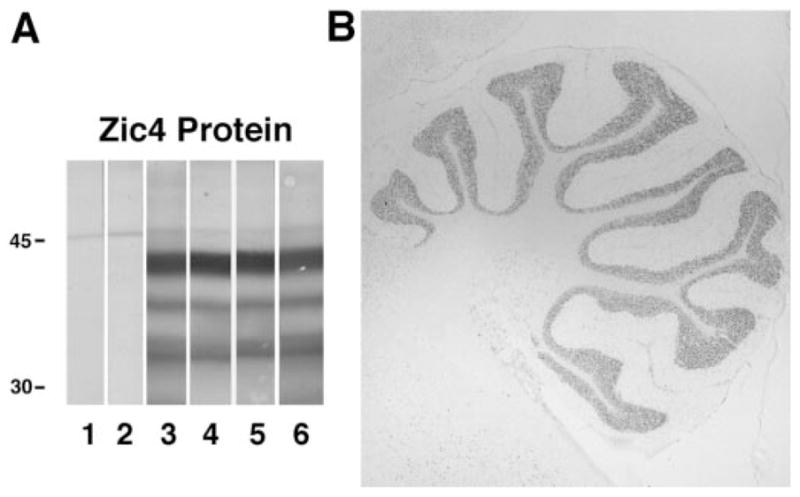
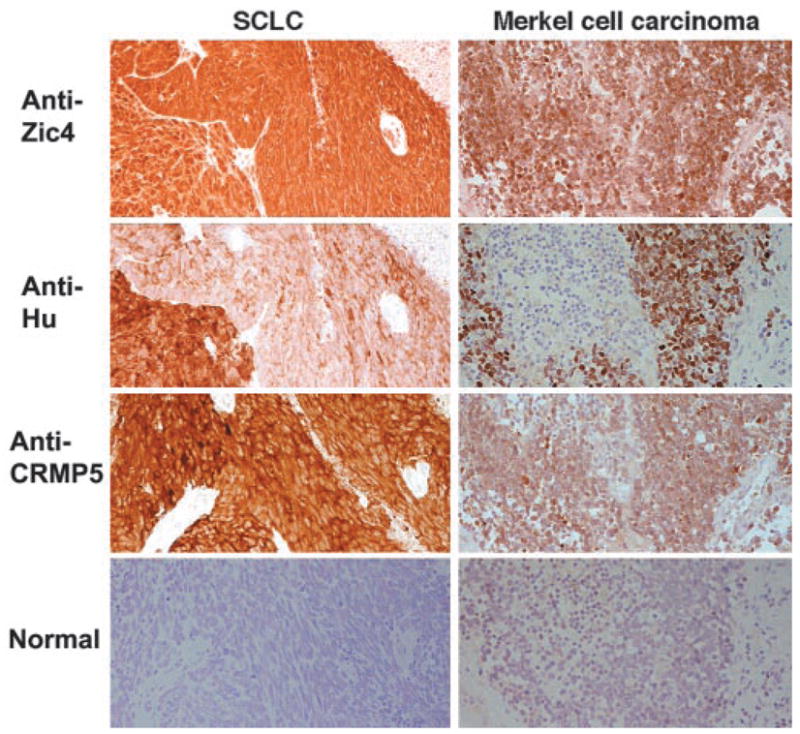
Design/methods: The authors studied 498 patients (215 with PND and 283 without PND or without cancer). The presence of antibodies was tested with immunoblots of Zic4, HuD, and CRMP5 proteins. The tumor expression of these proteins was determined by immunohistochemistry.
Results: Zic4 antibodies were identified in 61 patients. Ninety-two percent of patients with Zic4 antibodies had SCLC; detection of these antibodies segregated with the presence of PND (p = 0.031). Intrathecal synthesis of Zic4 antibodies was demonstrated in 5/7 patients with PND. None of 175 control patients without PND or cancer had Zic4 antibodies. Because of the robust association between Zic autoimmunity and SCLC, all patients were tested for other SCLC-related antibodies; concurrent Zic4, Hu, or CRMP5 antibodies occurred in the serum or CSF of 27% of SCLC patients with PND. Patients with isolated Zic4 antibodies were more likely to develop predominant cerebellar dysfunction than patients with several immunities (p < 0.001). Tumors of patients with and without onconeuronal antibodies coexpressed Zic, Hu, and CRMP5 proteins, indicating that the tumor expression of these antigens is necessary, but not sufficient, for immunologic activation.
Conclusions: In patients with neurologic symptoms of unknown cause detection of Zic4 antibodies predicts a neoplasm, usually a SCLC, and suggests that the neurologic disorder is paraneoplastic. Detection of Zic4 antibodies often associates with anti-Hu or CRMP5 antibodies. Patients with isolated Zic4 antibodies are more likely to develop cerebellar dysfunction than those with concurrent immunities.
Figures
Comment in
-
Antibodies to Zic4 in paraneoplastic neurologic disorders and small-cell lung cancer.Neurology. 2004 Oct 12;63(7):1339; author reply 1339. doi: 10.1212/wnl.63.7.1339. Neurology. 2004. PMID: 15477575 No abstract available.
References
-
- Yokota N, Aruga J, Takai S, et al. Predominant expression of human zic in cerebellar granule cell lineage and medulloblastoma. Cancer Res. 1996;56:377–383. - PubMed
-
- Aruga J, Yokota N, Hashimoto M, Furuichi T, Fukuda M, Mikoshiba K. A novel zinc finger protein, zic, is involved in neurogenesis, especially in the cell lineage of cerebellar granule cells. J Neurochem. 1994;63:1880–1890. - PubMed
-
- Aruga J, Tohmonda T, Homma S, Mikoshiba K. Zic1 promotes the expansion of dorsal neural progenitors in spinal cord by inhibiting neuronal differentiation. Dev Biol. 2002;244:329–341. - PubMed
-
- Bataller L, Wade DF, Fuller GN, Rosenfeld MR, Dalmau J. Cerebellar degeneration and autoimmunity to zinc-finger proteins of the cerebellum. Neurology. 2002;59:1985–1987. - PubMed
Publication types
MeSH terms
Substances
Grants and funding
LinkOut - more resources
Full Text Sources
Medical
