. 2004 Mar 23;101(12):4198-203.
doi: 10.1073/pnas.0400131101. Epub 2004 Mar 8.

Disruption of Doppel prevents neurodegeneration in mice with extensive Prnp deletions

Affiliations

Disruption of Doppel prevents neurodegeneration in mice with extensive Prnp deletions

Nicolas Genoud et al. Proc Natl Acad Sci U S A. .

Abstract

The Prnp gene encodes the cellular prion protein PrP(C). Removal of its ORF does not result in pathological phenotypes, but deletions extending into the upstream intron result in cerebellar degeneration, possibly because of ectopic cis-activation of the Prnd locus that encodes the PrP(C) homologue Doppel (Dpl). To test this hypothesis, we removed Prnd from Prnp(o/o) mice by transallelic meiotic recombination. Balanced loxP-mediated ablation yielded mice lacking both PrP(C) and Dpl (Prn(o/o)), which developed normally and showed unimpaired immune functions but suffered from male infertility. However, removal of the Prnd locus abolished cerebellar degeneration, proving that this phenotype is caused by Dpl upregulation. The absence of compound pathological phenotypes in Prn(o/o) mice suggests the existence of alternative compensatory mechanisms. Alternatively, Dpl and PrP(C) may exert distinct functions despite having partly overlapping expression profiles.


Figures
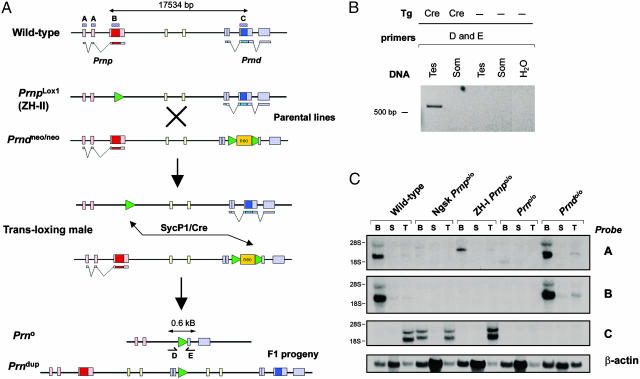
Fig. 1.
Fig. 1.
Recombination strategy. (A) Schematic representation of Cre-mediated TAMERE. In ZH-II mice, 0.26 kb of intron 2, the entire PrP ORF, and the 3′ noncoding region of exon 3 were replaced by a 34-bp loxP sequence. In Prndneo/neo mice, the Dpl ORF was replaced by a selection cassette flanked by loxP sequences. These lines were intercrossed to produce triple transgenic “transloxing” males containing the Prnplox1, Prndneo, and SycP1-Cre alleles (Fig. 1 A). After chromosome pairing and Cre expression in meiotic prophase, transallelic recombination generates two novel alleles. In the first allele (Prn°), the intergenic sequence is deleted. In the second allele (Prndup), the intergenic sequence between Prnp and Prnd is produced in the same orientation as in the original Prndup. Boxes in AC show DNA probes used for Northern blot analysis. (B) PCR amplification of genomic DNA from testes of transloxing males, with or without the SycP1-Cre transgene. Primers D and E amplify a 0.6-kb fragment diagnostic of the deleted locus only in presence of Cre. No recombination was found in somatic transloxer tissues. (C) Northern blot analysis confirmed the absence of any transcripts in the Prno/o mice with probe B and C in different tissues, but a weak band was detected with probe A. Dup, duplication; Tes, testis; Som, somatic; B, brain; S, spleen; T, testis.
Fig. 2.
Fig. 2.
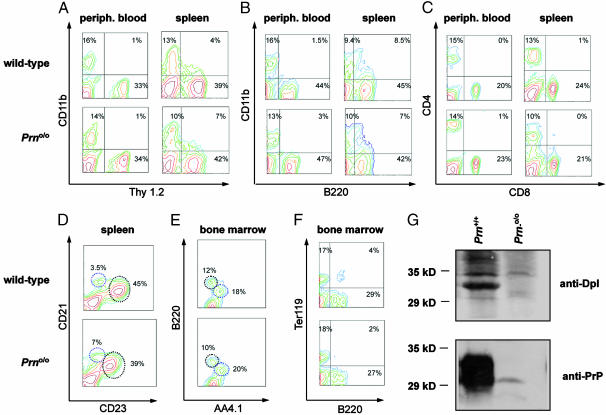
FACS analysis of immune cell subsets in Prno/o mice and wild-type littermates. Normal population of T cells (Thy1.2) (A), macrophages/monocytes (CD11b) (A and B), and B cells (B220) (B) in peripheral blood and spleen of wild-type and Prno/o mice, as indicated. (C) FACS analysis of peripheral blood and spleen revealed no alteration in CD4+ and CD8+ T cell subsets in mutant mice. (D) Similar density of B220+ splenic marginal-zone B cells (CD21high CD23neg-low) and B220+ follicular B cells (CD21med/low CD23high; circles). (E–F) Analysis of bone-marrow cells did not indicate alterations in the prevalence of AA4.1+ B220low immature B cells, AA4.1- B220high mature B cells, B220- AA4.1+ hematopoietic progenitor cells, and Ter119+ erythroblasts of Prno/o mice. Percentages of gated living cells are shown. (G) Western blot analysis of Dpl and PrPC in spleen.
Fig. 3.
Fig. 3.
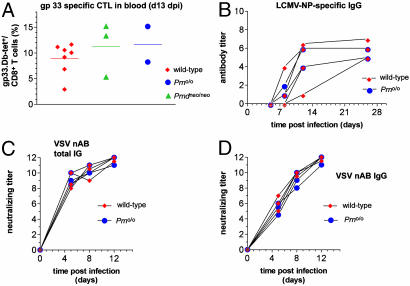
Susceptibility of control and Prno/o mice to LCMV and VSV. (A) To assess CD8+ T cell immune responses, control mice, Prndneo/neo, and Prno/o mice were immunized by i.v. injection of 200 pfu of LCMV. LCMV-specific cytotoxic T lymphocytes (CTL) were assessed in blood by using gp33–41:H2Db-tetramers 13 days later. Controls and mutants mice yielded similar high LCMV-specific responses. (B) LCMV-neutralizing Ab responses were similar in control and mutant mice. (C and D) On i.v. immunization of 2 × 10⁶ pfu of VSV, controls and Prno/o mice mounted a similarly strong production of neutralizing total Igs (C) or IgG (D).
Fig. 5.
Fig. 5.
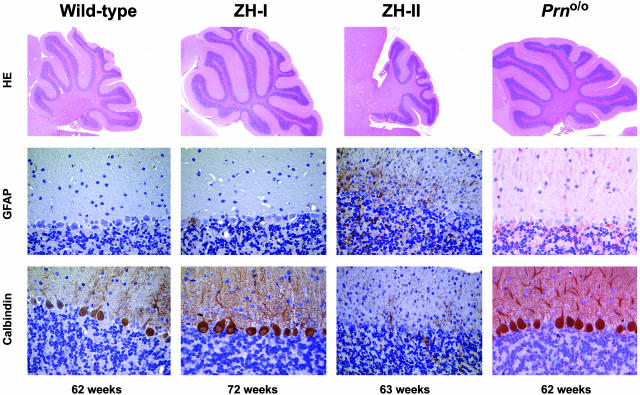
Cerebellar histopathology of Prnp and Prnd mutant mice. (Top) Parasagittal sections of wild-type, ZH-I, ZH-II, and Prno/o mice stained with hematoxylin/eosin. (Middle) Glial fibrillary acidic protein (GFAP) staining of cerebellar cortex with gliosis in ZH-II mice, but not in wild-type, ZH-I, or Prno/o mice. (Bottom) Calbindin stains (specific for PC). Wild-type, ZH-I, and Prno/o mice show an intact PC layer, whereas ZH-II mice undergo extensive cell loss.
Fig. 4.
Fig. 4.
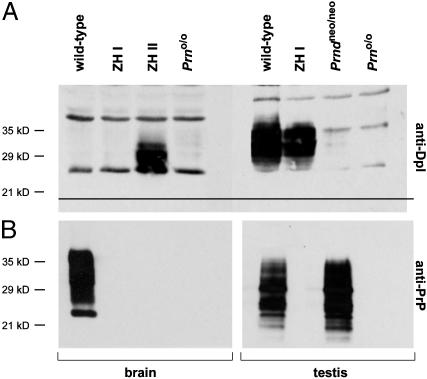
Dpl and PrP protein levels in testes and brains of wild-type, Prndneo/neo, ZH-I, ZH-II, and Prno/o mice. (A) Western blot analysis was performed on tissue homogenates with rabbit anti-Dpl polyclonal Ab. Overexpression of Dpl in the brain of ZH-II mice is abrogated in Prno/o.(B) As expected, Western blot analysis did not reveal expression of PrPC in brain and testis of Prno/o mice. Detection was done by using anti-PrP ICSM18 Ab.

References

    1. Aguzzi, A., Montrasio, F. & Kaeser, P. S. (2001) Nat. Rev. Mol. Cell Biol. 2, 118-126. - PubMed
    1. Büeler, H. R., Aguzzi, A., Sailer, A., Greiner, R. A., Autenried, P., Aguet, M. & Weissmann, C. (1993) Cell 73, 1339-1347. - PubMed
    1. Sailer, A., Büeler, H., Fischer, M., Aguzzi, A. & Weissmann, C. (1994) Cell 77, 967-968. - PubMed
    1. Mo, H., Moore, R. C., Cohen, F. E., Westaway, D., Prusiner, S. B., Wright, P. E. & Dyson, H. J. (2001) Proc. Natl. Acad. Sci. USA 98, 2352-2357. - PMC - PubMed
    1. Silverman, G. L., Qin, K., Moore, R. C., Yang, Y., Mastrangelo, P., Tremblay, P., Prusiner, S. B., Cohen, F. E. & Westaway, D. (2000) J. Biol. Chem. 275, 26834-26841. - PubMed

Publication types

MeSH terms