


The effect of eosinophils on collagen gel contraction and implications for tissue remodelling
- PMID: 15008974
- PMCID: PMC1808957
- DOI: 10.1111/j.1365-2249.2004.02396.x
The effect of eosinophils on collagen gel contraction and implications for tissue remodelling
Abstract
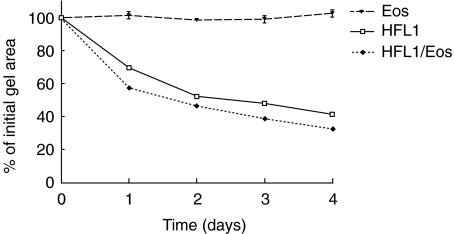
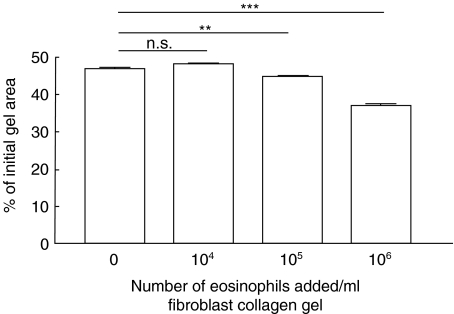
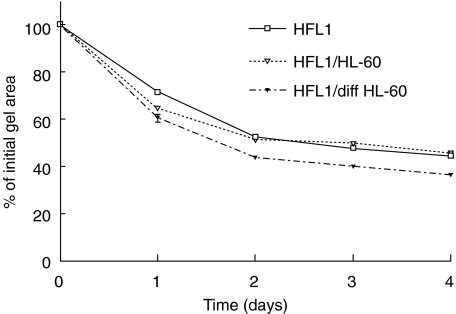
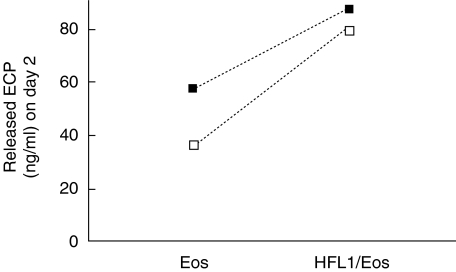
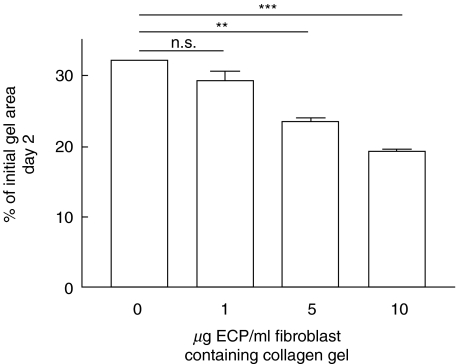
Asthma is characterized by an eosinophilic inflammation and a subepithelial fibrosis in the airways. Eosinophils contain several cytotoxic substances, such as eosinophil cationic protein (ECP), which can promote inflammation and cause tissue damage. This has generated the hypothesis that eosinophils may drive remodelling of extracellular matrix (ECM). To investigate the role of eosinophils we used an in vitro model for remodelling, the three-dimensional collagen gel contraction assay. Two sources of eosinophils were used in this study, isolated human peripheral eosinophils (purity > 95%) and stimulated [interleukin (IL)-5, IL-3 and granulocyte macrophage-colony stimulating factor (GM-CSF)] HL-60 clone 15 cells. Human eosinophils or HL-60 cells were cast together with human lung fibroblasts (HFL1) in type I collagen gels. Both types of eosinophils augmented fibroblast-mediated collagen gel contraction in a time and concentration-dependent manner. At 48 h, the gel area in HFL1/eosinophil co-culture was 46.5% +/- 0.5 (mean +/- s.e.m.) of initial area and in HFL1 culture 52.3% +/- 0.1 (P < 0.001). Respective figures for HFL1/stimulated HL-60 co-culture and HFL1 culture only were 44.1% +/- 0.5 and 52.4% +/- 0.4 (P < 0.001). The release of ECP was increased when fibroblasts were cultured with eosinophils compared to eosinophils cultured alone. In addition, native ECP added to fibroblast gel cultures also augmented contraction. Our results suggest that eosinophils may interact with mesenchymal cells, promoting remodelling of ECM and that ECP constitutes one potential eosinophil-derived mediator driving this process. We conclude that this may be one important mechanism by which eosinophil-ECM interactions will lead to airway tissue remodelling in asthma.
Figures

References
-
- Roche WR, Beasley R, Williams JH, Holgate ST. Subepithelial fibrosis in the bronchi of asthmatics. Lancet. 1989;1:520–4. - PubMed
-
- Jeffery PK, Wardlaw AJ, Nelson FC, Collins JV, Kay AB. Bronchial biopsies in asthma. An ultrastructural, quantitative study and correlation with hyperreactivity. Am Rev Respir Dis. 1989;140:1745–53. - PubMed
-
- Wilson JW, Bamford TL. Assessing the evidence for remodelling of the airway in asthma. Pulm Pharmacol Ther. 2001;14:229–47. - PubMed
-
- Blyth DI, Wharton TF, Pedrick MS, Savage TJ, Sanjar S. Airway subepithelial fibrosis in a murine model of atopic asthma: suppression by dexamethasone or anti-interleukin-5 antibody. Am J Respir Cell Mol Biol. 2000;23:241–6. - PubMed
-
- Rudd RM, Haslam PL, Turner-Warwick M. Cryptogenic fibrosing alveolitis. Relationships of pulmonary physiology and bronchoalveolar lavage to response to treatment and prognosis. Am Rev Respir Dis. 1981;124:1–8. - PubMed
Publication types
MeSH terms
Substances
LinkOut - more resources
Full Text Sources
Medical
Miscellaneous
