Mood Disorders in Family Practice: Beyond Unipolarity to Bipolarity
- PMID: 15014722
- PMCID: PMC315483
- DOI: 10.4088/pcc.v04n0405
Mood Disorders in Family Practice: Beyond Unipolarity to Bipolarity
Abstract
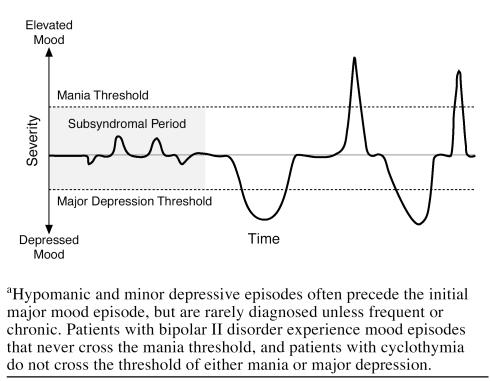
Primary care physicians increasingly have treated depressive disorders over the last decade. Unrecognized bipolar disorder, sometimes misdiagnosed as unipolar depression, may lead to treatment resistance or nonresponse. We describe differences between unipolar and bipolar disorders, focusing on recognition, diagnosis, and treatment of bipolar spectrum disorders such as bipolar I, bipolar II, antidepressant-induced mania, and cyclothymia. Broadening the understanding of these different disorders and their presentation in primary care settings can enable earlier and more targeted treatment. Though 3 mood stabilizers are U.S. Food and Drug Administration-approved for treatment of acute mania, no medications are currently approved for treating bipolar depression.
Figures
References
-
- Wells KB, Stewart A, Hays RD, et al. The functioning and well-being of depressed patients: results from the Medical Outcomes Study. JAMA. 1989;262:914–919. - PubMed
-
- Spitzer RL, Kroenke K, Linzer M, et al. Health-related quality of life in primary care patients with mental disorders: results from the PRIME-MD 1000 Study. JAMA. 1995;274:1511–1517. - PubMed
-
- Hays RD, Wells KB, Sherbourne CD, et al. Functioning and well-being outcomes of patients with depression compared with chronic general medical illnesses. Arch Gen Psychiatry. 1995;52:11–19. - PubMed
-
- Simon GE, Katon WJ, VonKorff M, et al. Cost-effectiveness of a collaborative care program for primary care patients with persistent depression. Am J Psychiatry. 2001;158:1638–1644. - PubMed
-
- Lin EH, VonKorff M, Russo J, et al. Can depression treatment in primary care reduce disability? a stepped care approach. Arch Fam Med. 2000;9:1052–1058. - PubMed
LinkOut - more resources
Full Text Sources