Is inflammatory bowel disease an independent and disease specific risk factor for thromboembolism?
- PMID: 15016749
- PMCID: PMC1773996
- DOI: 10.1136/gut.2003.025411
Is inflammatory bowel disease an independent and disease specific risk factor for thromboembolism?
Abstract
Background: Patients with inflammatory bowel disease (IBD) are thought to be at increased risk of venous thromboembolism (TE). However, the extent of this risk is not known. Furthermore, it is not known if this risk is specific for IBD or if it is shared by other chronic inflammatory diseases or other chronic bowel diseases.
Aims: To compare the risk of TE in patients with IBD, rheumatoid arthritis, and coeliac disease with matched control subjects.
Patients and methods: Study subjects answered a questionnaire assessing the history of TE, any cases of which had to be confirmed radiologically. A total of 618 patients with IBD, 243 with rheumatoid arthritis, 207 with coeliac disease, and 707 control subjects were consecutively included. All three patient groups were compared with control subjects matched to the respective group by age and sex.
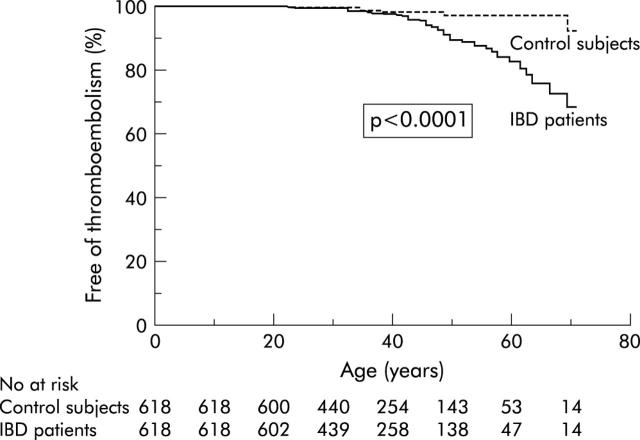
Results: Thirty eight IBD patients (6.2%) had suffered TE. This was significantly higher compared with the matched control population with only 10 cases reported (1.6%) (p<0.001; odds ratio (OR) 3.6 (95% confidence interval (CI) 1.7-7.8)). Five patients with rheumatoid arthritis (2.1%) had suffered TE compared with six subjects (2.5%) in the control population matched to patients with rheumatoid arthritis (NS; OR 0.7 (95% CI 0.2-2.9)). TE had occurred in two patients with coeliac disease (1%) compared with four subjects (1.9%) in the control population matched to the coeliac disease group (NS; OR 0.4 (95% CI 0.1-2.5)). In 60% of TE cases in the IBD group, at least one IBD specific factor (active disease, stenosis, fistula, abscess) was present at the time TE occurred.
Conclusions: IBD is a risk factor for TE. It seems that TE is a specific feature of IBD as neither rheumatoid arthritis, another chronic inflammatory disease, nor coeliac disease, another chronic bowel disease, had an increased risk of TE.
Figures
References
-
- Grip O, Svensson P, Lindgren S. Inflammatory bowel disease promotes venous thrombosis earlier in life. Scand J Gastroenterol 2000;35:619–23. - PubMed
-
- Sloan W, Bargen A, Gage R. Life histories of patients with chronic ulcerative colitis: a review of 2000 cases. Gastroenterology 1950;16:25–38. - PubMed
-
- Talbot R, Heppell J, Dozois R, et al. Vascular complications of inflammatory bowel disease. Mayo Clin Proc 1986;61:140–5. - PubMed
-
- Bernstein C, Blanchard J, Houston D, et al. The incidence of deep venous thrombosis and pulmonary embolism among patients with inflammatory bowel disease: a population based cohort study. Thromb Haemost 2001;85:430–4. - PubMed
Publication types
MeSH terms
LinkOut - more resources
Full Text Sources
Medical
Miscellaneous