


Human immunodeficiency virus type 1 subtypes have a distinct long terminal repeat that determines the replication rate in a host-cell-specific manner
- PMID: 15016888
- PMCID: PMC371093
- DOI: 10.1128/jvi.78.7.3675-3683.2004
Human immunodeficiency virus type 1 subtypes have a distinct long terminal repeat that determines the replication rate in a host-cell-specific manner
Abstract
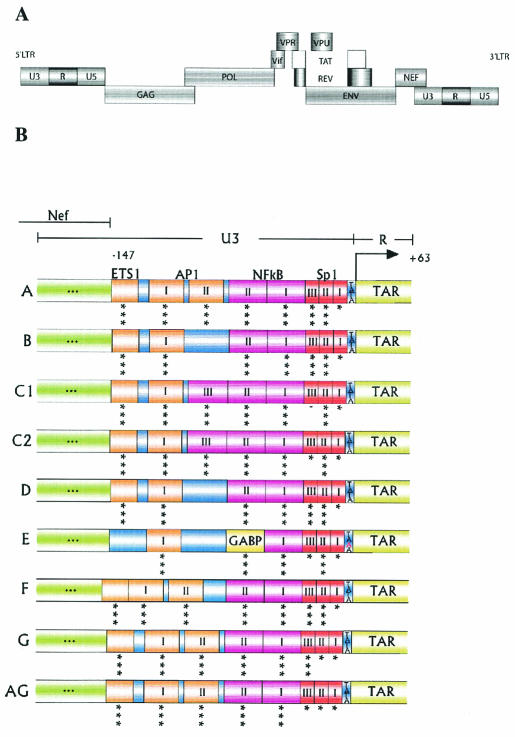
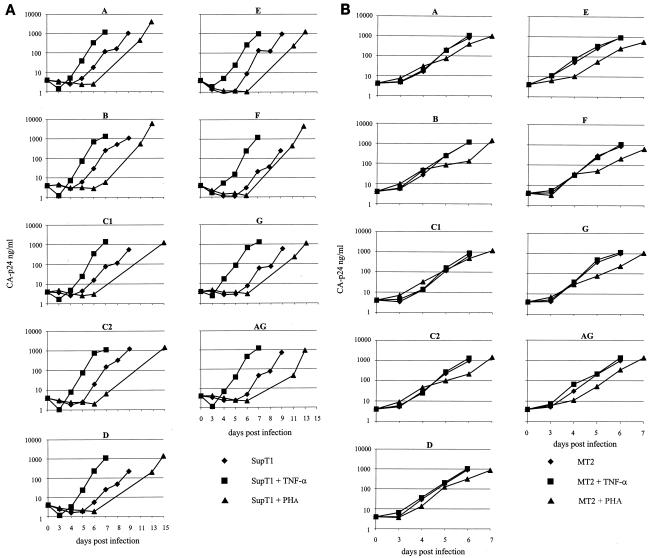
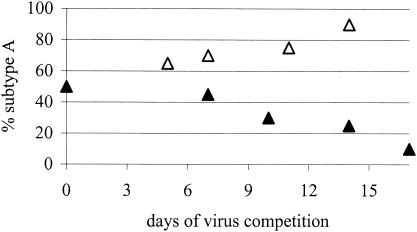
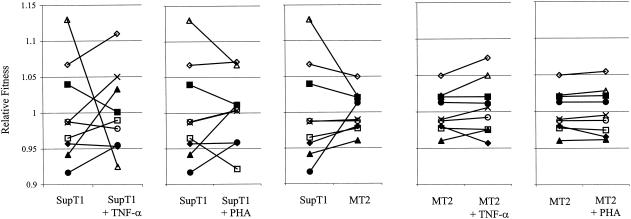
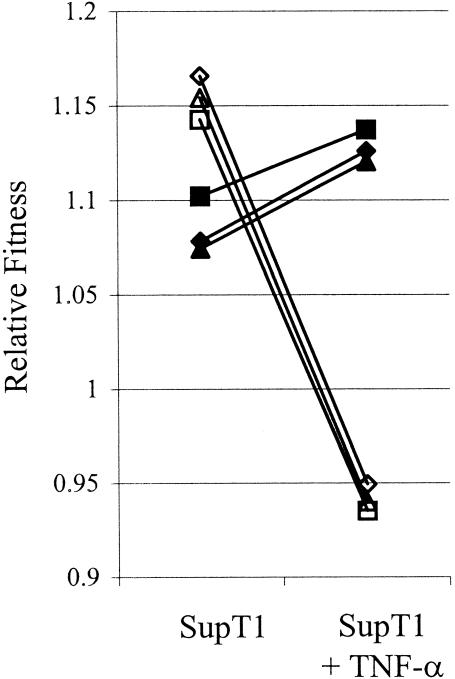
The long terminal repeat (LTR) transcriptional promoters of different human immunodeficiency virus (HIV) type 1 subtypes were inserted into the LAI molecular clone of subtype B. The viral genotypes represent seven subtypes (A, B, C, D, E, F, and G) and one circulating recombinant form (AG). We performed replication studies with this isogenic set of viruses across six cellular environments. This approach revealed strong cellular environment effects, but the method was not sensitive enough to detect small differences in the replication rate between the subtypes. By conducting pairwise competition experiments between the virus variants in six cellular environments, we could demonstrate significant differences in the replication rates of the subtypes and that LTR-determined viral fitness depends both on the host cell type and the activation state of the cell. In addition, we determined the degree of conservation of the transcription factor-binding sites (TFBS) in the different-subtype LTRs by analyzing sequences from the HIV sequence database. The sequence analyses revealed subtype-specific conservation of certain TFBS. The results indicate that one should consider the possibility of subtype-specific viral replication rates in vivo, which are strongly influenced by the host environment. We argue that the multidimensional host environment may have shaped the genetic structures of the subtype LTRs.
Figures
Similar articles
-
Functional differences between the long terminal repeat transcriptional promoters of human immunodeficiency virus type 1 subtypes A through G.J Virol. 2000 Apr;74(8):3740-51. doi: 10.1128/jvi.74.8.3740-3751.2000. J Virol. 2000. PMID: 10729149 Free PMC article.
-
Latency profiles of full length HIV-1 molecular clone variants with a subtype specific promoter.Retrovirology. 2011 Sep 16;8:73. doi: 10.1186/1742-4690-8-73. Retrovirology. 2011. PMID: 21923919 Free PMC article.
-
Analysis of the HIV-1 LTR NF-kappaB-proximal Sp site III: evidence for cell type-specific gene regulation and viral replication.Virology. 2000 Sep 1;274(2):262-77. doi: 10.1006/viro.2000.0476. Virology. 2000. PMID: 10964770
-
The human immunodeficiency virus type 1 promoter contains a CATA box instead of a TATA box for optimal transcription and replication.J Virol. 2004 Jul;78(13):6883-90. doi: 10.1128/JVI.78.13.6883-6890.2004. J Virol. 2004. PMID: 15194764 Free PMC article.
-
Drastic decrease of transcription activity due to hypermutated long terminal repeat (LTR) region in different HIV-1 subtypes and recombinants.Antiviral Res. 2010 Nov;88(2):152-9. doi: 10.1016/j.antiviral.2010.08.007. Epub 2010 Aug 14. Antiviral Res. 2010. PMID: 20713090
Cited by
-
tat Exon 1 exhibits functional diversity during HIV-1 subtype C primary infection.J Virol. 2013 May;87(10):5732-45. doi: 10.1128/JVI.03297-12. Epub 2013 Mar 13. J Virol. 2013. PMID: 23487450 Free PMC article.
-
Differences in the fitness of two diverse wild-type human immunodeficiency virus type 1 isolates are related to the efficiency of cell binding and entry.J Virol. 2005 Jun;79(11):7121-34. doi: 10.1128/JVI.79.11.7121-7134.2005. J Virol. 2005. PMID: 15890952 Free PMC article.
-
CCR5- and CXCR4-tropic subtype C human immunodeficiency virus type 1 isolates have a lower level of pathogenic fitness than other dominant group M subtypes: implications for the epidemic.J Virol. 2009 Jun;83(11):5592-605. doi: 10.1128/JVI.02051-08. Epub 2009 Mar 18. J Virol. 2009. PMID: 19297481 Free PMC article.
-
Higher transactivation activity associated with LTR and Tat elements from HIV-1 BF intersubtype recombinant variants.Retrovirology. 2006 Feb 16;3:14. doi: 10.1186/1742-4690-3-14. Retrovirology. 2006. PMID: 16483381 Free PMC article.
-
HIV-1 Latency and Latency Reversal: Does Subtype Matter?Viruses. 2019 Nov 28;11(12):1104. doi: 10.3390/v11121104. Viruses. 2019. PMID: 31795223 Free PMC article. Review.
References
-
- Ait-Khaled, M., J. E. McLaughlin, M. A. Johnson, and V. C. Emery. 1995. Distinct HIV-1 long terminal repeat quasispecies present in nervous tissues compared to that in lung, blood and lymphoid tissues of an AIDS patient. AIDS 9:675-683. - PubMed
-
- Aldovini, A., and B. D. Walker. 1990. Techniques in HIV research. Stockton Press, New York, N.Y.
-
- Auersperg, N. 1964. Long-term cultivation of hypodiploid human tumor cells. J. Natl. Cancer Inst. 32:135-163. - PubMed
-
- Ball, S. C., A. Abraha, K. R. Collins, A. J. Marozsan, H. Baird, M. E. Quinones-Mateu, A. Penn-Nicholson, M. Murray, N. Richard, M. Lobritz, P. A. Zimmerman, T. Kawamura, A. Blauvelt, and E. J. Arts. 2003. Comparing the ex vivo fitness of CCR5-tropic human immunodeficiency virus type 1 isolates of subtypes B and C. J. Virol. 77:1021-1038. - PMC - PubMed
-
- Berkhout, B., A. Gatignol, A. B. Rabson, and K. T. Jeang. 1990. TAR-independent activation of the HIV-1 LTR: evidence that tat requires specific regions of the promoter. Cell 62:757-767. - PubMed
Publication types
MeSH terms
LinkOut - more resources
Full Text Sources
