. 2004 Jun 1;557(Pt 2):571-82.
doi: 10.1113/jphysiol.2003.057711. Epub 2004 Mar 12.

Effect of high intensity training on capillarization and presence of angiogenic factors in human skeletal muscle

Affiliations

Effect of high intensity training on capillarization and presence of angiogenic factors in human skeletal muscle

L Jensen et al. J Physiol. .

Abstract

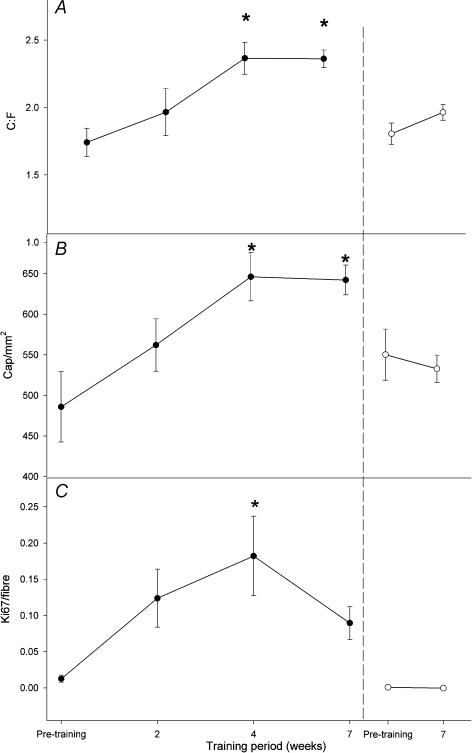
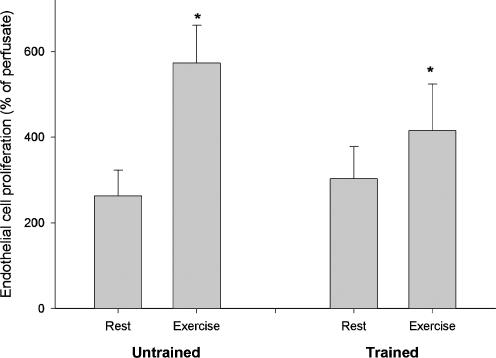
The effect of intense training on endothelial proliferation, capillary growth and distribution of vascular endothelial growth factor (VEGF) and basic fibroblast growth factor (bFGF) was examined in human skeletal muscle. Two intermittent knee extensor training protocols (at approximately 150% (Study 1) versus approximately 90% (Study 2) of leg (O(2) max)) were conducted. Muscle biopsies were obtained throughout the training periods for immunohistochemical assessment of capillarization, cell proliferation (Ki-67-positive cells), VEGF and bFGF. In Study 1, microdialysis samples were collected from the trained and untrained leg at rest and during exercise and added to endothelial cells to measure the proliferative effect. After 4 weeks of training there was a higher (P < 0.05) capillary-to-fibre ratio (Study 1: 2.4 +/- 0.1 versus 1.7 +/- 0.1) and number of Ki-67-positive cells (Study 1: 0.18 +/- 0.05 versus 0.00 +/- 0.01) than before training. Neither the location of proliferating endothelial cells nor capillarization was related to muscle fibre type. The endothelial cell proliferative effect of the muscle microdialysate increased from rest to exercise in both the untrained leg (from 262 +/- 60 to 573 +/- 87% of control perfusate) and the trained leg (from 303 +/- 75 to 415 +/- 108% of perfusate). VEGF and bFGF were localized in endothelial and skeletal muscle cells and training induced no changes in distribution. The results demonstrate that intense intermittent endurance training induces capillary growth and a transient proliferation of endothelial cells within 4 weeks, with a similar growth occurring around type I versus type II muscle fibres.


Figures
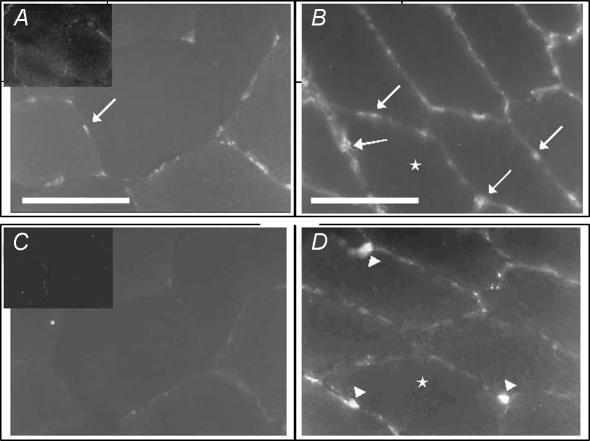
Figure 1
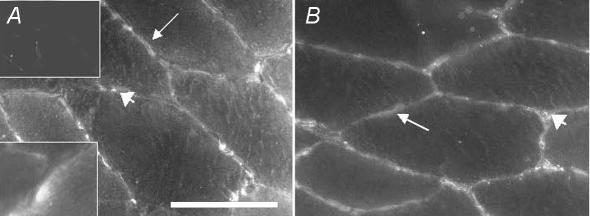
Figure 1. Representative serial sections showing immunohistochemical staining of capillaries and proliferating cells in human skeletal muscle before and after intense intermittent training
CD31-positive capillaries (arrow) before (A) and after (B) 4 weeks of high intensity intermittent training. Ki-67-positive proliferating cells, indicating developing capillaries (arrowhead) before (C) and after (D) 4 weeks of high intensity intermittent training. Negative control (obtained without primary antibody) is inserted in the upper left corner of micrographs. Scale bars = 50 μm; bar in A applies to C and D.
Figure 2
Figure 2. Presence of capillaries and proliferating endothelial cells in human skeletal muscle before and after intense (150% of O2max) intermittent training
Capillary-to-fibre ratio (C : F; A), capillary density (cap mm−2; B) and endothelial cell associated proliferating cells (C) before, during and after a 6.8 week training period in the trained (•) and the control (○) leg. *P < 0.05versus pre-training, n = 6.
Figure 3
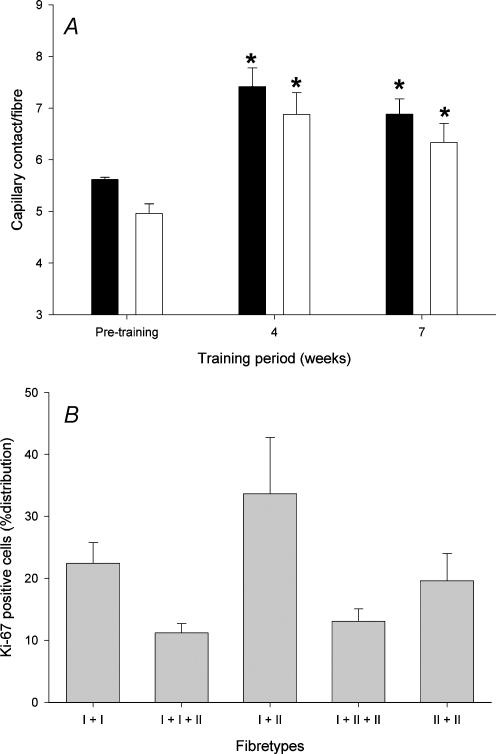
Figure 3. Effect of high intensity (150% of O2max) intermittent training on capillary distribution in relation to fibre types
A, capillaries in contact with fibre type I (filled columns) or II (open columns) before, during and after the training period. *P < 0.05versus pretraining, n = 6. B, proliferating capillaries after 4 weeks of training in contact with two type I fibres (I + I), two type I and one type II fibres (I + I + II), one type I and one type II fibre (I + II), one type I and two type II fibres (I + II + II) or two type II fibres (II + II). n = 6.
Figure 4
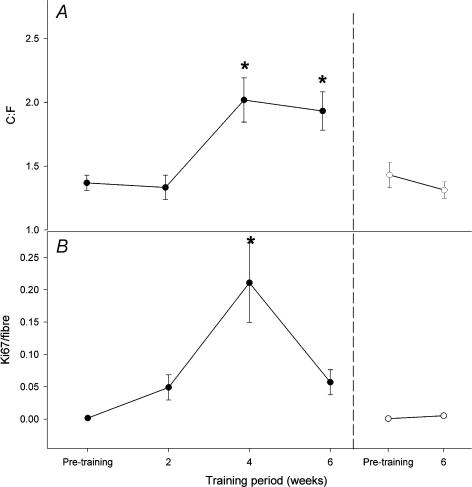
Figure 4. Presence of capillaries and proliferating endothelial cells in human skeletal muscle before and after intense (90% of O2max) intermittent training
Capillary-to-fibre ratio (C : F; A) and endothelial cell associated proliferating cells (B) before, during and after a 6 week training period in the trained (•) and the control (○) leg. *P < 0.05versus pre-training, n = 7.
Figure 5
Figure 5. Effect of intense (150% of O2max) training on the endothelial cell proliferative effect of skeletal muscle microdialysate
Proliferation of endothelial cells, as assessed by incorporation of bromodeoxyuridine (BrdU), after addition of skeletal muscle microdialysate from the trained and untrained leg obtained at rest (Rest) and during knee extensor exercise at 30 W (Exercise). *P < 0.05 versus rest, n = 6.
Figure 6
Figure 6. Representative micrographs showing immunohistochemical staining of VEGF and bFGF in human skeletal muscle
Discontinuous VEGF staining was observed in sarcolemma (arrow) and staining was weak in the cytosol of the muscle cells. VEGF staining was also observed in the extracellular space predominantly in association with endothelial cells (arrowhead). A, the insertion in the lower left corner shows VEGF staining in a cluster close to the periphery of the cell. In the upper left corner there is a negative control for which no primary antibody has been used. B, bFGF expression is detectable in cytosol and sarcolemma (arrow) of muscle cells and between muscle cells (arrowhead). Scale bar = 50 μm and applies to all panels.

References

    1. Amaral SL, Linderman JR, Morse MM, Greene AS. Angiogenesis induced by electrical stimulation is mediated by angiotensin II and VEGF. Microcirculation. 2001;8:57–67. - PubMed
    1. Andersen P, Adams RP, Sjogaard G, Thorboe A, Saltin B. Dynamic knee extension as model for study of isolated exercising muscle in humans. J Appl Physiol. 1985;59:1647–1653. - PubMed
    1. Andersen P, Henriksson J. Capillary supply of the quadriceps femoris muscle of man: adaptive response to exercise. J Physiol. 1977;270:677–690. - PMC - PubMed
    1. Annex BH, Torgan CE, Lin P, Taylor DA, Thompson MA, Peters KG, Kraus WE. Induction and maintenance of increased VEGF protein by chronic motor nerve stimulation in skeletal muscle. Am J Physiol. 1998;274:H860–H867. - PubMed
    1. Aoyagi M, Yamamoto M, Wakimoto H, Azuma H, Hirakawa K, Yamamoto K. Immunohistochemical detection of Ki-67 in replicative smooth muscle cells of rabbit carotid arteries after balloon denudation. Stroke. 1995;26:2328–2331. - PubMed

Publication types

Substances