. 2004 Apr;2(4):E98.
doi: 10.1371/journal.pbio.0020098. Epub 2004 Feb 24.

Sequence-specific inhibition of small RNA function

Affiliations

Sequence-specific inhibition of small RNA function

György Hutvágner et al. PLoS Biol. 2004 Apr.

Abstract

Hundreds of microRNAs (miRNAs) and endogenous small interfering RNAs (siRNAs) have been identified from both plants and animals, yet little is known about their biochemical modes of action or biological functions. Here we report that 2'-O-methyl oligonucleotides can act as irreversible, stoichiometric inhibitors of small RNA function. We show that a 2'-O-methyl oligonucleotide complementary to an siRNA can block mRNA cleavage in Drosophila embryo lysates and HeLa cell S100 extracts and in cultured human HeLa cells. In Caenorhabditis elegans, injection of the 2'-O-methyl oligonucleotide complementary to the miRNA let-7 can induce a let-7 loss-of-function phenocopy. Using an immobilized 2'-O-methyl oligonucleotide, we show that the C. elegans Argonaute proteins ALG-1 and ALG-2, which were previously implicated in let-7 function through genetic studies, are constituents of a let-7-containing protein-RNA complex. Thus, we demonstrate that 2'-O-methyl RNA oligonucleotides can provide an efficient and straightforward way to block small RNA function in vivo and furthermore can be used to identify small RNA-associated proteins that mediate RNA silencing pathways.


Conflict of interest statement

The authors have declared that no conflicts of interest exist.

Figures
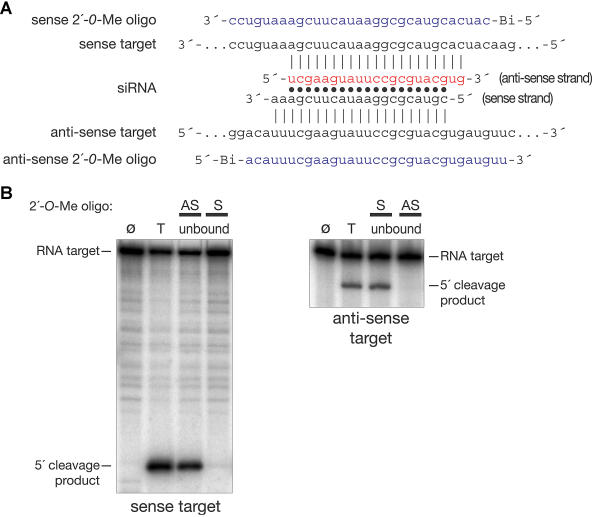
Figure 1
Figure 1. A 2′-O-Methyl RNA Oligonucleotide Inhibits RNAi In Vitro in Drosophila Embryo Lysate
(A) Sequences of the sense and antisense Pp-luc target RNAs (black), the siRNA (red, antisense strand; black, sense strand), and the sense and antisense 2′-O-methyl oligonucleotides (blue) used. (B) Sequence-specific depletion of RNAi activity by immobilized 2′-O-methyl oligonucleotides from Drosophila embryo lysate programmed with siRNA. siRNA was incubated with lysate to assemble RISC; then, immobilized 2′-O-methyl oligonucleotide was added. Finally, the beads were removed from the supernatant, and either sense or antisense 32P-radiolabeled target RNA was added to the supernatant to measure RISC activity for each siRNA strand. Symbols and abbreviations: Ø, target RNA before incubation with siRNA-programmed lysate; T, total reaction before depletion; unbound, the supernatant after incubation with the immobilized antisense (AS) or sense (S) 2′-O-methyl oligonucleotides shown in (A). The absence of 5′ cleavage product demonstrates that the sense oligonucleotide depleted RISC containing antisense siRNA, but not sense siRNA, and the antisense oligonucleotide depleted the sense RISC, but not that containing antisense siRNA. Bi, 5′ biotin attached via a six-carbon linker.
Figure 2
Figure 2. 2′-O-Methyl Oligonucleotides Act as Stoichiometric, Irreversible Inhibitors of RISC Function
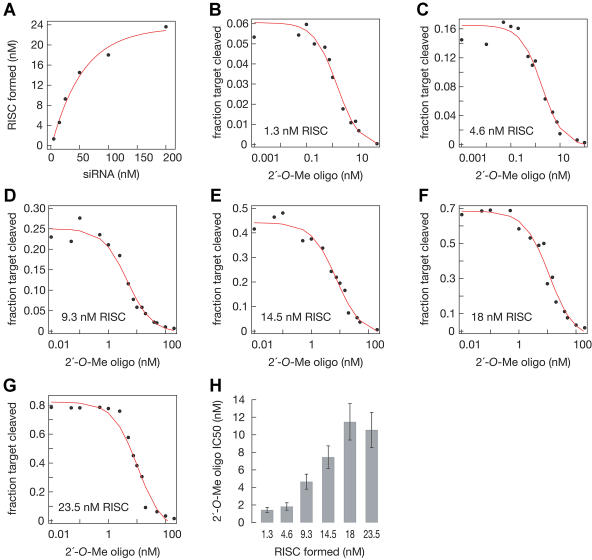
(A) The immobilized sense 2′-O-methyl oligonucleotide was used to determine the concentration of 32P-radiolabeled antisense siRNA assembled into RISC in Drosophila embryo. The 2′-O-methyl oligonucleotide and siRNA duplex are shown in Figure 1A. (B–G) Inhibition of RNAi was measured using free 2′-O-methyl oligonucleotide and 1.3 nM (B), 4.6 nM (C), 9.3 nM (D), 14.5 nM (E), 18 nM (F), and 23.5 nM (G) RISC. The concentration of 2′-O-methyl oligonucleotide required for half-maximal inhibition (IC50) was calculated by fitting each dataset to a sigmoidal curve using a Hill coefficient of 1. (H) A plot of IC50 versus RISC concentration suggests that each 2′-O-methyl oligonucleotide binds a single RISC. The data suggest that binding is essentially irreversible.
Figure 3
Figure 3. RISC Does Not Act through an Antisense Mechanism
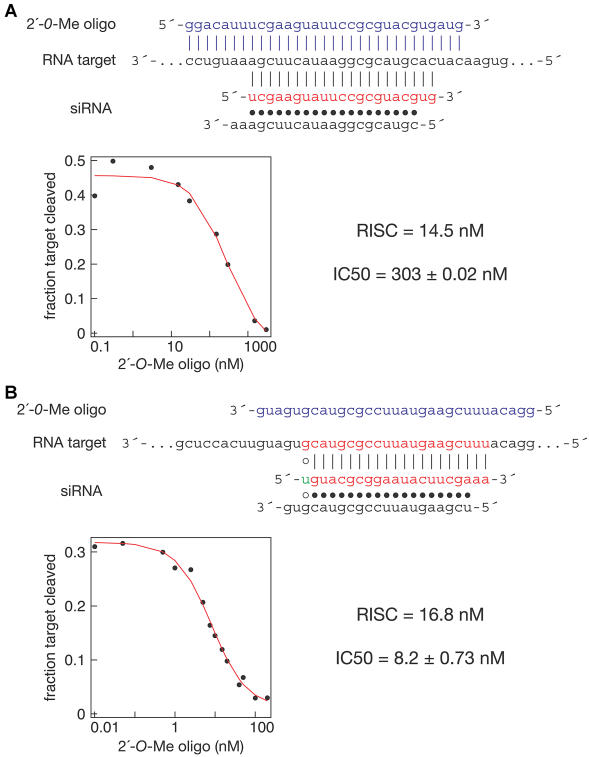
(A) Inhibition of sense target cleavage by an antisense 2′-O-methyl oligonucleotide requires an approximately 40-fold higher concentration than by a sense oligonucleotide. The antisense oligonucleotide can pair completely with the sense target RNA, but not with the antisense siRNA-programmed RISC. The IC50 value and the RISC concentration are indicated. Also shown are the sequences of the sense Pp-luc RNA target (black), the siRNA (red, antisense strand; black, sense strand), and the 2′-O-methyl oligonucleotide (blue). (B) The same antisense 2′-O-methyl oligonucleotide is an effective competitor of antisense target cleavage. In this experiment, inhibition occurs via binding of the antisense oligonucleotide to the sense siRNA-programmed RISC, not the target RNA. The IC50 value and the RISC concentration are indicated. Also shown are the sequences of the Pp-luc antisense RNA target (black), the siRNA (red, antisense strand; black, sense strand), and the 2′-O-methyl oligonucleotide (blue). The G:U wobble in the siRNA duplex in (B) acts to direct the sense strand into RISC and improving its efficacy in target cleavage.
Figure 4
Figure 4. A 2′-O-Methyl Oligonucleotide Is a Potent Inhibitor of RNAi in Human Cultured HeLa Cells
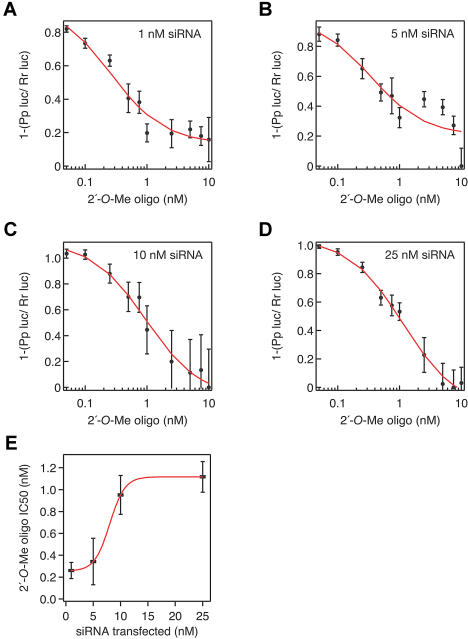
(A–D) HeLa cells were transfected with 1 nM (A), 5 nM (B), 10 nM (C), or 25 nM (D) siRNA-targeting Pp-luc mRNA. The next day the cells were cotransfected with Rr-luc-and Pp-luc-expressing plasmids together with various amounts of a 31-nt 2′-O-methyl oligonucleotide complementary to the antisense strand of the siRNA. The half-maximal concentration of 2′-O-methyl oligonucleotide required to inhibit (IC50) was determined by fitting the data to a sigmoidal curve using a Hill coefficient of 1. (E) IC50 plotted as a function of the concentration of transfected siRNA.
Figure 5
Figure 5. A Complementary 2′-O-Methyl Oligonucleotide Blocks Endogenous let-7-Containing RISC Function
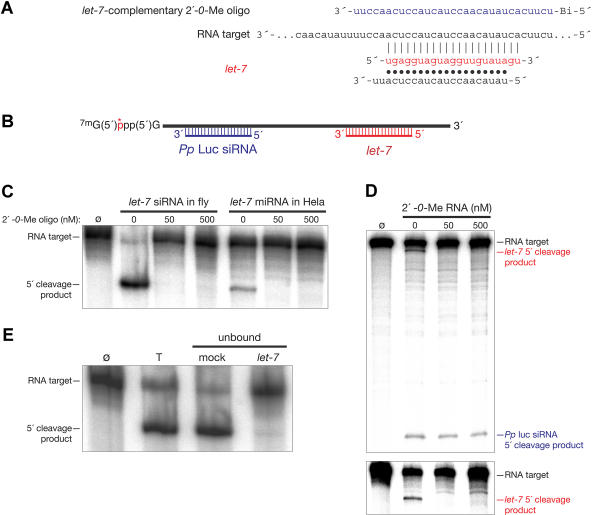
(A) Sequence of the let-7-complementary site in the target RNA (black), of the siRNA (red, antisense strand; black, sense strand), and of the let-7-complementary 2′-O-methyl oligonucleotide (blue). (B) Schematic representation of the target RNA, which contained both Pp-luc and antisense let-7 sequences. (C) Drosophila embryo lysate (left) was programmed with let-7 siRNA; then, the target RNA and the 2′-O-methyl oligonucleotide were added together. Target RNA and 2′-O-methyl oligonucleotide (right) were added to HeLa S100 extract, which contains endogenous human let-7-programmed RISC. (D) An RNA target containing both Pp-luc and antisense let-7 sequence can be simultaneously targeted by Pp-luc siRNA and endogenous let-7 in HeLa S100 lysate. The let-7-complementary 2′-O-methyl oligonucleotide blocks let-7-programmed, but not Pp-luc siRNA-programmed, RISC function. The bottom panel shows the same samples analyzed separately to better resolve the let-7 5′ cleavage product. (E) Drosophila embryo lysate was programmed with let-7 siRNA and then incubated with biotinylated 2′-O-methyl oligonucleotide tethered to paramagnetic streptavidin beads. The beads were removed and the supernatant tested for RNAi activity. Symbols and abbreviations: Ø, target RNA before incubation with siRNA-programmed lysate; T, total reaction before depletion; unbound, the supernatant after incubation with the paramagnetic beads. “Mock” indicates that no oligonucleotide was used on the beads; “let-7” indicates that the beads contained the let-7-complementary oligonucleotide shown in (A).
Figure 6
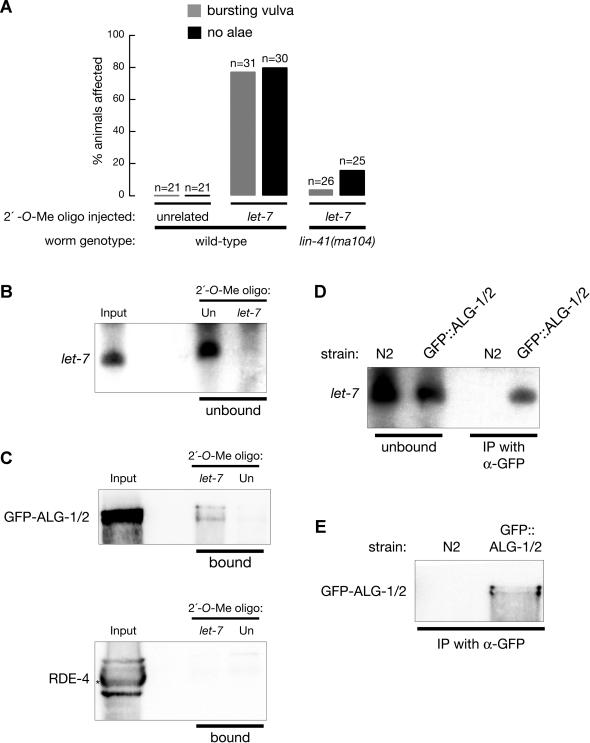
Figure 6. Injection of a 2′-O-Methyl Oligonucleotide Complementary to let-7 miRNA Can Phenocopy the Loss of let-7 Function in C. elegans
(A) Wild-type and lin-41(ma104) L2-stage C. elegans larvae were injected with either a 2′-O-methyl oligonucleotide complementary to let-7 miRNA (Figure 5A) or an unrelated Pp-luc 2′-O-methyl oligonucleotide. Absence of alae and presence of bursting vulvae were scored when the injected animals reached adulthood. (B) Isolation of let-7-associated proteins with a tethered 2′-O-methyl oligonucleotide. Northern blot analysis of let-7 miRNA remaining in the supernatant of the worm lysate after incubation with the let-7-complementary (let-7) or Pp-luc (unrelated) oligonucleotide. Input represents the equivalent of 50% of the total extract incubated with tethered oligonucleotide. (C) Western blot analysis of the GFP-tagged ALG-1 and ALG-2 proteins associated with let-7. The upper band corresponds to GFP-tagged ALG-1 and the lower to GFP-tagged ALG-2. Extracts from a transgenic strain expressing the tagged proteins was incubated with the indicated tethered 2′-O-methyl oligonucleotide; then, the beads were washed and bound proteins were fractionated on an 8% SDS-polyacrylamide gel. Western blots were probed using anti-GFP monoclonal or anti-RDE-4 polyclonal antibody. The RDE-4-specific band is marked with an asterisk (Tabara et al. 2002). (D and E) Analysis of let-7 miRNA in ALG-1/ALG-2 complexes (D). Extracts prepared from mixed-stage wild-type worms (N2) or from GFP::ALG-1/ALG-2 transgenic worms were immunoprecipitated using anti-GFP monoclonal antibodies. The unbound and immunoprecipitated RNAs were analyzed by Northern blot hybridization for let-7 (D), and 5% of the immunoprecipitated protein was analyzed by Western blotting for GFP to confirm recovery of the GFP-tagged ALG-1/ALG-2 proteins (E).

References

    1. Ambros V, Lee RC, Lavanway A, Williams PT, Jewell D. MicroRNAs and other tiny endogenous RNAs in C. elegans . Curr Biol. 2003;13:807–818. - PubMed
    1. Aravin AA, Lagos-Quintana M, Yalcin A, Zavolan M, Marks D, et al. The small RNA profile during Drosophila melanogaster development. Dev Cell. 2003;5:337–350. - PubMed
    1. Bernstein E, Caudy AA, Hammond SM, Hannon GJ. Role for a bidentate ribonuclease in the initiation step of RNA interference. Nature. 2001;409:363–366. - PubMed
    1. Boutla A, Delidakis C, Tabler M. Developmental defects by antisense-mediated inactivation of micro-RNAs 2 and 13 in Drosophila and the identification of putative target genes. Nucleic Acids Res. 2003;31:4973–4980. - PMC - PubMed
    1. Brennecke J, Cohen S. Towards a complete description of the microRNA complement of animal genomes. Genome Biol. 2003;4:228. - PMC - PubMed

Publication types

Associated data