. 2004 Mar;2(3):E50.
doi: 10.1371/journal.pbio.0020050. Epub 2004 Mar 16.

A spontaneous, recurrent mutation in divalent metal transporter-1 exposes a calcium entry pathway

Affiliations

A spontaneous, recurrent mutation in divalent metal transporter-1 exposes a calcium entry pathway

Haoxing Xu et al. PLoS Biol. 2004 Mar.

Abstract

Divalent metal transporter-1 (DMT1/DCT1/Nramp2) is the major Fe(2+) transporter mediating cellular iron uptake in mammals. Phenotypic analyses of animals with spontaneous mutations in DMT1 indicate that it functions at two distinct sites, transporting dietary iron across the apical membrane of intestinal absorptive cells, and transporting endosomal iron released from transferrin into the cytoplasm of erythroid precursors. DMT1 also acts as a proton-dependent transporter for other heavy metal ions including Mn(2+), Co(2+), and Cu(2), but not for Mg(2+) or Ca(2+). A unique mutation in DMT1, G185R, has occurred spontaneously on two occasions in microcytic (mk) mice and once in Belgrade (b) rats. This mutation severely impairs the iron transport capability of DMT1, leading to systemic iron deficiency and anemia. The repeated occurrence of the G185R mutation cannot readily be explained by hypermutability of the gene. Here we show that G185R mutant DMT1 exhibits a new, constitutive Ca(2+) permeability, suggesting a gain of function that contributes to remutation and the mk and b phenotypes.


Conflict of interest statement

The authors have declared that no conflicts of interest exist.

Figures
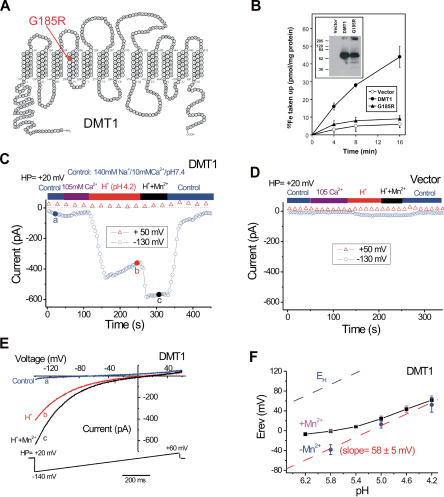
Figure 1
Figure 1. Wild-Type DMT1-Expressing Cells Exhibit a Proton Current and a Proton-Dependent Mn2+-Induced Current
(A) The G185R mutation is in the fourth of 12 putative TM domains in both mouse (shown) and rat DMT1 proteins. (B) 55Fe2+ uptake was greatly reduced for G185R in comparison to wild-type DMT1, although the protein expression levels were comparable (inset). (C–E) Representative currents induced by protons (pH 4.2) and Mn2+ (100 μM) at +50 mV (open triangles; some of the datapoints have been removed for clarity) and −130 mV (open circles) in a wild-type DMT1-transfected CHO-K1 cell. Whole-cell currents were elicited by repeated voltage ramps (−140 to +60 mV, 1,000 ms), shown in (E), with a 4 s interval between ramps. Holding potential (HP) was +20 mV. Neither control solution (10mM Ca2+/140 mM Na+/[pH7.4]) nor isotonic Ca2+ (105 mM) solution induced significant current. Representative I-V relations are shown in (E). Current responses from a vector (pTracer)-transfected cell are shown in (D). (F) pH-dependence of the Erev of the wild-type DMT1 current in the presence or absence of 300 μM [Mn2+]o. In the absence of Mn2+, the pH dependence of the Erev can be fitted by a line with a slope 58 mV/pH unit. In the presence of 300 μM Mn2+, the relationship was nonlinear, especially at higher pH. EH, H+ equilibrium potential. Note that the currents were not leak-subtracted.
Figure 2
Figure 2. G185R-Expressing Cells Display a Constitutive [Ca2+]o-Dependent Cationic Current
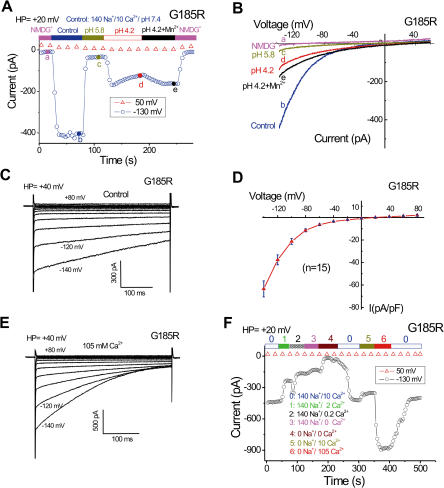
(A–B) Large inward currents were evoked by control solution (10mM Ca2+/140 mM Na+ [pH 7.4]) in G185R-transfected cells. The current was inhibited by lowering the solution pH to 5.8 without altering other ions. Further reducing the pH to 4.2 induced IDMT1-like current (enhanced by adding 100 μM Mn2+). No significant inward current was seen in NMDG+ (Na+-free, Ca2+-free) solution. (C) Time- and voltage-dependent kinetics of IG185R recorded in control solution in response to voltage steps. (D) Current densities (mean ± SEM, n = 15) of IG185R in control solution mea-sured at various voltages and normalized by cell capacitance. (E) Time- and voltage-dependent kinetics of IG185R in the presence of 105 mM Ca2+. (F) Ca2+ is more permeant than Na+ in G185R-expressing cells.
Figure 3
Figure 3. Ca2+ Permeability of IG185R
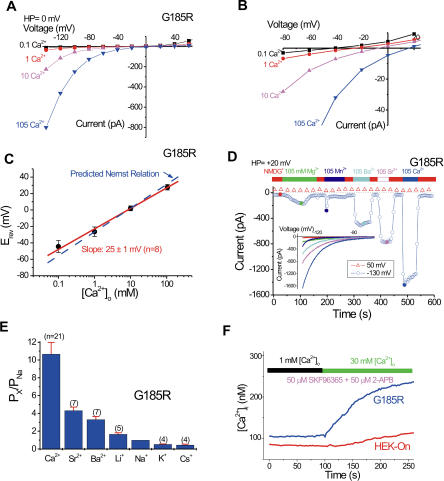
(A) Whole-cell I-V relations in the presence of [Ca2+]o are indicated. (B) Enlarged view of (A) to show the Erev measurement. (C) [Ca2+]o dependence of Erev. The slope was fit by linear regression to 25 mV per decade, close to the 29 mV per decade predicted for a Ca2+-selective electrode (dotted line). (D) Currents through G185R in various isotonic divalent solutions. I-Vs are shown in the inset. Note that currents induced by isotonic Mg2+ and Mn2+ were transient. (E) Relative permeability of various divalent and monovalent cations. The reversal potentials of IG185R in 10 mM test divalent cations were measured under bi-ionic conditions as described in Materials and Methods. The permeability was calculated using Equations 1 and 2. (F) [Ca2+]i changes estimated by Fura-2 fluorescence in response to an elevation of [Ca2+]o from 1 to 30 mM. The results were averaged from five (HEK-On) and seven (G185R) independent experiments (n = 3–13 cells each). To minimize potential endogenous depletion-activated and/or TRP-mediated Ca2+ influx, cells were bathed in the presence of 50 μM SKF96365 and 50 μM 2-APB. The F340/F380 ratio was recorded and converted into estimated [Ca2+]i based on an ionomycin-induced Ca2+ calibration.
Figure 4
Figure 4. Voltage Dependence and Pharmacological Properties of IG185R
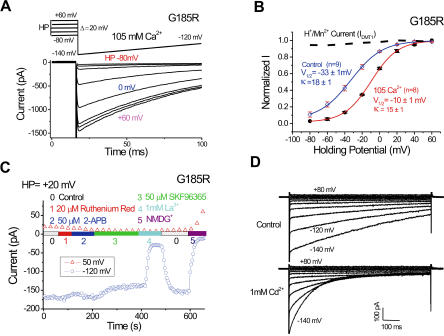
(A) Whole-cell currents recorded in 105 mM [Ca2+]o were dependent on holding potential before the voltage ramps (−140 to −120 mV shown). For clarity, only the first 20 ms of the 4 s-long holding potential is shown. (B) Voltage dependence of IG185R in control solution and 105 mM [Ca2+]o. IDMT1 (dotted line) exhibited no depen-dence on the holding potential. Abbreviations: V1/2 , half activation voltage. κ, slope factor. (C and D) Sensitivity of IG185R to various pharmacological agents and cation channel blockers. IG185R was relatively insensitive to RR, 2-APB, or SKF96365, but was blocked by 1mM La3+ or Cd2+ (D).
Figure 5
Figure 5. DMT1-Like and G185R-Like Currents in Enterocytes Isolated from Wild-Type and mk/mk Mice, Respectively
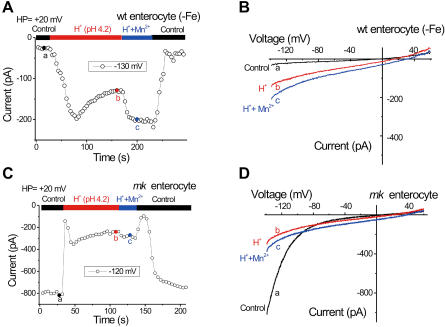
(A) Enterocyte currents isolated from an iron-deficient wild-type mouse (−Fe). Reducing bath pH (140 mM NaCl) induced a slowly desensitizing inward current that was further enhanced by addition of Mn2+. (B) Both proton and H+/Mn2+currents were inwardly rectifying. (C and D) An mk enterocyte expressed a large constitutive inward current in control bath solution. Reducing the bath pH (140 mM NaCl) first inhibited and then activated another inward current insensitive to the holding potential. This slowly-desensitizing current displayed a less steeply rectifying I-V as shown in (D).

References

    1. Adams SV, DeFelice LJ. Flux coupling in the human serotonin transporter. Biophys J. 2002;83:3268–3282. - PMC - PubMed
    1. Andrews NC. Iron homeostasis: Insights from genetics and animal models. Nat Rev Genet. 2000;1:208–217. - PubMed
    1. Bakowski D, Parekh AB. Voltage-dependent conductance changes in the store-operated Ca2+ current ICRACin rat basophilic leukaemia cells. J Physiol. 2000;529:295–306. - PMC - PubMed
    1. Berridge MJ, Bootman MD, Roderick HL. Calcium signalling: Dynamics, homeostasis and remodelling. Nat Rev Mol Cell Biol. 2003;4:517–529. - PubMed
    1. Cammack JN, Schwartz EA. Channel behavior in a gamma-aminobutyrate transporter. Proc Natl Acad Sci U S A. 1996;93:723–727. - PMC - PubMed

Publication types

MeSH terms

Associated data