


Variations in GABRA2, encoding the alpha 2 subunit of the GABA(A) receptor, are associated with alcohol dependence and with brain oscillations
- PMID: 15024690
- PMCID: PMC1181946
- DOI: 10.1086/383283
Variations in GABRA2, encoding the alpha 2 subunit of the GABA(A) receptor, are associated with alcohol dependence and with brain oscillations
Abstract
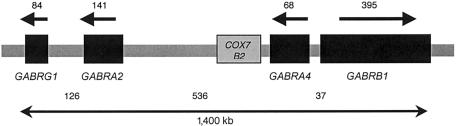
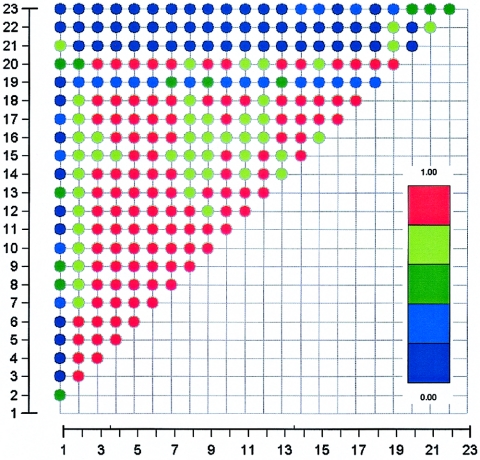
Alcoholism is a complex disease with both genetic and environmental risk factors. To identify genes that affect the risk for alcoholism, we systematically ascertained and carefully assessed individuals in families with multiple alcoholics. Linkage and association analyses suggested that a region of chromosome 4p contained genes affecting a quantitative endophenotype, brain oscillations in the beta frequency range (13-28 Hz), and the risk for alcoholism. To identify the individual genes that affect these phenotypes, we performed linkage disequilibrium analyses of 69 single-nucleotide polymorphism (SNPs) within a cluster of four GABA(A) receptor genes, GABRG1, GABRA2, GABRA4, and GABRB1, at the center of the linked region. GABA(A) receptors mediate important effects of alcohol and also modulate beta frequencies. Thirty-one SNPs in GABRA2, but only 1 of the 20 SNPs in the flanking genes, showed significant association with alcoholism. Twenty-five of the GABRA2 SNPs, but only one of the SNPs in the flanking genes, were associated with the brain oscillations in the beta frequency. The region of strongest association with alcohol dependence extended from intron 3 past the 3' end of GABRA2; all 43 of the consecutive three-SNP haplotypes in this region of GABRA2 were highly significant. A three-SNP haplotype was associated with alcoholism, with P=.000000022. No coding differences were found between the high-risk and low-risk haplotypes, suggesting that the effect is mediated through gene regulation. The very strong association of GABRA2 with both alcohol dependence and the beta frequency of the electroencephalogram, combined with biological evidence for a role of this gene in both phenotypes, suggest that GABRA2 might influence susceptibility to alcohol dependence by modulating the level of neural excitation.
Figures
References
Electronic-Database Information
-
- dbSNP Home Page, http://www.ncbi.nlm.nih.gov/SNP/ (for markers listed in tables 1 and 3, including new SNPs submitted: ss15649710, ss15649711, ss15649712, and ss15649713)
-
- LocusLink, http://www.ncbi.nlm.nih.gov/LocusLink/
-
- NCBI Reference Sequence, http://www.ncbi.nlm.nih.gov/RefSeq/
-
- Online Mendelian Inheritance in Man (OMIM), http://www.ncbi.nlm.nih.gov/Omim/ (for alcoholism)
References
-
- Almasy L, Williams JT, Dyer TD, Blangero J (1999) Quantitative trait locus detection using combined linkage/disequilibrium analysis. Genet Epidemiol 17 Suppl 1:S31–S36 - PubMed
-
- American Psychiatric Association (1987) Diagnostic and statistical manual of mental disorders, 3rd ed, revised. American Psychiatric Association Press, Washington, DC
-
- ——— (1994) Diagnostic and statistical manual of mental disorders, 4th ed. American Psychiatric Association Press, Washington, DC
Publication types
MeSH terms
Substances
Grants and funding
LinkOut - more resources
Full Text Sources
Other Literature Sources
Medical
Molecular Biology Databases
Miscellaneous
