Review
doi: 10.1128/JB.186.7.1919-1926.2004.
Unveiling molecular scaffolds of the type IV secretion system
Affiliations
- PMID: 15028675
- PMCID: PMC374423
- DOI: 10.1128/JB.186.7.1919-1926.2004
Item in Clipboard
Review
Unveiling molecular scaffolds of the type IV secretion system
J Bacteriol.
2004 Apr.
No abstract available
Figures

(A) Gene organization and nomenclature of T4SSs. The proteins are grouped according to their putative functions: ATPases in green, core components in blue, pilus structures in orange, lytic transglycosylases in yellow, and proteins with no assigned function in magenta. Individual proteins within a functional group are distinguished by different shadings. (B) Model of the type IV secretion machinery. The association of energy-generating transporters with the machinery needs to be defined, as well as the translocation of substrates from the cytoplasm through the core complex. Surface structures (pili) may initiate contact with the host cell, but the substrate translocation pathway is unknown. This assembly model reflects our present knowledge on protein-protein interaction linkage of T4SS components.

Molecular features of HP0525 (PDB code 1g6o). (A) Ribbon presentation of HP0525 bound to ADP. The N and C termini are indicated (N-ter and C-ter, respectively). The two domains are colored differently: NTDs in gold and CTDs in magenta. The ADP molecule is in cyan. (B) Ribbon diagram showing the two-ring feature of the HP0525 hexamer. The color scheme is the same as that in panel A. The proposed membrane-associated state of the HP0525 hexamer is modeled. (C) HP0525 hexamer viewed down the small hole of the chamber formed by the CTDs. The six subunits are color coded differently. (D) Surface of the HP0525 hexamer, color coded according to charge: blue for the most positive regions and red for the most negative regions, with interpolations in between. (Left) View along the sixfold axis membrane pole. (Center) Cutaway of the HP0525 hexamer to highlight the inside channel. The orientation corresponds to that shown in panel B. (Right) Surface of HP0525 viewed down the small hole of the chamber. This side of the hexamer, with a highly negative charge, would face the cytoplasm. The orientation corresponds to that shown in panel C.

Molecular features of TrwB (PDB code 1e9r). (A) Ribbon presentation of TrwBΔN70 bound to ADP. The N and C termini are indicated (N-ter and C-ter, respectively). Magenta, AAD; gold, NBD. A bound ADP molecule is shown as a cyan stick model to position the nucleotide-binding site. (B) TrwBΔN70 hexamer viewed from the side. The color-coding scheme is the same as that in panel A. (C) TrwBΔN70 hexamer viewed down the small hole at the base of the hexamer formed by the AADs. Each monomer is color coded differently. (D) Surface of the TrwBΔN70 hexamer, color coded as described in the legend to Fig. 2D. (Left) View along the sixfold axis membrane pole. (Center) Cutaway of the TrwBΔN70 hexamer to highlight the inside channel. The orientation corresponds to that shown in panel B. (Right) Surface of the TrwBΔN70 hexamer viewed down the hole in the cytoplasmic side. The orientation corresponds to that shown in panel C.
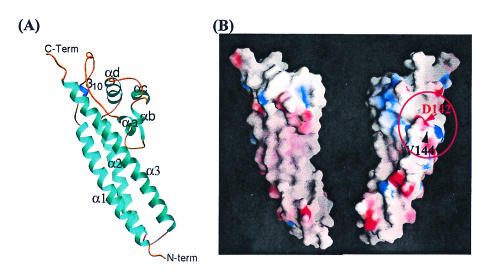
Structure of TraC (PDB code 1r8i) and mapping of functional residues onto the TraC surface. (A) Ribbon diagram of the structure of the TraC monomer. α-Helices, the 310 helix, and loops are colored cyan, blue, and amber, respectively. The three major helices are labeled as α1 to α3, while the short helices between α1 and α2 are labeled as αa to αd. (B) Electrostatic-potential surface of TraC. (Left) TraC is in the same orientation as in panel A. (Right) The surface has been rotated 180° from the view on the left. The red circle delineates the region found to differentially affect the functions of TraC. It contains residues D142 and V144.
References
-
- Abrahams, J. P., A. G. Leslie, R. Lutter, and J. E. Walker. 1994. Structure at 2.8 Å resolution of F1-ATPase from bovine heart mitochondria. Nature 370:621-628. - PubMed
-
- Baron, C., D. O'Callaghan, and E. Lanka. 2002. Bacterial secrets of secretion: EuroConference on the biology of type IV secretion processes. Mol. Microbiol. 43:1359-1366. - PubMed
-
- Boschiroli, M. L., S. Ouahrani-Bettache, V. Foulongne, S. Michaux-Charachon, G. Bourg, A. Allardet-Servent, C. Cazevieille, J. P. Lavigne, J. P. Liautard, M. Ramuz, and D. O'Callaghan. 2002. Type IV secretion and Brucella virulence. Vet. Microbiol. 90:341-348. - PubMed
Publication types
MeSH terms
Substances
LinkOut - more resources
Full Text Sources