Comparative Study
. 2004 Jul;92(1):349-60.
doi: 10.1152/jn.00960.2003. Epub 2004 Mar 17.

Interlimb transfer of novel inertial dynamics is asymmetrical

Affiliations
Comparative Study

Interlimb transfer of novel inertial dynamics is asymmetrical

Jinsung Wang et al. J Neurophysiol. 2004 Jul.

Abstract

Mechanisms underlying interlimb transfer of adaptation to visuomotor rotations have recently been explored in depth. However, little data are available regarding interlimb transfer of adaptation to novel inertial dynamics. The present study thus investigated interlimb transfer of dynamics by examining the effect of initial training with one arm on subsequent performance with the other in adaptation to a 1.5-kg mass attached eccentrically to the forearm. Using inverse dynamic analysis, we examined the changes in torque strategies associated with adaptation to the extra mass, and with interlimb transfer of that adaptation. Following initial training with the dominant arm, nondominant arm performance improved substantially in terms of linearity and initial direction control as compared with naïve performance. However, initial training with the nondominant arm had no effect on subsequent performance with the dominant arm. Inverse dynamic analysis revealed that improvements in kinematics were implemented by increasing flexor muscle torques at the elbow to counter load-induced increases in extensor interaction torques as well as increasing flexor muscle torques at the shoulder to counter the extensor actions of elbow muscle torque. Following opposite arm adaptation, the nondominant arm adopted this dynamic strategy early in adaptation. These findings suggest that dominant arm adaptation to novel inertial dynamics leads to information that can be accessed and utilized by the opposite arm controller, but not vice versa. When compared with our previous findings on interlimb transfer of visuomotor rotations, our current findings suggest that adaptations to visuomotor and dynamic transformations are mediated by distinct neural mechanisms.


Figures
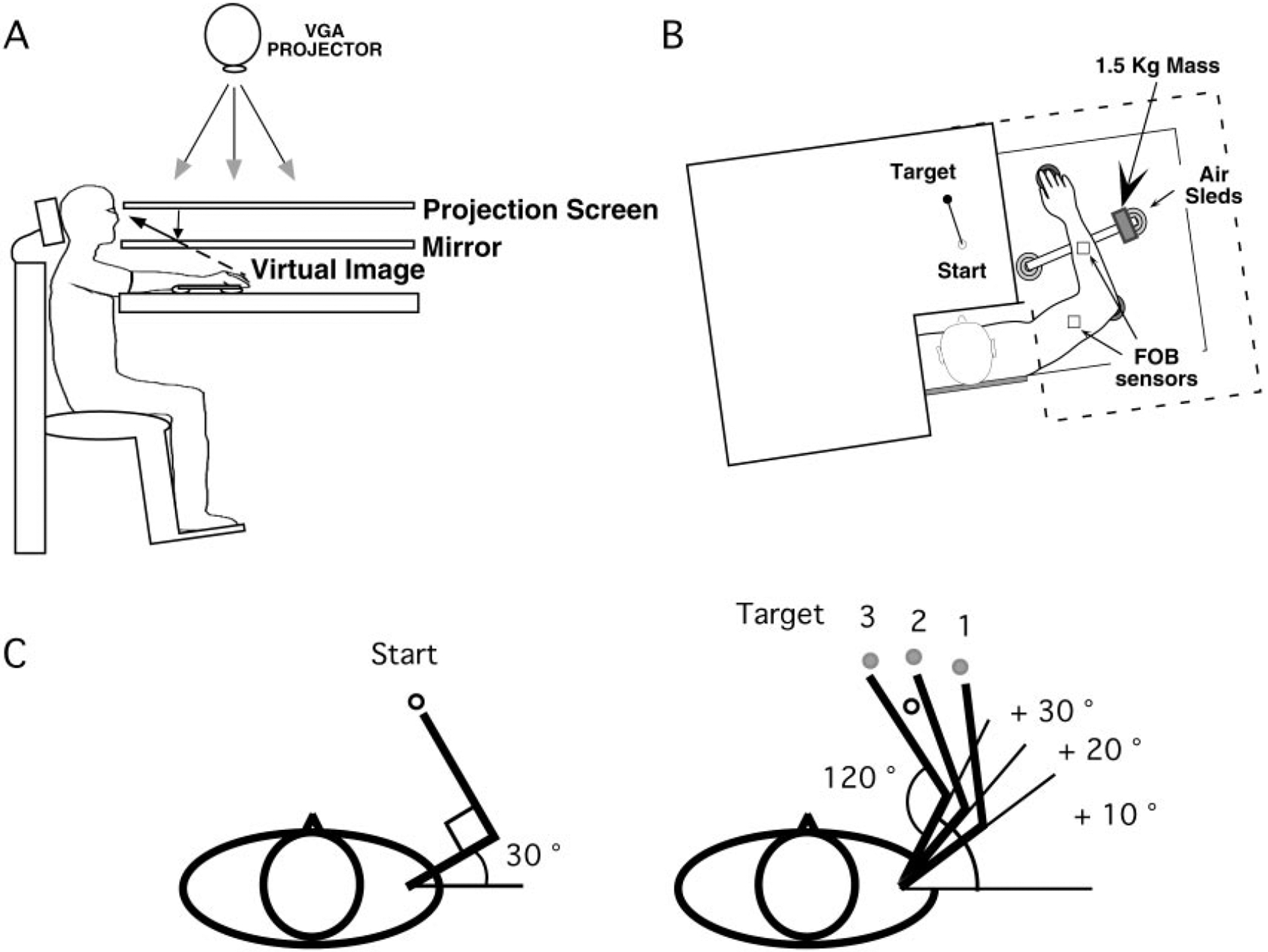
FIG. 1.
FIG. 1.
A: side view: subjects were seated in a dentist-type chair with the arm supported by an air jet system that removed the effects of friction on arm movement. Targets and the cursor representing finger position were back-projected on a screen placed above the arm. A mirror placed below this screen reflected the image, such that the projection was perceived in the plane of the arm. B: top view: the positions of the Flock of Birds sensors are shown. For the mass condition, a 1.5-kg mass was attached at the end of the arm support. C: target was randomly displayed on one of the 3 target locations. Shoulder angle varied systematically across targets while the elbow angle remained constant
FIG. 2.
FIG. 2.
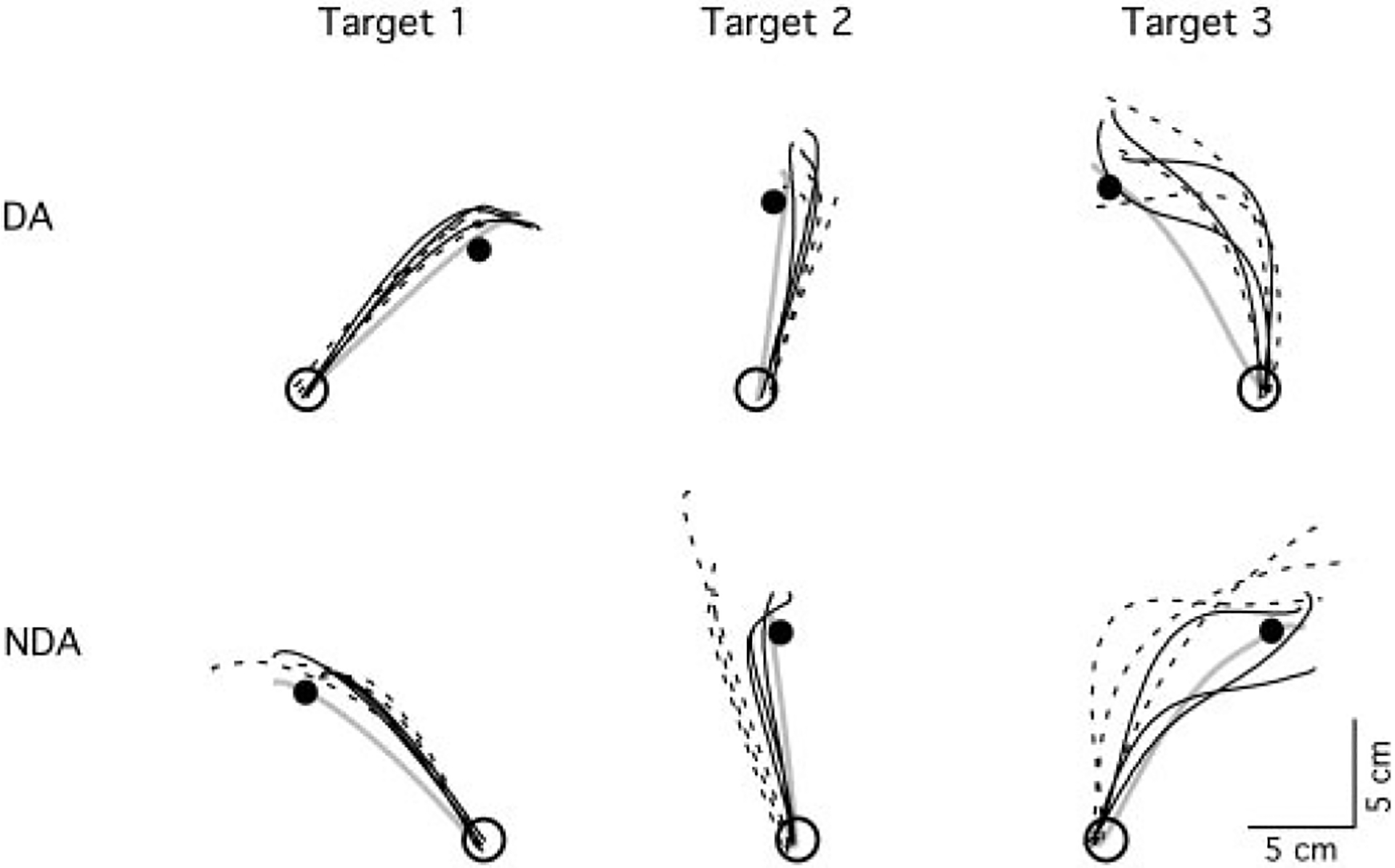
Hand-paths of representative subjects. Top: dominant hand paths; bottom: nondominant hand paths. Each column shows hand-paths of the first three trials of naive performance (broken lines) and performance following opposite arm adaptation (black solid lines) for each target direction. Hand-path after adaptation to the inertial load is represented by a gray solid line
FIG. 3.
FIG. 3.
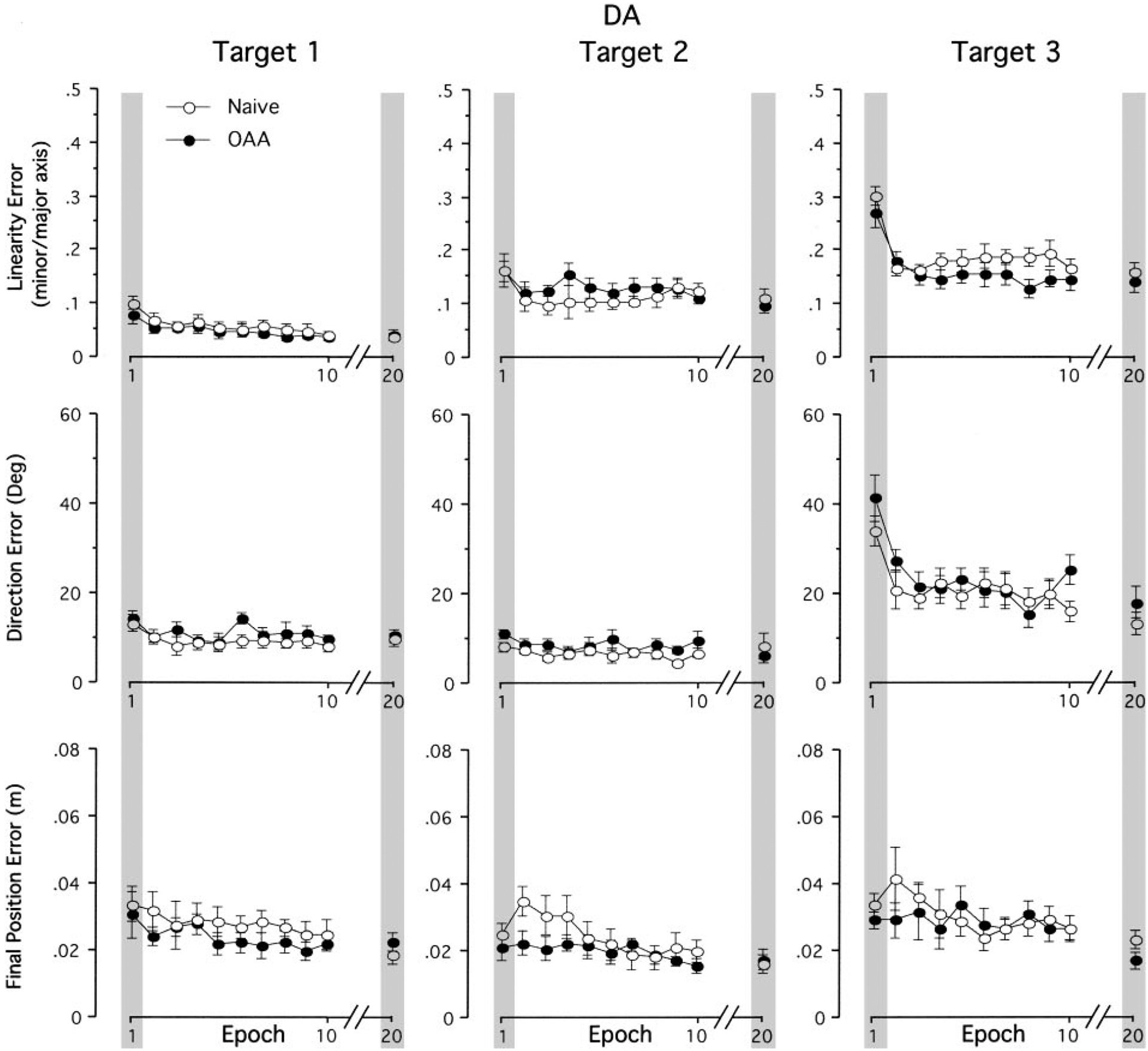
Mean performance measures of linearity error, direction error at Amax and final position error for dominant arm. Every data point shown on x axis represents the average of 3 consecutive trials for each target across all subjects (means ± SE). Performance measures for naive performance (○) and performance following opposite arm adaptation (●) are shown separately. For clarity, data between epochs 10 and 20 are removed
FIG. 4.
FIG. 4.
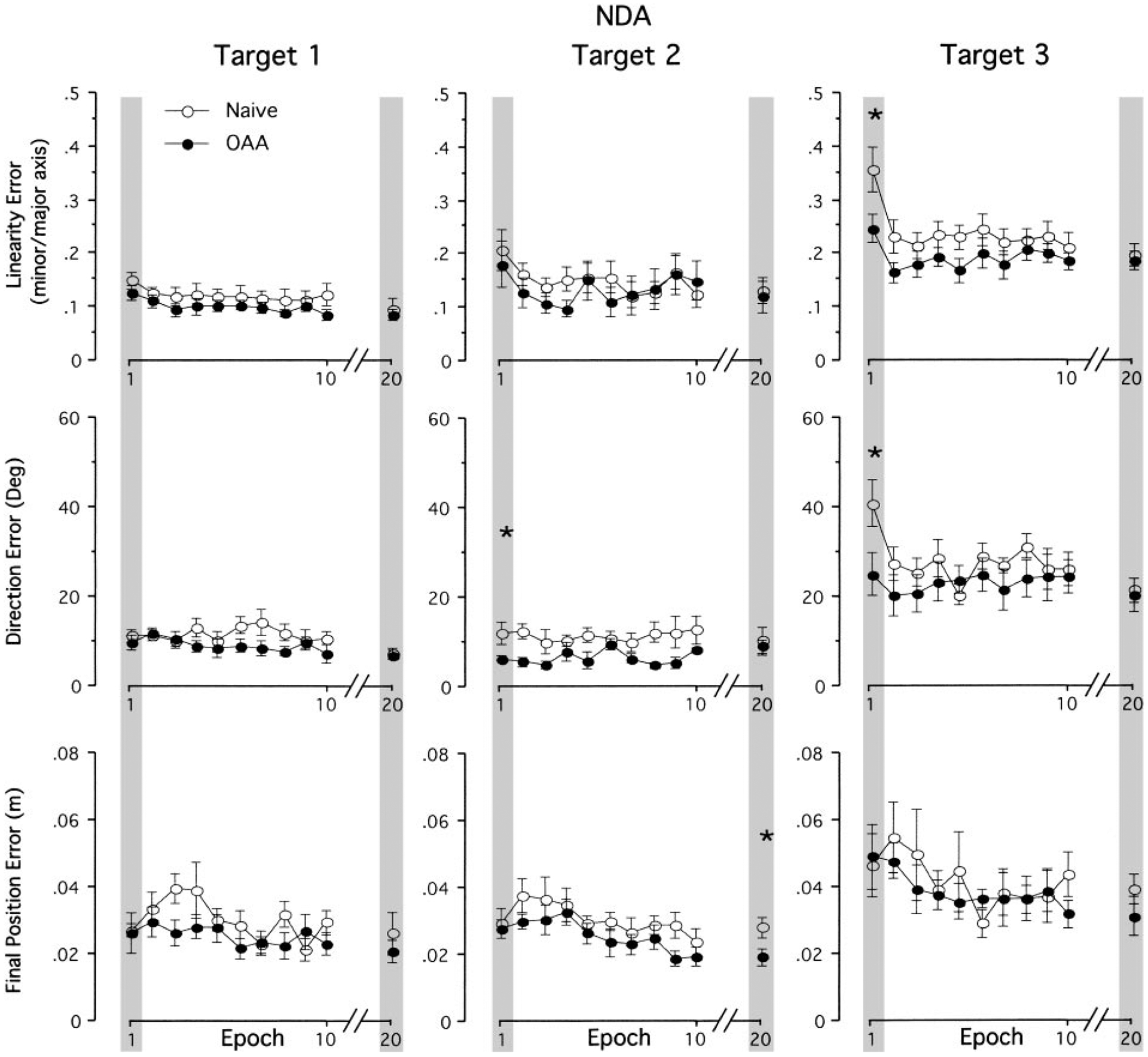
Mean performance measures of linearity error, direction error at Amax and final position error for nondominant arm. Every data point shown on x axis represents the average of 3 consecutive trials for each target across all subjects (means ± SE). Performance measures for naive performance (●) and performance following opposite arm adaptation (○) are shown separately. For clarity, data between epochs 10 and 20 are removed. *, a significant difference between naive performance and performance following opposite arm adaptation (OAA) at P < 0.05
FIG. 5.
FIG. 5.
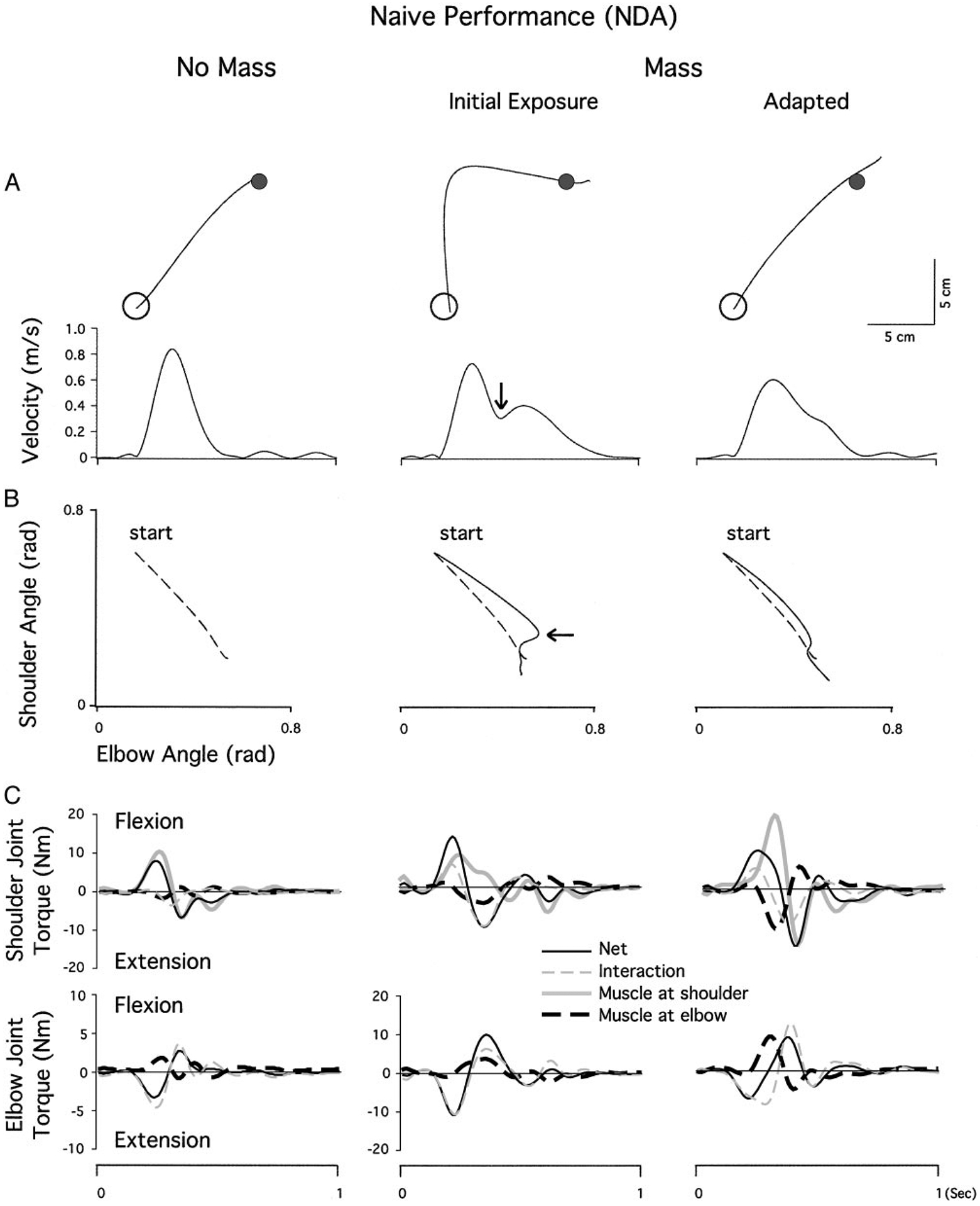
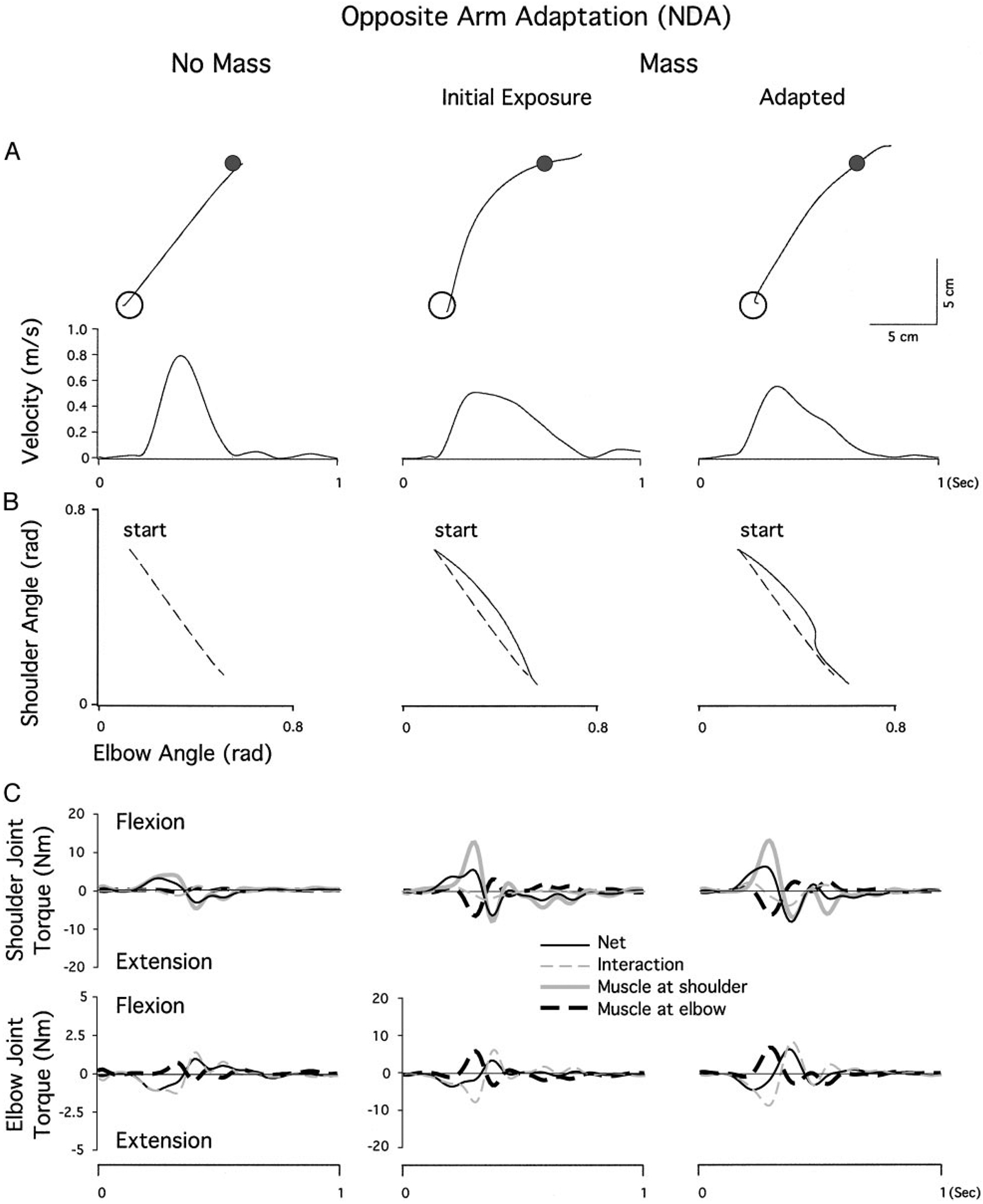
A: nondominant arm movements made toward target 3 during naïve performance. Hand paths and velocity profiles of representative subjects from the last epoch of baseline session (left), the 1st epoch of mass session (middle), and the last epoch of mass session (right). B: angle-angle plots representing the shoulder and elbow coordination patterns that correspond to the hand paths and velocity profiles shown in A. Arrows in A and B indicate the point at which a movement correction is made. C: torque patterns that correspond to the kinematic profiles shown in A and B. Top: shoulder joint torques, partitioned into net, interaction, and muscle torques; bottom: the elbow joint torques. Elbow torque profiles for the baseline session are shown at twice the scale of the mass sessions for clarity
FIG. 6.
FIG. 6.
A: nondominant arm movements made toward target 3 during performance following opposite arm adaptation. Hand paths and velocity profiles of representative subjects from the last epoch of the baseline session (left), the 1st epoch of the mass session (middle), and the last epoch of the mass session (right). B: angle-angle plots representing the shoulder and elbow coordination patterns that correspond to the hand-paths and velocity profiles shown in A. Arrows in A and B indicate the point at which a movement correction is made. C: torque patterns that correspond to the kinematic profiles shown in A and B. Top: shoulder joint torques, partitioned into net, interaction, and muscle torques; bottom: the elbow joint torques. Elbow torque profiles for the baseline session are shown at 4 times the scale of the mass sessions for clarity
FIG. 7.
FIG. 7.
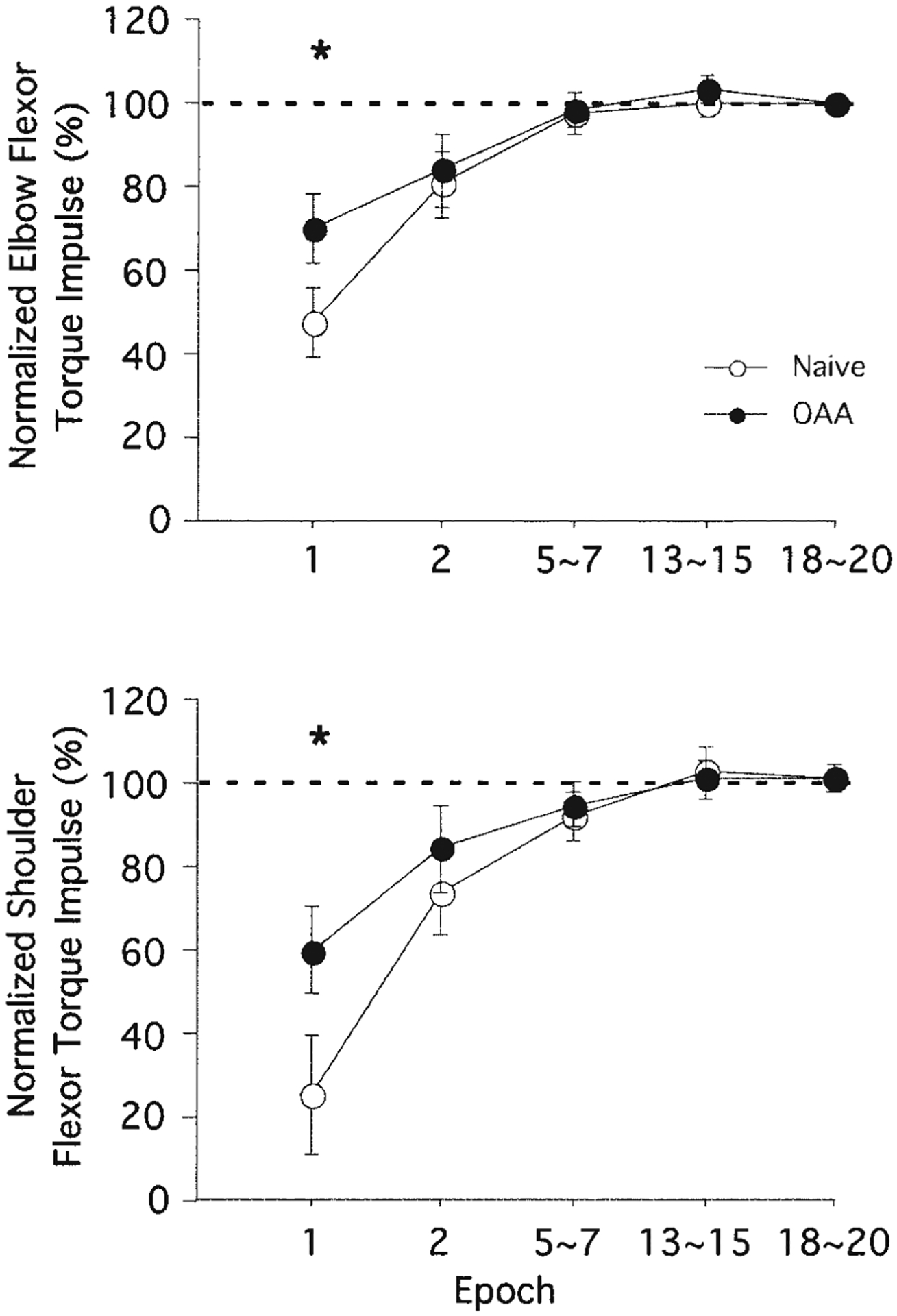
Normalized flexor muscle torque impulses from nondominant arm movements made toward target 3. Each data point at epochs 1 and 2 represents the average of 3 consecutive trials across all subjects (means ± SE), whereas every other data point represents the average of 9 consecutive trials. Performance measures for naive performance (○) and performance following opposite arm adaptation (●) are shown separately. *, a significant difference between naive performance and performance following OAA at P < 0.05

References

    1. Bagesteiro LB and Sainburg RL. Handedness: dominant arm advantages in control of limb dynamics. J Neurophysiol 88: 2408–2421, 2002. - PMC - PubMed
    1. Clower DM, Hoffman JM, Votaw JR, Faber TL, Woods RP , and Alexander GE. Role of posterior parietal cortex in the recalibration of visually guided reaching. Nature 383: 618–621, 1996. - PubMed
    1. Cohen MM. Visual feedback, distribution of practice, and intermanual transfer of prism aftereffects. Percept Psychophys 14: 401–406, 1973. - PubMed
    1. Criscimagna-Hemminger SE, Donchin O, Gazzaniga MS , and Shadmehr R. Learned dynamics of reaching movements generalize from dominant to nondominant arm. J Neurophysiol 89: 168–176, 2003. - PubMed
    1. Dassonville P, Zhu XH, Uurbil K, Kim SG , and Ashe J. Functional activation in motor cortex reflects the direction and the degree of handedness. Proc Natl Acad Sci USA 94: 14015–14018, 1997. - PMC - PubMed

Publication types

LinkOut - more resources