


Conserved T cell receptor usage in primary and recall responses to an immunodominant influenza virus nucleoprotein epitope
- PMID: 15037737
- PMCID: PMC387353
- DOI: 10.1073/pnas.0401279101
Conserved T cell receptor usage in primary and recall responses to an immunodominant influenza virus nucleoprotein epitope
Abstract
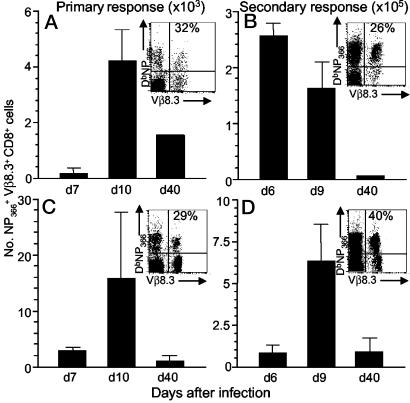
The CD8+ T cell response to the immunodominant DbNP366 epitope has been analyzed sequentially to determine the prevalence and persistence of different T cell antigen receptor (TCR)Vbeta8.3 clonotypes after primary and secondary influenza virus challenge. Based on the length and amino acid sequences of the complementarity-determining region 3 of TCRbeta (CDR3beta) loop and associated Jbeta usage, the same dominant TCRbeta signatures were found in the blood, the spleen, and the site of virus-induced pathology in the infected respiratory tract. Longitudinal analysis demonstrated that TCRbeta prominent in the antigen-driven phase of response persisted into memory and were again expanded after secondary challenge. A proportion of these high-frequency TCRbeta expressed "public" CDR3beta sequences that were detected in every mouse sampled, whereas others were found more than once but were not invariably present. Analysis of N-region nucleotide diversity established that as many as 10 different nucleic acid sequences (maximum of four "nucleotypes" in any one mouse) could encode a single public TCRbeta amino acid sequence. Conversely, whereas some of the unique, "private" TCRbeta achieved a substantial clone size, they were always specified by a single nucleotype. Although there is a strong stochastic element in this response, the public TCRbeta seem to represent a "best fit" for this immunodominant epitope, are selected preferentially from the naive TCR repertoire, and assume even greater prominence after secondary challenge.
Figures
References
-
- Arstila, T. P., Casrouge, A., Baron, V., Even, J., Kanellopoulos, J. & Kourilsky, P. (1999) Science 286, 958-961. - PubMed
-
- Casrouge, A., Beaudoing, E., Dalle, S., Pannetier, C., Kanellopoulos, J. & Kourilsky, P. (2000) J. Immunol. 164, 5782-5787. - PubMed
-
- Davis, M. M., McHeyzer-Williams, M. & Chien, Y. H. (1995) Ann. N.Y. Acad. Sci. 756, 1-11. - PubMed
-
- Mikszta, J. A., McHeyzer-Williams, L. J. & McHeyzer-Williams, M. G. (1999) J. Immunol. 163, 5978-5988. - PubMed
-
- Kjer-Nielsen, L., Clements, C. S., Purcell, A. W., Brooks, A. G., Whisstock, J. C., Burrows, S. R., McCluskey, J. & Rossjohn, J. (2003) Immunity 18, 53-64. - PubMed
Publication types
MeSH terms
Substances
Grants and funding
LinkOut - more resources
Full Text Sources
Research Materials
