


Vaccine potential of the Neisseria meningitidis 2086 lipoprotein
- PMID: 15039331
- PMCID: PMC375149
- DOI: 10.1128/IAI.72.4.2088-2100.2004
Vaccine potential of the Neisseria meningitidis 2086 lipoprotein
Erratum in
-
Correction for Fletcher et al., "Vaccine Potential of the Neisseria meningitidis 2086 Lipoprotein".Infect Immun. 2017 May 23;85(6):e00212-17. doi: 10.1128/IAI.00212-17. eCollection 2017 Jun. Infect Immun. 2017. PMID: 31305626 Free PMC article.
Abstract
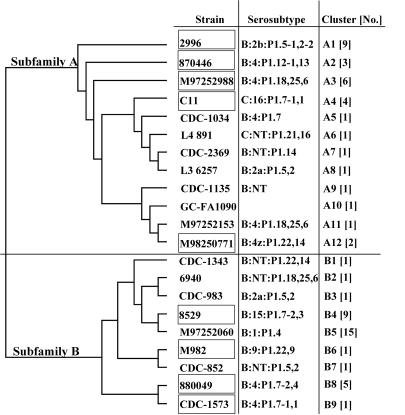
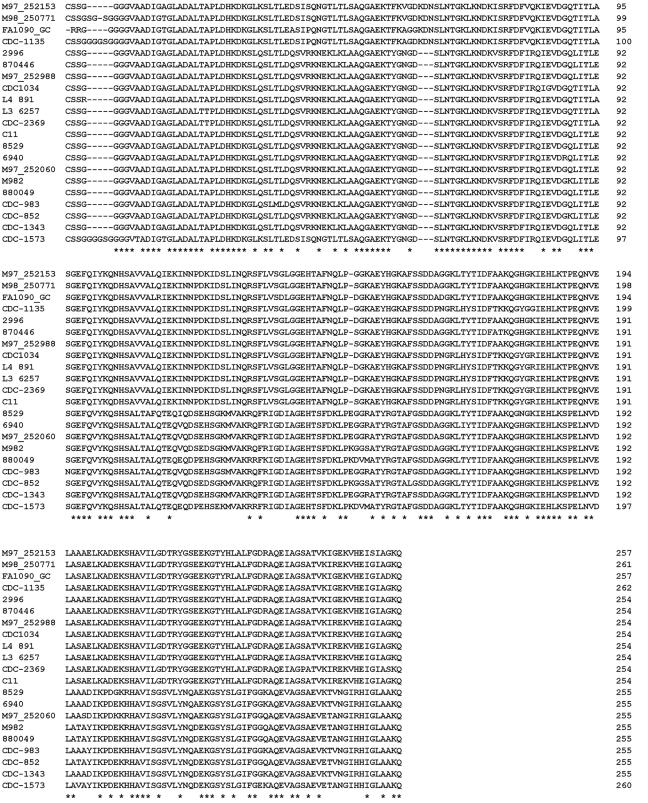
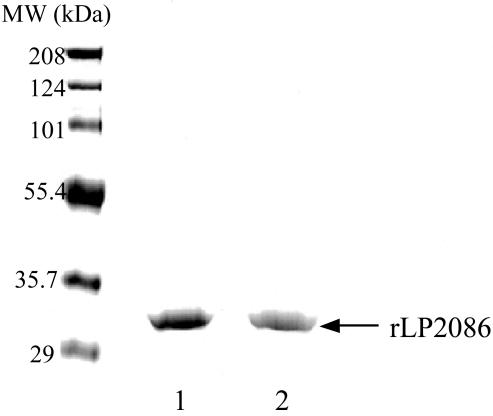
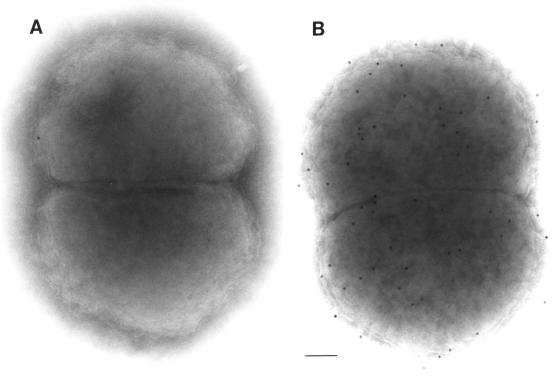
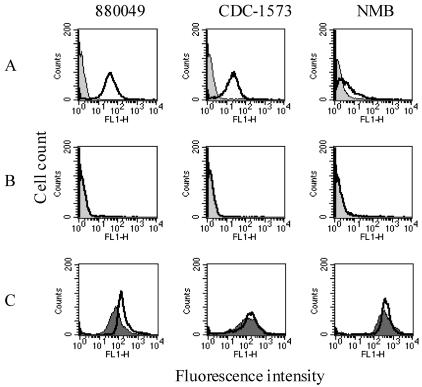
A novel antigen that induces cross-reactive bactericidal antibodies against a number of Neisseria meningitidis strains is described. This antigen, a approximately 28-kDa lipoprotein called LP2086, was first observed within a complex mixture of soluble outer membrane proteins (sOMPs) following a series of fractionation, protein purification, and proteomics steps. Approximately 95 different neisserial isolates tested positive by Western blotting and PCR screening methods for the presence of the protein and the gene encoding LP2086. The strains tested included isolates of N. meningitidis serogroups A, B, C, W135, and Y, Neisseria gonorrhoeae, and Neisseria lactamica. To better understand the microheterogeneity of this protein, the 2086 genes from 63 neisserial isolates were sequenced. Two different subfamilies of LP2086 were identified based on deduced amino acid sequence homology. A high degree of amino acid sequence similarity exists within each 2086 subfamily. The highest degree of genetic diversity was seen between the two subfamilies which share approximately 60 to 75% homology at the nucleic acid level. Flow cytometry (fluorescence-activated cell sorting) analyses and electron microscopy indicated that the LP2086 is localized on the outer surface of N. meningitidis. Antiserum produced against a single protein variant was capable of eliciting bactericidal activity against strains expressing different serosubtype antigens. Combining one recombinant lipidated 2086 (rLP2086) variant from each subfamily with two rPorA variants elicited bactericidal activity against all strains tested. The rLP2086 family of antigens are candidates worthy of further vaccine development.
Figures
References
-
- Abdillahi, H., and J. T. Poolman. 1987. Whole cell ELISA for typing Neisseria meningitidis with monoclonal antibodies. FEMS Microbiol. Lett. 48:367-371. - PubMed
-
- Ashton, F. E., L. Mancino, A. J. Ryan, J. T. Poolman, H. Abdillahi, and W. D. Zollinger. 1991. Serotypes and subtypes of Neisseria meningitidis serogroup B strains associated with meningococcal disease in Canada, 1977-1989. Can. J. Microbiol. 37:613-617. - PubMed
-
- Bernfield, L., L. Fletcher, A. Howell, J. Farley, R. Zagursky, M. Knauf, and G. Zlotnick. 2002. Identification of a novel vaccine candidate for group B Neisseria meningitidis, p. 116. In D. A. Caugant and E. Wedege (ed.), Abstracts of the Thirteenth International Pathogenic Neisseria Conference. National Institute of Public Health, Oslo, Norway.
-
- Bessler, W. G., and G. Jung. 1992. Synthetic lipopeptides as novel adjuvants. Res. Immunol. 143:548-553. - PubMed
MeSH terms
Substances
Associated data
- Actions
- Actions
- Actions
- Actions
- Actions
- Actions
- Actions
- Actions
- Actions
- Actions
- Actions
- Actions
- Actions
- Actions
- Actions
- Actions
- Actions
- Actions
- Actions
- Actions
- Actions
- Actions
- Actions
- Actions
- Actions
- Actions
- Actions
- Actions
- Actions
- Actions
- Actions
- Actions
- Actions
- Actions
- Actions
- Actions
- Actions
- Actions
- Actions
- Actions
- Actions
- Actions
- Actions
- Actions
- Actions
- Actions
- Actions
- Actions
- Actions
- Actions
- Actions
- Actions
- Actions
- Actions
- Actions
- Actions
- Actions
- Actions
- Actions
- Actions
- Actions
- Actions
- Actions
- Actions
LinkOut - more resources
Full Text Sources
Other Literature Sources
