


Prevalence of hyperuricemia and relation of serum uric acid with cardiovascular risk factors in a developing country
- PMID: 15043756
- PMCID: PMC406506
- DOI: 10.1186/1471-2458-4-9
Prevalence of hyperuricemia and relation of serum uric acid with cardiovascular risk factors in a developing country
Abstract
Background: The prevalence of hyperuricemia has rarely been investigated in developing countries. The purpose of the present study was to investigate the prevalence of hyperuricemia and the association between uric acid levels and the various cardiovascular risk factors in a developing country with high average blood pressures (the Seychelles, Indian Ocean, population mainly of African origin).
Methods: This cross-sectional health examination survey was based on a population random sample from the Seychelles. It included 1011 subjects aged 25 to 64 years. Blood pressure (BP), body mass index (BMI), waist circumference, waist-to-hip ratio, total and HDL cholesterol, serum triglycerides and serum uric acid were measured. Data were analyzed using scatterplot smoothing techniques and gender-specific linear regression models.
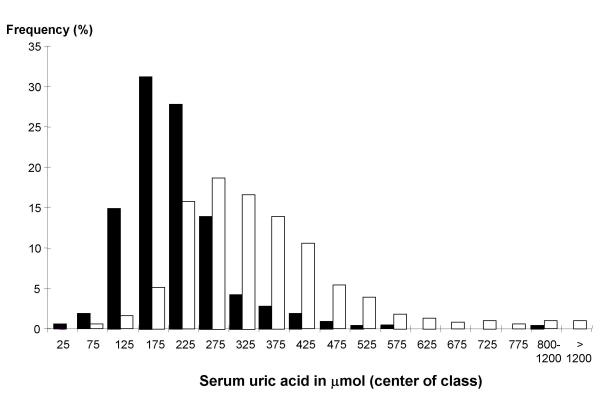
Results: The prevalence of a serum uric acid level >420 micromol/L in men was 35.2% and the prevalence of a serum uric acid level >360 micromol/L was 8.7% in women. Serum uric acid was strongly related to serum triglycerides in men as well as in women (r = 0.73 in men and r = 0.59 in women, p < 0.001). Uric acid levels were also significantly associated but to a lesser degree with age, BMI, blood pressure, alcohol and the use of antihypertensive therapy. In a regression model, triglycerides, age, BMI, antihypertensive therapy and alcohol consumption accounted for about 50% (R2) of the serum uric acid variations in men as well as in women.
Conclusions: This study shows that the prevalence of hyperuricemia can be high in a developing country such as the Seychelles. Besides alcohol consumption and the use of antihypertensive therapy, mainly diuretics, serum uric acid is markedly associated with parameters of the metabolic syndrome, in particular serum triglycerides. Considering the growing incidence of obesity and metabolic syndrome worldwide and the potential link between hyperuricemia and cardiovascular complications, more emphasis should be put on the evolving prevalence of hyperuricemia in developing countries.
Figures
References
-
- Gertler MM, Garn SM, Levine SA. Serum uric acid in relation to age and physique in health and coronary heart disease. Ann Intern Med. 1951;34:1421–1431. - PubMed
-
- Verdecchia P, Schillaci G, Reboldi GP, Santeusanio F, Porcellati C, Brunetti P. Relation between serum uric acid and risk of cardiovascular disease in essential hypertension. Hypertension. 2000;36:1072–1078. - PubMed
-
- Liese AD, Hense HW, Löwel H, Döring A, Tietze M, Keil U. Association of serum uric acid with all-cause and cardiovascular disease mortality and incident myocardial infarction in the MONICA Augsburg cohort. Epidemiology. 1999;10:391–397. - PubMed
-
- Brand FN, McGee DL, Kannel WB, Stokes J, III, Castelli WP. Hyperuricemia as a risk factor of coronary heart disease: the Framingham study. Am J Epidemiol. 1985;121:11–18. - PubMed
Publication types
MeSH terms
Substances
LinkOut - more resources
Full Text Sources
