Clinical Trial
. 2004 Apr 13;101(15):5328-35.
doi: 10.1073/pnas.0400053101. Epub 2004 Mar 24.

All-trans retinoic acid/As2O3 combination yields a high quality remission and survival in newly diagnosed acute promyelocytic leukemia

Affiliations
Clinical Trial

All-trans retinoic acid/As2O3 combination yields a high quality remission and survival in newly diagnosed acute promyelocytic leukemia

Zhi-Xiang Shen et al. Proc Natl Acad Sci U S A. .

Abstract

Both all-trans retinoic acid (ATRA) and arsenic trioxide (As(2)O(3)) have proven to be very effective in obtaining high clinical complete remission (CR) rates in acute promyelocytic leukemia (APL), but they had not been used jointly in an integrated treatment protocol for remission induction or maintenance among newly diagnosed APL patients. In this study, 61 newly diagnosed APL subjects were randomized into three treatment groups, namely by ATRA, As(2)O(3), and the combination of the two drugs. CR was determined by hematological analysis, tumor burden was examined with real-time quantitative RT-PCR of the PML-RAR alpha (promyelocytic leukemia-retinoic acid receptor alpha) fusion transcripts, and side effects were evaluated by means of clinical examinations. Mechanisms possibly involved were also investigated with cellular and molecular biology methods. Although CR rates in three groups were all high (> or =90%), the time to achieve CR differed significantly, with that of the combination group being the shortest one. Earlier recovery of platelet count was also found in this group. The disease burden as reflected by fold change of PML-RAR alpha transcripts at CR decreased more significantly in combined therapy as compared with ATRA or As(2)O(3) mono-therapy (P < 0.01). This difference persisted after consolidation (P < 0.05). Importantly, all 20 cases in the combination group remained in CR whereas 7 of 37 cases treated with mono-therapy relapsed (P < 0.05) after a follow-up of 8-30 months (median: 18 months). Synergism of ATRA and As(2)O(3) on apoptosis and degradation of PML-RAR alpha oncoprotein might provide a plausible explanation for superior efficacy of combination therapy in clinic. In conclusion, the ATRA/As(2)O(3) combination for remission/maintenance therapy of APL brings much better results than either of the two drugs used alone in terms of the quality of CR and the status of the disease-free survival.


Figures
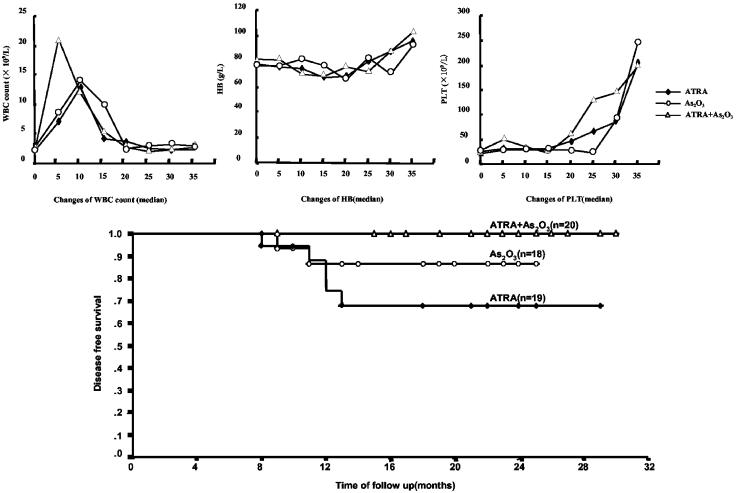
Fig. 1.
Fig. 1.
(Upper) Examination of whole peripheral blood cell counts. Each point on the curves represents the median of the counts of all patients from three groups. (Lower) Kaplan-Meier DFS survival curves. The relapse rate of group 1 is significantly higher than that of group 3 (P = 0.0202, Fisher's exact test). When patients of the two mono-therapy groups are put together, the relapse rate is also statistically higher than that of group 3 (P = 0.038).
Fig. 2.
Fig. 2.
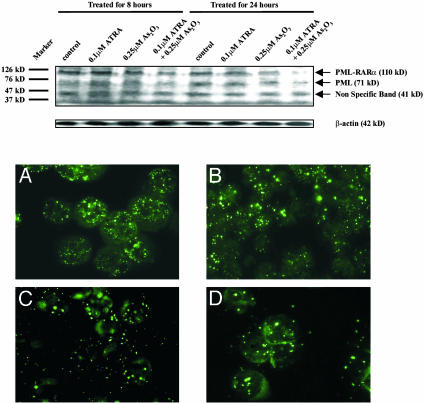
(Upper) Western blot analysis of PML-RARα fusion protein in cultured NB4 cells. Note that the intensity of the band corresponding to PML-RARα (arrow, 110 kDa) decreased on cotreatment with ATRA/As2O3 within 8 h. After 24 h of incubation, this band was almost undetectable in the eighth lane, and obvious degradation was observed in cells treated with 0.25 μM As2O3. (Lower) Immunofluorescence analysis of the subcellular localization of PML-RARa/PML in cultured fresh APL cells(original magnification ×1,000). (A) Untreated; (B) 8 h after 0.1 μM ATRA treatment; (C) 8 h after 0.25 μM As2O3 treatment; (D) 8 h after cotreatment with ATRA/As2O3 at the same concentrations.
Fig. 3.
Fig. 3.
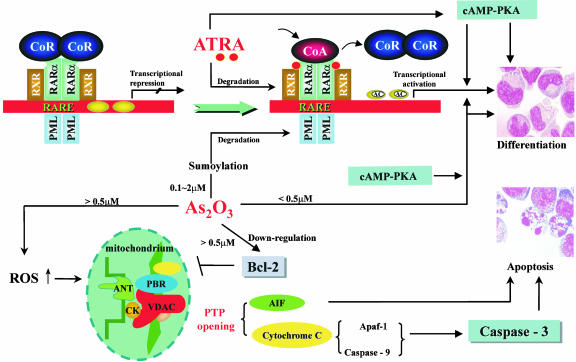
Potential mechanisms of effects of ATRA/As2O3 on APL cells. ATRA induces differentiation in two major pathways. First, ATRA disassociates corepressor from the PML-RARα/RXR complex and recruits CoA, leading to transcription of target genes. Secondly, ATRA regulates the cAMP-PKA signaling pathway, which may also lead to the transcription activation and finally the differentiation of APL cells. Besides, ATRA could modulate and degrade the PML-RARα oncoprotein as well. As2O3 exerts dose-dependent dual effects. Low dose (<0.5 μM) of As2O3 mediates differentiation of APL cells, which may cross-talk with PKA-cAMP-signaling pathway(s) and RAR/RXR signaling pathway(s) and may ultimately facilitate histone acetylation. On the other hand, a high dose of As2O3 initiates apoptosis by means of decreasing mitochondrial transmembrane potentials (Δψm), opening mitochondrial permeability transition pore (PTP) and releasing cytochrome c and other pre-apoptotic factors. It is of note that As2O3 can trigger the modulation and/or degradation of PML-RARα oncoprotein under a wide range of dosage. →, stimulation; ┤, inhibition; AIF, apoptosis-inducing factor; ANT, adenosine nucleotide translocator; Apaf-1, apoptosis-activating factor-1; CK, cytokinin; CoA, coactivator; CoR, corepressor; VDAC, voltage-dependent anion channel; PBR, peripheral benzidiazepine receptor; PTP, permeability transition pore; PKA, protein kinase A; ROS, reactive oxygen species; AC, acetylation.

References

    1. Brown, D., Kogan, S., Lagasse, E., Weissman, I., Alcalay, M., Pelicci, P. G., Atwater, S. & Bishop, J. M. (1997) Proc. Natl. Acad. Sci. USA. 94, 2551–2556. - PMC - PubMed
    1. Avvisati, G., Petti, M. C., Lo-Coco, F., Vegna, M. L., Amadori, S., Baccarani, M., Cantore, N., Di Bona, E., Ferrara, F. & Fioritoni, G., et al. (2002) Blood 100, 3141–3146. - PubMed
    1. Paran, M., Sachs, L., Barak, Y. & Resnitzky, P. (1970) Proc. Natl. Acad. Sci. USA 67, 1542–1549. - PMC - PubMed
    1. Breitman, T. R., Collins, S. J. & Keene, B. R. (1981) Blood 57, 1000–1004. - PubMed
    1. Huang, M. E., Ye, Y. C., Chen, S. R., Chai, J. R., Lu, J. X., Zhoa, L., Gu, L. J. & Wang, Z. Y. (1988) Blood 72, 567–572. - PubMed

Publication types

MeSH terms