


Local inhibition of nitric oxide and prostaglandins independently reduces forearm exercise hyperaemia in humans
- PMID: 15047770
- PMCID: PMC1665102
- DOI: 10.1113/jphysiol.2004.061283
Local inhibition of nitric oxide and prostaglandins independently reduces forearm exercise hyperaemia in humans
Abstract
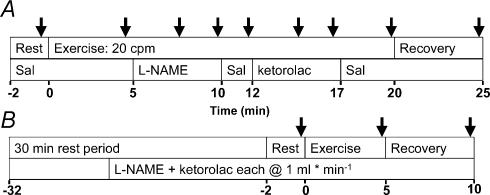
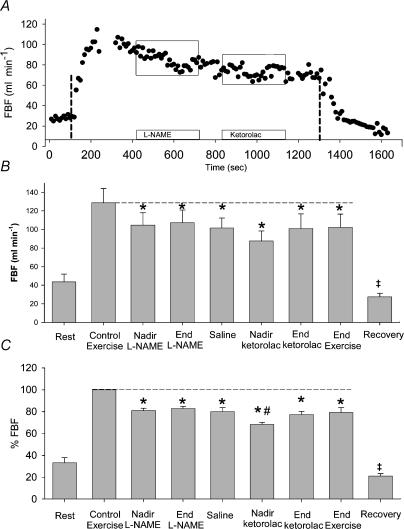
We tested the hypothesis that inhibition of synthesis of either nitric oxide (NO) or vasodilating prostaglandins (PGs) would not alter exercise hyperaemia significantly, but combined inhibition would synergistically reduce the hyperaemia. Fourteen subjects performed 20 min of moderate rhythmic forearm exercise (10% maximal voluntary contraction). Forearm blood flow (FBF) was measured by Doppler ultrasound. Saline or study drugs were infused (2 ml x min(-1)) into the forearm via a brachial artery catheter to locally inhibit synthesis of NO and PGs during steady state exercise (N(G)-nitro-L-arginine methyl ester (L-NAME), 25 mg over 5 min to inhibit NO synthase (NOS); and ketorolac, 3 mg over 5 min to inhibit cyclooxygenase (COX)). After achieving steady state exercise over 5 min (control), L-NAME was infused for 5 min, followed by 2 min saline, then by a 5 min infusion of ketorolac, and finally by 3 min of saline (n= 7). Drug order was reversed in seven additional subjects, such that single inhibition of NOS or COX was followed by combined inhibition. FBF during exercise decreased to 83 +/- 2% of control exercise (100%) with NOS inhibition, followed by a transient decrease to 68 +/- 2% of control during COX inhibition. However, FBF returned to levels similar to those achieved during NOS inhibition within 2 min (80 +/- 3% of control) and remained stable through the final 3 min of exercise. When COX inhibition was performed first, FBF decreased transiently to 88 +/- 4% of control (P < 0.01), and returned to control saline levels by the end of ketorolac infusion. Addition of L-NAME reduced FBF to 83 +/- 3% of control, and it remained stable through to the end of exercise. Regardless of drug order, FBF was approximately 80% of steady state control exercise (P < 0.01) during the last 30 s of exercise. We conclude that (1). NO provides a significant, consistent contribution to hyperaemia, (2). PGs contribute modestly and transiently, suggesting a redundant signal compensates for the loss of vasodilating PGs, and (3). NO and PG signals appear to contribute independently to forearm exercise hyperaemia.
Figures

Comment in
-
Redundancy reflects versatility of blood flow regulation mechanisms.J Physiol. 2004 Jun 1;557(Pt 2):346. doi: 10.1113/jphysiol.2004.066548. Epub 2004 Apr 23. J Physiol. 2004. PMID: 15107476 Free PMC article. No abstract available.
References
-
- Bian X, Tune JD, Downey HF. KATP+ channels, nitric oxide, and adenosine are not required for local metabolic coronary vasodilation. Am J Physiol. 2001;281:H831–H837.
-
- Dornyei G, Kaley G, Koller A. Exercise training augments flow-dependent dilation in rat skeletal muscle arterioles. Role of endothelial nitric oxide and prostaglandins. Am J Physiol. 1998;275:H831–H836. - PubMed
-
- Duffy SJ, New G, Tran BT, Harper RW, Meredith IT. Relative contribution of vasodilator prostanoids and no to metabolic vasodilation in the human forearm. Am J Physiol. 1999;276:H663–H670. - PubMed
Publication types
MeSH terms
Substances
Grants and funding
LinkOut - more resources
Full Text Sources
Medical
Miscellaneous
