


Long-lived poxvirus immunity, robust CD4 help, and better persistence of CD4 than CD8 T cells
- PMID: 15047796
- PMCID: PMC374286
- DOI: 10.1128/jvi.78.8.3811-3816.2004
Long-lived poxvirus immunity, robust CD4 help, and better persistence of CD4 than CD8 T cells
Abstract
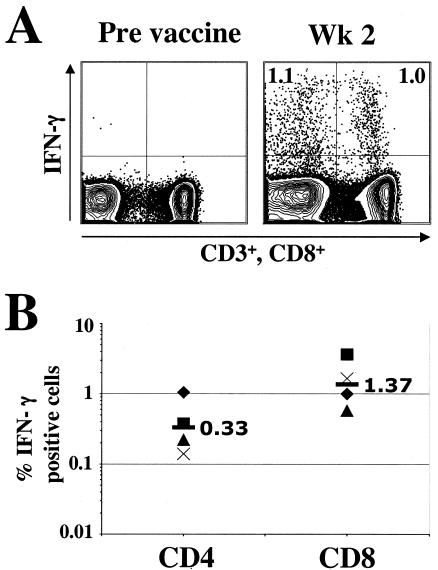
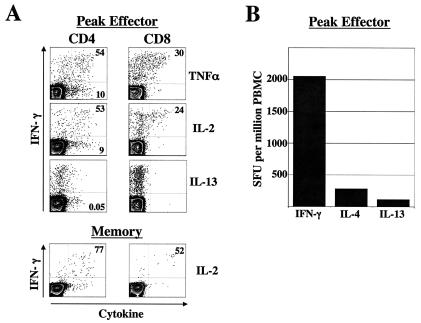
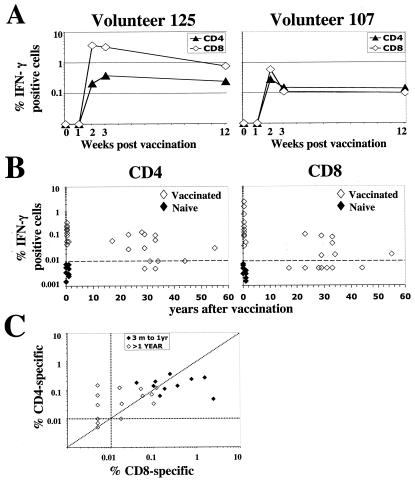
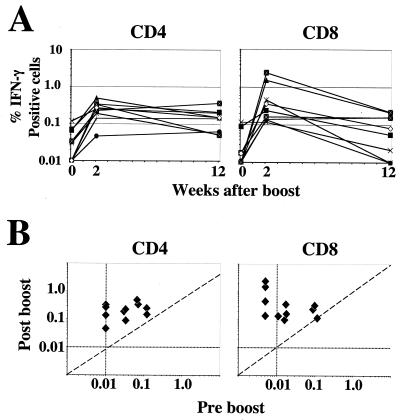
The currently used smallpox vaccine is associated with a high incidence of adverse events, and there is a serious need for a safe and effective alternative vaccine. Here, we carried out a longitudinal evaluation of vaccinia virus-specific CD4 and CD8 T cells in smallpox-vaccinated individuals by using a highly sensitive intracellular cytokine staining assay. Our results demonstrate that, in addition to the CD8 response, the smallpox vaccinations raised a robust CD4 response with a Th1-dominant cytokine profile. These CD4 T cells were stable and exhibited only a twofold contraction between peak effector and memory phases compared with an approximate sevenfold contraction for CD8 cells. A significant proportion of vaccinated individuals lost detectable CD8 memory while maintaining CD4 memory. After a booster immunization, these individuals generated a robust CD8 response, which some of them rapidly lost. Thus, the current smallpox vaccine provides long-lasting CD4 help that may be critical for long-lived B-cell memory. We suggest that the provision of adequate CD4 help for CD8 and humoral effector functions will be critical to the success of the next generation of smallpox vaccines.
Figures
References
-
- Amara, R. R., F. Villinger, J. D. Altman, S. L. Lydy, S. P. O'Neil, S. Staprans, D. C. Montefiori, Y. Xu, J. G. Herndon, L. S. Wyatt, M. A. Candido, N. L. Kozyr, P. L. Earl, J. M. Smith, H.-L. Ma, B. D. Grimm, M. L. Hulsey, J. Miller, H. M. McClure, J. M. McNicholl, B. Moss, and H. L. Robinson. 2001. Control of a mucosal challenge and prevention of AIDS by a multiprotein DNA/MVA vaccine. Science 292:69-74. - PubMed
-
- Belyakov, I. M., P. Earl, A. Dzutsev, V. A. Kuznetsov, M. Lemon, L. S. Wyatt, J. T. Snyder, J. D. Ahlers, G. Franchini, B. Moss, and J. A. Berzofsky. 2003. Shared modes of protection against poxvirus infection by attenuated and conventional smallpox vaccine viruses. Proc. Natl. Acad. Sci. USA 100:9458-9463. - PMC - PubMed
-
- Bourgeois, C., H. Veiga-Fernandes, A. M. Joret, B. Rocha, and C. Tanchot. 2002. CD8 lethargy in the absence of CD4 help. Eur. J. Immunol. 32:2199-2207. - PubMed
-
- Crotty, S., E. N. Kersh, J. Cannons, P. L. Schwartzberg, and R. Ahmed. 2003. SAP is required for generating long-term humoral immunity. Nature 421:282-287. - PubMed
Publication types
MeSH terms
Substances
Grants and funding
LinkOut - more resources
Full Text Sources
Other Literature Sources
Medical
Research Materials
