Comparative Study
. 2004 Apr;78(8):4134-44.
doi: 10.1128/jvi.78.8.4134-4144.2004.

The differential sensitivity of human and rhesus macaque CCR5 to small-molecule inhibitors of human immunodeficiency virus type 1 entry is explained by a single amino acid difference and suggests a mechanism of action for these inhibitors

Affiliations
Comparative Study

The differential sensitivity of human and rhesus macaque CCR5 to small-molecule inhibitors of human immunodeficiency virus type 1 entry is explained by a single amino acid difference and suggests a mechanism of action for these inhibitors

Erika Billick et al. J Virol. 2004 Apr.

Abstract

AD101 and SCH-C are two chemically related small molecules that inhibit the entry of human immunodeficiency virus type 1 (HIV-1) via human CCR5. AD101 also inhibits HIV-1 entry via rhesus macaque CCR5, but SCH-C does not. Among the eight residues that differ between the human and macaque versions of the coreceptor, only one, methionine-198, accounts for the insensitivity of macaque CCR5 to inhibition by SCH-C. Thus, the macaque coreceptor engineered to contain the natural human CCR5 residue (isoleucine) at position 198 is sensitive to HIV-1 entry inhibition by SCH-C, whereas a human CCR5 mutant containing the corresponding macaque residue (methionine) is resistant. Position 198 is in CCR5 transmembrane (TM) helix 5 and is not located within the previously defined binding site for AD101 and SCH-C, which involves residues in TM helices 1, 2, 3, and 7. SCH-C binds to human CCR5 whether residue 198 is isoleucine or methionine, and it also binds to macaque CCR5. However, the binding of a conformation-dependent monoclonal antibody to human CCR5 is inhibited by SCH-C only when residue 198 is isoleucine. These observations, taken together, suggest that the antiviral effects of SCH-C and AD101 involve stabilization, or induction, of a CCR5 conformation that is not compatible with HIV-1 infection. However, SCH-C is unable to exert this effect on CCR5 conformation when residue 198 is methionine. The region of CCR5 near residue 198 has, therefore, an important influence on the conformational state of this receptor.


Figures
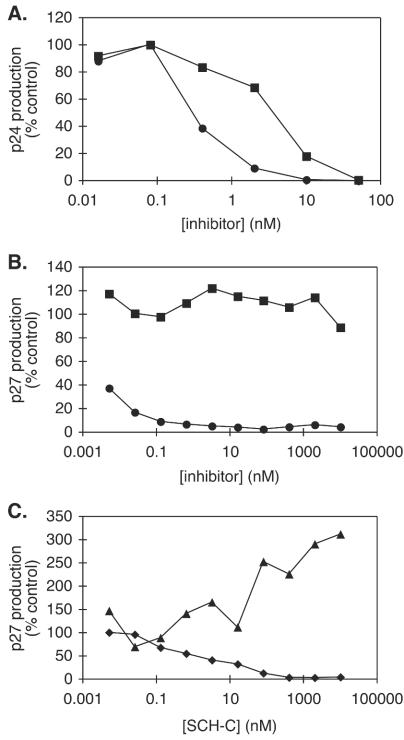
FIG. 1.
FIG. 1.
Inhibitory activities of SCH-C and AD101 with human or rhesus macaque PBMC. SCH-C or AD101 was added at the concentrations indicated to mitogen-activated PBMC in the presence of virus. (A) Inhibition of replication of HIV-1 JR-FL in human PBMC by AD101 (circles) and SCH-C (squares). (B) Inhibition of replication of SIVmac251 in macaque PBMC by AD101 (circles) and SCH-C (squares). (C) Inhibition of SHIV-162P4 replication by SCH-C in human PBMC (diamonds) and macaque PBMC (triangles). Results shown are from one representative experiment. All data were normalized to the amount of p27 or p24 produced in the absence of inhibitor (defined as 100%) and are shown as percent virus replication. Similar results were obtained by using PBMC from a minimum of two different macaque and human donors.
FIG. 2.
FIG. 2.
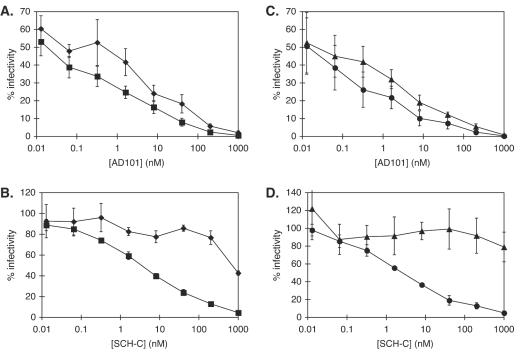
Inhibitory activities of SCH-C and AD101 in an Env pseudotype assay of HIV-1 entry. SCH-C or AD101 was added at the concentrations indicated to U87MG-CD4 cells that transiently expressed CCR5 or a CCR5 mutant. The entry of HIVJR-FL Env pseudotypes was then measured in the transfected cells. Shown is inhibition by AD101 (A and C) and SCH-C (B and D) of entry into cells expressing hu-CCR5 (squares), rh-CCR5 (diamonds), hu-CCR5(I198M) (triangles), or rh-CCR5(M198I) (circles). Data were normalized to the amount of luciferase expressed in the absence of inhibitor and are shown as percent luciferase activity. Error bars, standard errors of the means for values derived from three to five independent experiments.
FIG. 3.
FIG. 3.
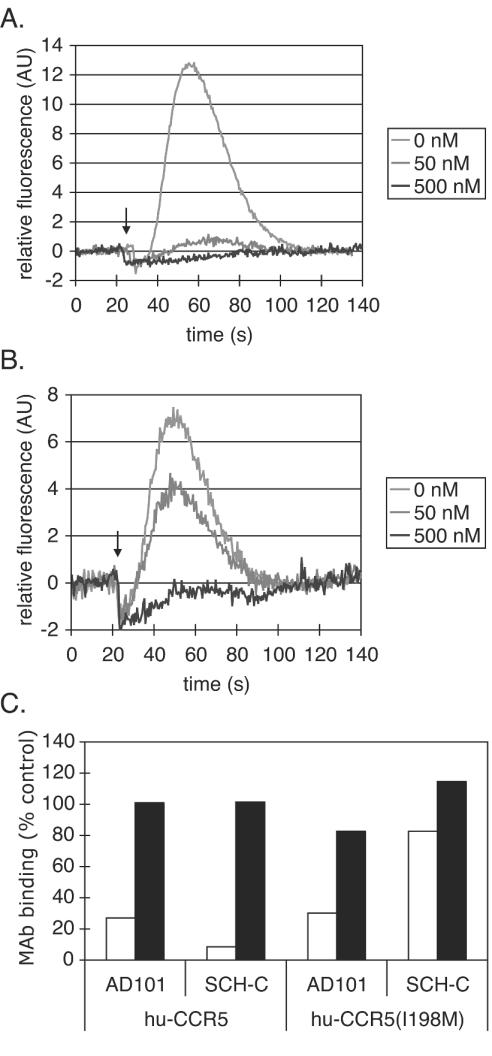
SCH-C inhibition of RANTES signaling via CCR5 and MAb binding to CCR5. (A and B) Calcium mobilization in response to RANTES in 293T cells transfected with hu-CCR5 (A) or hu-CCR5(I198M) (B). RANTES (34 nM) was added 5 min after the indicated concentration of SCH-C. The recordings begin ∼25 s before RANTES addition (indicated by the arrow). Signals are expressed as a percentage of the response induced by carbachol (1 μM) in the same cells and have been corrected for baseline signals. Results of one representative experiment are shown. (C) Binding of MAb 45523 (open bars) or MAb 2D7 (solid bars) to 293T cells transfected with the CCR5 expression construct indicated in the presence or absence of AD101 (100 nM) or SCH-C (1 μM). MAb binding is expressed as a percentage of that occurring in the absence of an inhibitor (defined as 100% binding). Data shown were derived from a single representative experiment.
FIG. 4.
FIG. 4.
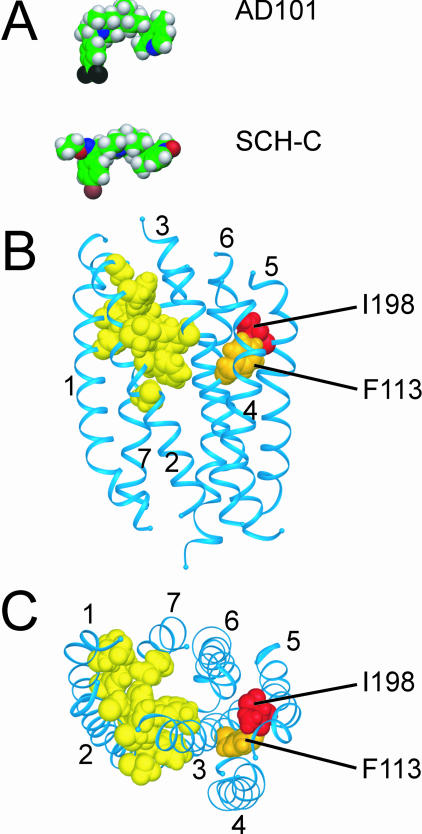
Structural model of the TM domain of CCR5 with energy-minimized structures of AD101 and SCH-C. (A) Energy-minimized structures of AD101 and SCH-C were calculated by using the PM3 semiempirical method of the HyperChem software (Hypercube, Inc.) (63) and are depicted in space-filling representation. Atoms are color-coded: carbon, green; oxygen, red; nitrogen, blue; hydrogen, grey; bromine, brown; fluorine, black. (B) Structural model of the TM domain of CCR5 viewed from within the plane of the membrane. The extracellular surface is oriented toward the top of the figure; the cytoplasmic surface is oriented toward the bottom. The seven α-helical TM segments are depicted as blue ribbons. Amino acid side chains of residues involved in the interaction of CCR5 with AD101 and/or SCH-C are shown in space-filling representation. Red, residue I198; orange, F113; yellow, L33, Y37, D76, F79, W86, V83, A90, Y108, E283, and G286. (C) View of the CCR5 model from the extracellular side of the membrane after rotation of the model by approximately 90° out of the paper plane from the orientation shown in panel B. Labeling and color-coding are the same as for panel B. The CCR5 model is based on homology with rhodopsin by using the crystal structure of bovine rhodopsin as a template (63). Models in all panels are shown at the same scale.
FIG. 5.
FIG. 5.
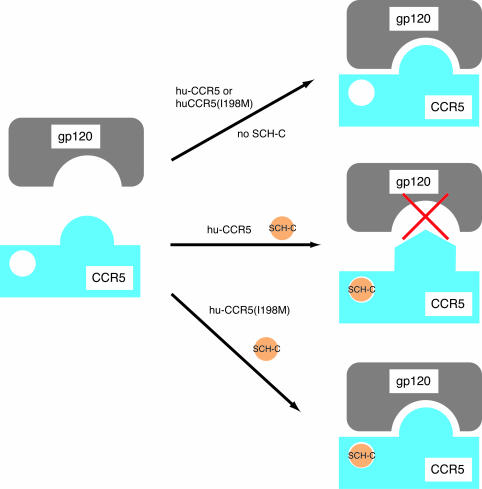
Model for the mechanism of action of the I198M substitution on SCH-C inhibition of HIV-1 infection. Orange circle, SCH-C; grey, gp120; blue, CCR5. The interaction between gp120 and CCR5 is shown in a simple, one-site form, with no intent to identify any individual gp120 domain(s) that might be involved in the overall interaction. (Top) hu-CCR5 or hu-CCR5(I198M) in the absence of SCH-C adopts a conformation permissive for gp120 binding, as indicated by the fit between gp120 and the extracellular regions of CCR5. (Center) Binding of SCH-C to hu-CCR5 stabilizes a conformation of CCR5 that does not productively interact with gp120, as represented by the change in the shape of the extracellular regions of CCR5 and the red “X” indicating that productive interaction does not occur. (Bottom) SCH-C binds to the mutant CCR5 as in the center scenario, but it does not alter the conformation of the extracellular regions so as to block infection.

References

    1. Ansari-Lari, M. A., X. M. Liu, M. L. Metzker, A. R. Rut, and R. A. Gibbs. 1997. The extent of genetic variation in the CCR5 gene. Nat. Genet. 16:221-222. - PubMed
    1. Baba, M., O. Nishimura, N. Kanzaki, M. Okamoto, H. Sawada, Y. Iizawa, M. Shiraishi, Y. Aramaki, K. Okonogi, Y. Ogawa, K. Meguro, and M. Fujino. 1999. A small-molecule, nonpeptide CCR5 antagonist with highly potent and selective anti-HIV-1 activity. Proc. Natl. Acad. Sci. USA 96:5698-5703. - PMC - PubMed
    1. Blanpain, C., B. J. Doranz, A. Bondue, C. Govaerts, A. De Leener, G. Vassart, R. W. Doms, A. Proudfoot, and M. Parmentier. 2003. The core domain of chemokines binds CCR5 extracellular domains while their amino terminus interacts with the transmembrane helix bundle. J. Biol. Chem. 278:5179-5187. - PubMed
    1. Blanpain, C., B. Lee, M. Tackoen, B. Puffer, A. Boom, F. Libert, M. Sharron, V. Wittamer, G. Vassart, R. W. Doms, and M. Parmentier. 2000. Multiple nonfunctional alleles of CCR5 are frequent in various human populations. Blood 96:1638-1645. - PubMed
    1. Carrington, M., M. Dean, M. P. Martin, and S. J. O'Brien. 1999. Genetics of HIV-1 infection: chemokine receptor CCR5 polymorphism and its consequences. Hum. Mol. Genet. 8:1939-1945. - PubMed

Publication types

MeSH terms

LinkOut - more resources