. 2004 Apr;78(8):4145-55.
doi: 10.1128/jvi.78.8.4145-4155.2004.

Specific and common alterations in host gene transcript accumulation following infection of the chestnut blight fungus by mild and severe hypoviruses

Affiliations

Specific and common alterations in host gene transcript accumulation following infection of the chestnut blight fungus by mild and severe hypoviruses

Todd D Allen et al. J Virol. 2004 Apr.

Abstract

We report the use of a cDNA microarray to monitor global transcriptional responses of the chestnut blight fungus, Cryphonectria parasitica, to infection by mild and severe isolates of virulence-attenuating hypoviruses that share 87 to 93% and 90 to 98% identity at the nucleotide and amino acid levels, respectively. Infection by the mild hypovirus isolate CHV1-Euro7 resulted in differential expression of 166 of the ca. 2,200 genes represented on the microarray (90 upregulated and 76 downregulated). This is roughly half the number of genes scored as differentially expressed after infection by the severe isolate, CHV1-EP713 (295 genes; 132 upregulated and 163 downregulated). Comparison of the lists of genes responsive to infection by the two hypovirus isolates revealed 80 virus-common responsive genes. Infection by CHV1-EP713 also caused changes in gene transcript accumulation that were, in general, of greater magnitude than those observed with CHV1-Euro7 infections. Thus, the host transcriptional response to infection by severe hypovirus CHV1-EP713 appears to be considerably more dynamic than the response to infection by the mild isolate CHV1-Euro7. Real-time reverse transcription-PCR was performed on 39 different clones, with false-positive rates of 3 and 8% observed for the microarray-predicted list of genes responsive to CHV1-EP713 and CHV1-Euro7 infections, respectively. This analysis has allowed an initial assignment for ca. 2,200 unique C. parasitica-expressed genes as being unresponsive to hypovirus infection, selectively responsive to a specific hypovirus, or generally responsive to hypovirus infection.


Figures
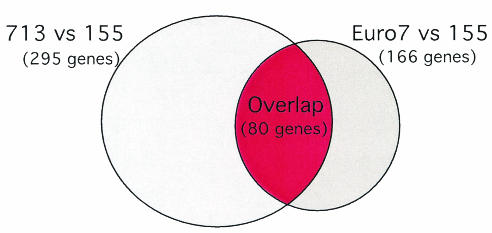
FIG. 1.
FIG. 1.
Venn diagram illustrating the total number of differentially expressed genes identified in hybridizations between EP155/CHV1-EP713 versus EP155 (1) and EP155/CHV1-Euro7 versus EP155 (the present study). A total of 80 genes were found on both lists of differentially expressed clones, and these genes are described in Table 1.
FIG. 2.
FIG. 2.
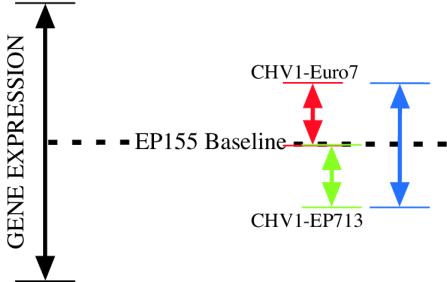
Illustration of the differences predicted in the list of differentially regulated genes generated from EP155/CHV1-EP713 versus EP155/CHV1-Euro7 hybridizations from those lists generated from EP155/CHV1-EP713 versus EP155 and EP155/CHV1-Euro7 versus EP155 hybridizations. The length of each colored arrow represents transcript abundance measurements of various magnitude relative to virus-free EP155. The red and green arrows represent transcript changes too small to be reliably detected by microarray profiling for EP155/CHV1-Euro7 versus EP155 and EP155/CHV1-EP713 versus EP155 hybridizations, respectively. The blue arrow represents the same transcript that can be reliably detected by microarray profiling for EP155/CHV1-EP713 versus EP155/CHV1-Euro7 hybridizations. Clones identified in this manner include clones [35], [23], and [12] highlighted in Fig. 3 and Table 3.
FIG. 3.
FIG. 3.
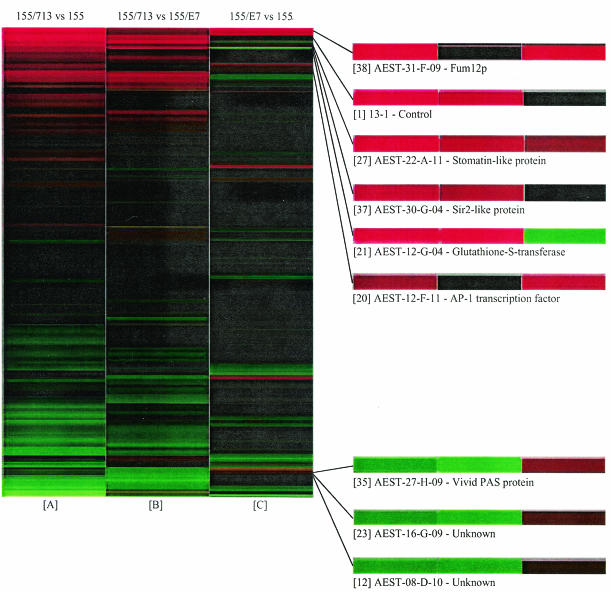
Visual representation of hierarchically clustered hybridization data sorted according to similarities in gene expression patterns. Column A represents the average log2 (cy3/cy5) ratio for each cDNA clone measured in six hybridizations of EP155/CHV1-EP713 versus EP155. Column B represents the average log2 (cy3/cy5) ratio for each cDNA clone measured in five hybridizations of EP155/CHV1-EP713 versus EP155/CHV1-Euro7. Column C represents the average log2 (cy3/cy5) ratio for each cDNA clone measured in six hybridizations of EP155/CHV1-Euro7 versus EP155. In columns A and C, red lines indicate an increase in transcript abundance in hypovirus-infected strains relative to virus-free EP155. Green lines indicate a decrease in transcript accumulation. In column B, red lines indicate an increase in transcript abundance in EP155/CHV1-EP713 relative to EP155/CHV1-Euro7. Green lines indicate a decrease. In all columns, black lines indicate no significant change in transcript accumulation between biological samples. Clones of interest are highlighted to the right of the cluster diagram. Each clone is preceded by a number in brackets, which refers the reader to the real-time RT-PCR data in Table 3.
FIG. 4.
FIG. 4.
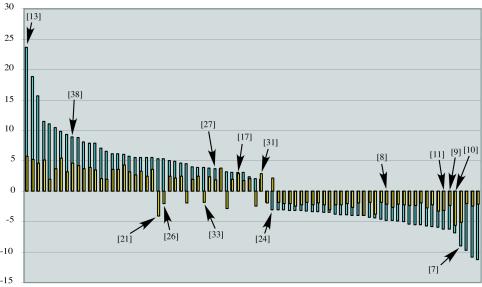
Graphical representation of the relative magnitudes of microarray-predicted changes in transcript accumulation for the 80 identified virus-common C. parasitica-responsive genes (from Table 1). Blue-shaded bars indicate the magnitude of transcript accumulation change following CHV1-EP713 infection (fold change [y axis]), whereas the magnitude of change for the same genes after CHV1-Euro7 infection is indicated by the yellow-shaded bars. Specific genes tested by real-time RT-PCR are indicated by bracketed numbers that refer the reader to data listed in Table 3.

References

    1. Allen, T. D., A. L. Dawe, and D. L. Nuss. 2003. Use of cDNA microarrays to monitor transcriptional responses of the chestnut blight fungus Cryphonetria parasitica to infection by virulence-attenuating hypoviruses. Eukaryot. Cell 2:1253-1265. - PMC - PubMed
    1. Anagnostakis, S. L. 1982. Biological control of chestnut blight. Science 215:466-471. - PubMed
    1. Chen, B., S. Gao, G. H. Choi, and D. L. Nuss. 1996. Extensive alteration of fungal gene transcript accumulation and elevation of G-protein-regulated cAMP levels by a virulence-attenuating hypovirus. Proc. Natl. Acad. Sci. USA 93:7996-8000. - PMC - PubMed
    1. Chen, B., and D. L. Nuss. 1999. Infectious cDNA clone of hypovirus CHV1-Euro7: a comparative virology approach to investigate virus-mediated hypovirulence of the chestnut blight fungus Cryphonectria parasitica. J. Virol. 73:985-992. - PMC - PubMed
    1. Choi, G. H., and D. L. Nuss. 1992. Hypovirulence of chestnut blight fungus conferred by an infectious viral cDNA. Science 257:800-803. - PubMed

Publication types

LinkOut - more resources