. 2004 Apr;134(4):1683-96.
doi: 10.1104/pp.103.033431. Epub 2004 Mar 26.

When defense pathways collide. The response of Arabidopsis to a combination of drought and heat stress

Affiliations

When defense pathways collide. The response of Arabidopsis to a combination of drought and heat stress

Ludmila Rizhsky et al. Plant Physiol. 2004 Apr.

Abstract

Within their natural habitat, plants are subjected to a combination of abiotic conditions that include stresses such as drought and heat. Drought and heat stress have been extensively studied; however, little is known about how their combination impacts plants. The response of Arabidopsis plants to a combination of drought and heat stress was found to be distinct from that of plants subjected to drought or heat stress. Transcriptome analysis of Arabidopsis plants subjected to a combination of drought and heat stress revealed a new pattern of defense response in plants that includes a partial combination of two multigene defense pathways (i.e. drought and heat stress), as well as 454 transcripts that are specifically expressed in plants during a combination of drought and heat stress. Metabolic profiling of plants subjected to drought, heat stress, or a combination of drought and heat stress revealed that plants subject to a combination of drought and heat stress accumulated sucrose and other sugars such as maltose and glucose. In contrast, Pro that accumulated in plants subjected to drought did not accumulate in plants during a combination of drought and heat stress. Heat stress was found to ameliorate the toxicity of Pro to cells, suggesting that during a combination of drought and heat stress sucrose replaces Pro in plants as the major osmoprotectant. Our results highlight the plasticity of the plant genome and demonstrate its ability to respond to complex environmental conditions that occur in the field.


Figures
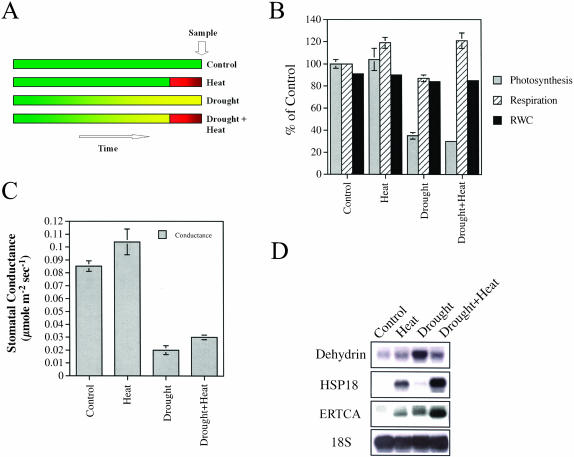
Figure 1.
Figure 1.
Physiological and molecular characterization of Arabidopsis plants subjected to a combination of drought and heat stress. Plants were subjected to heat stress, drought, or a combination of heat stress and drought, as described in “Materials and Methods.” Results are presented as mean and standard deviation of three individual measurements. A, The experimental design for applying a combination of drought and heat stress to Arabidopsis. This design attempts to mimic the conditions that occur in the field in which a relatively prolonged period of drought (yellow) is accompanied by a brief period of heat stress (red; usually during midday to early afternoon). B, Photosynthetic activity and dark respiration, measured with a Li-Cor LI-6400 apparatus. C, Stomatal conductance, measured with a Li-Cor LI-6400 apparatus. D, Steady-state level of stress-response transcripts, measured by RNA gel blots. Ribosomal RNA (18S) was used to control for equal loading of RNA.
Figure 2.
Figure 2.
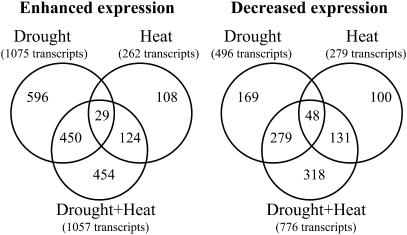
Venn diagrams showing the number of transcripts enhanced (left) or decreased (right) in plants in response to drought, heat stress, or a combination of drought and heat stress (compared to control nonstressed plants). Only transcripts with an increase or decrease in steady-state level of 1.5-fold (log2) over control unstressed plants are included. Results are presented as average of three independent experiments. RNA isolation and Affymetrix chip analysis were performed as described in “Materials and Methods.”
Figure 3.
Figure 3.
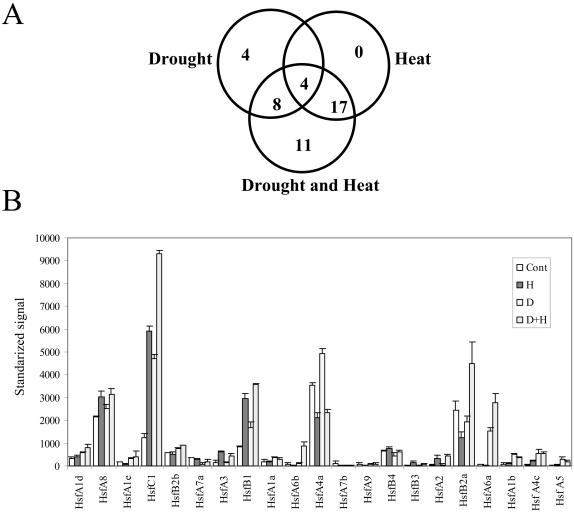
Steady-state transcript level of Arabidopsis transcripts encoding HSPs and HSFs in leaves of plants subjected to drought, heat stress, or a combination of drought and heat stress. Results are presented as average of three independent experiments. A, A Venn diagram showing the number of HSPs elevated during drought, heat stress, or a combination of drought and heat stress (cutoff 1.5-fold log2). B, Expression level of all Arabidopsis HSFs during drought, heat stress, and a combination of drought and heat stress. RNA isolation and Affymetrix chip analysis were performed as described in “Materials and Methods.” Cont, Control; D, drought; H, heat stress; D+H, a combination of drought and heat stress.
Figure 4.
Figure 4.
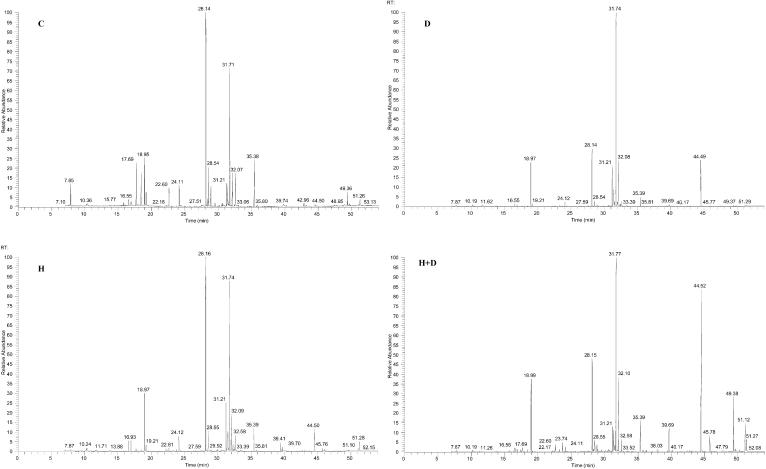
GC profiles of polar extracts obtained from control plants and plants subjected to heat stress, drought, or a combination of drought and heat stress. C, Control; D, drought; H, heat stress; D+H, a combination of drought and heat stress. Polar compound extraction and GC separation are described in “Materials and Methods.”
Figure 5.
Figure 5.
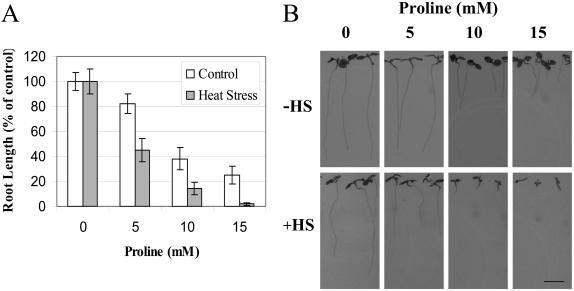
Amelioration of Pro toxicity during heat stress. A, Measurements of root length taken 48 h post a heat stress treatment of seedlings in the presence or absence of Pro. B, Photographs of Arabidopsis seedlings taken 96 h post a heat stress treatment of seedlings in the presence or absence of Pro; the bar in the lower right represents 4 mm. All measurements were performed as described in “Materials and Methods.”

References

    1. Apse MP, Blumwald E (2002) Engineering salt tolerance in plants. Curr Opin Biotechnol 13: 146–150 - PubMed
    1. Arabidopsis Genome Initiative (2000) Analysis of the genome sequence of the flowering plant Arabidopsis thaliana. Nature 408: 796–815 - PubMed
    1. Bohnert HJ (2000) What makes desiccation tolerable? Genome Biol 1: 1010.1–1010.4 - PMC - PubMed
    1. Chen W, Provart NJ, Glazebrook J, Katagiri F, Chang HS, Eulgem T, Mauch F, Luan S, Zou G, Whitham SA, et al. (2002) Expression profile matrix of Arabidopsis transcription factor genes suggests their putative functions in response to environmental stresses. Plant Cell 14: 559–574 - PMC - PubMed
    1. Craufurd PQ, Peacock JM (1993) Effect of heat and drought stress on sorghum. Exp Agr 29: 77–86

Publication types