. 2004 Apr 6;101(14):4984-9.
doi: 10.1073/pnas.0306802101. Epub 2004 Mar 29.

Germ-line expression of an oncogenic erbB2 allele confers resistance to erbB2-induced mammary tumorigenesis

Affiliations

Germ-line expression of an oncogenic erbB2 allele confers resistance to erbB2-induced mammary tumorigenesis

Eran R Andrechek et al. Proc Natl Acad Sci U S A. .

Abstract

We have previously shown that mammary epithelial specific expression of the activated erbB2 allele under the control of the endogenous promoter in mice resulted in the formation of mammary adenocarcinomas. To assess whether mammary tumorigenesis in this model is influenced by the developmental window of expression, we generated mice that expressed the activated erbB2 allele in the germ line. Although we were able to derive viable transgenic mice that were heterozygous for the activated erbB2 allele, mice homozygous for the activated erbB2 allele died at 12.5 days of embryogenesis. These two separate lines of mice expressed activated erbB2 at equal levels in the mammary gland. Surprisingly, unlike the tumor-prone mice expressing activated ErbB2 in the mammary epithelium, mice with the germ-line erbB2 allele failed to develop tumors. Gene expression analysis of the preneoplastic mammary glands revealed that there were a number of luminal epithelial markers expressed at higher levels in the tumor-prone mice. These data suggest either an expansion of a susceptible population in the tumor-prone mice or the loss of this population in the tumor-resistant mice. Taken together, these observations suggest that the temporal pattern of expression of activated ErbB2 is a critical determinant in mammary tumorigenesis. These results strongly suggest that there are feedback mechanisms present that can compensate for the expression of a potent oncogene.


Figures
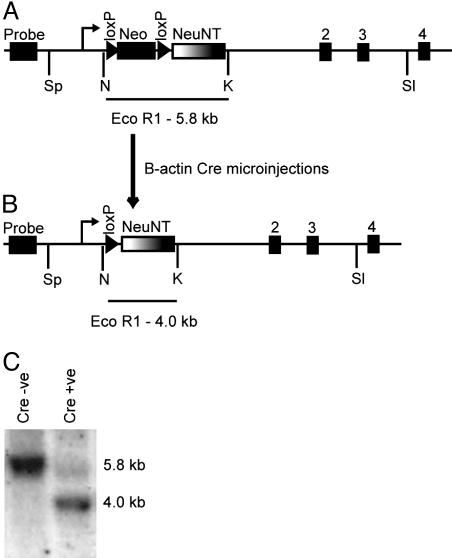
Fig. 1.
Fig. 1.
Generation of mice expressing NeuNT under the control of the endogenous promoter in the germ line. To create mice expressing the activated erbBB2 allele under the control of the endogenous promoter, mice containing a loxP neomycin loxP NeuNT sequence in place of exon 1 of the endogenous erbB2 allele (A) were interbred (12). The single-cell embryos from this cross were then microinjected with a circular β-actin Cre plasmid to excise the loxP flanked sequence resulting in the germ-line NeuNT allele (ErbB2WT/NT) (B). The excision of the neomycin cassette can be detected through a shift in size of the EcoR1 fragment detected in a Southern analysis using the activated erbB2 cDNA as a probe (C). Without the addition of Cre recombinase, there is a single band at 5.8 kb. However, after Cre-mediated excision, this band shifts to 4.0 kb, placing the activated erbB2 cDNA under the control of the endogenous promoter.
Fig. 2.
Fig. 2.
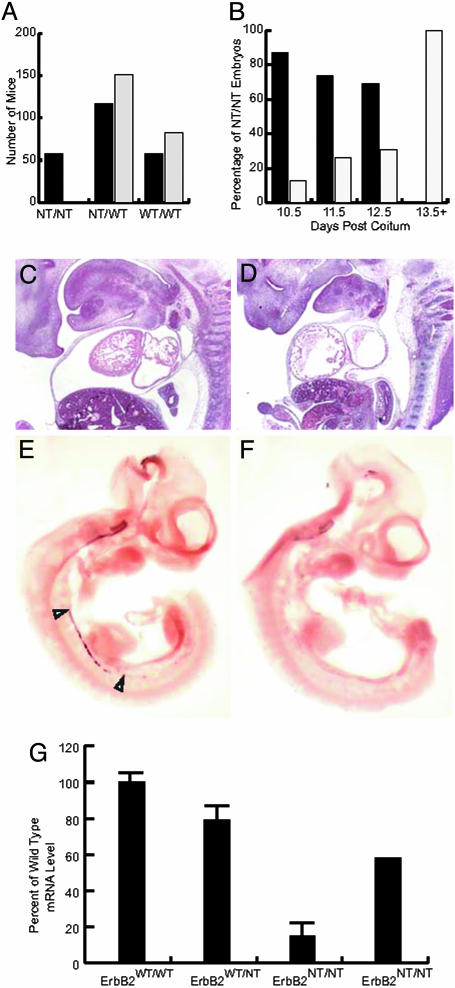
Embryonic lethality in ErbB2NT/NT mice at 12.5 dpc due to cardiac and neural defects. After interbreeding ErbB2WT/NT mice, the progeny were geno-typed, and the expected number of each genotype is shown with black bars. The observed genotypes are shown (gray bars), indicating that no viable ErbB2NT/NT mice were detected (A). On genotyping embryos from timed matings, we noted that no viable ErbB2NT/NT embryos were observed after 12.5 dpc. Examining only the ErbB2NT/NT genotype, the percentage of viable and dead or dying embryos is shown. The percentage of viable ErbB2NT/NT embryos (black bars) and the number of ErbB2NT/NT embryos that showed signs of being resorbed (gray bars) are shown from 10.5 to 13.5 dpc (B)(n = 58). Sections of the ErbB2WT/NT (C) and ErbB2NT/NT (D) embryos were examined at 12.5 dpc and illustrated that there was a defect in cardiac trabeculation in the ErbB2NT/NT embryos (D). Moreover, when the sympathetic chain ganglia was examined through a phox2a in situ analysis, it was clear that the heterozygous control was developing normally (E), whereas the ErbB2NT/NT embryos lacked proper development (F). The level of expression of the erbB2 transcript was examined in 10.5-dpc embryos through a quantitative RT-PCR analysis (G). When compared against the ErbB2WT/WT control, it was observed that the level of both ErbB2WT/NT and ErB2NT/NT transcript was reduced. Moreover, when the wild-type and heterozygous embryos were compared, an expected transcript level for the ErbB2NT/NT was generated that was far higher than the observed levels. Error bars denote standard deviation measured on four samples per genotype repeated three times and standardized to a GAPDH control.
Fig. 3.
Fig. 3.
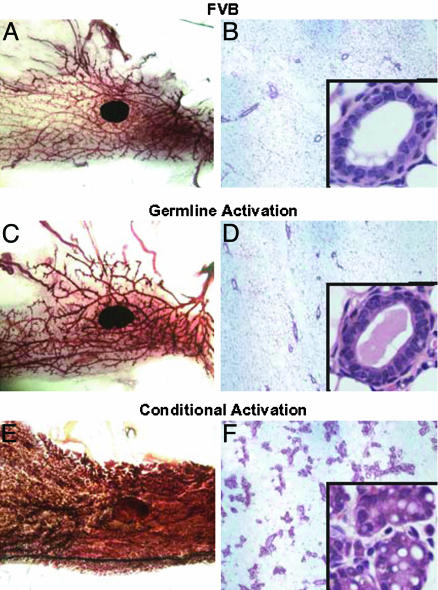
Effect of NeuNT expression on mammary gland development. Mammary glands from adult mice were compared to assess the effect of activated ErbB2 expression under the control of the endogenous promoter through both whole mounts and hematoxylin/eosin-stained histology. Wild-type (A and B), germ-line activation (C and D), and conditional activation (E and F) models were compared in this analysis. The wild-type and germ-line activation mammary glands are similar, whereas the conditional activation of ErbB2 results in a hyperplastic gland. The hematoxylin/eosin-stained sections of these whole mounts reinforce the differences in ductal density between the samples. Higher magnification (Insets) of these sections reveals no striking differences in ductal architecture between the wild-type and germ-line activation, whereas the hyperplasia in the conditional activation is readily observed. Whole-mount photomicrographs were taken at ×1.4, low-magnification histology at ×50, and Insets at ×400.
Fig. 4.
Fig. 4.
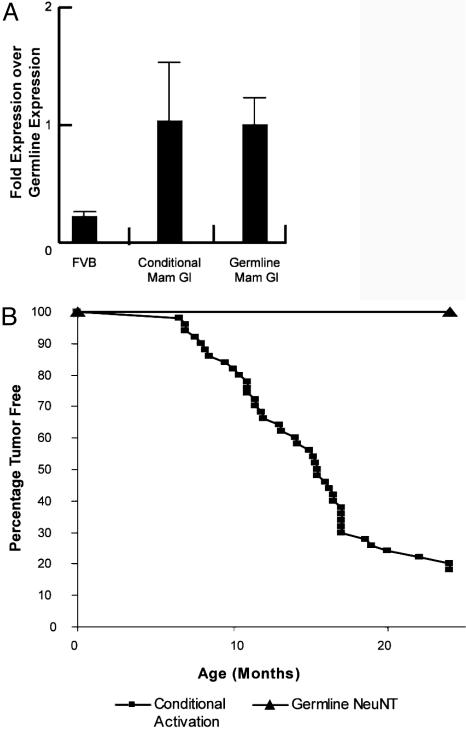
Lack of tumors in ErbB2WT/NT mice. Given the differences in mammary gland morphology between the germ-line and conditional models, the level of erbB2 transcripts were measured by quantitative RT-PCR with primers specific for the activated erbB2 allele. After setting the level of the germ-line expression to 1, it was clear that the conditional and germ-line models expressed the activated erbB2 allele at identical levels (A). Error bars represent standard deviation measured in four samples after repeating the analysis three times and standardizing to GAPDH. To determine whether the ErbB2WT/NT mice were susceptible to tumors, 25 mice were observed for >2 years and remained tumor free in all tissues (B). This is in stark contrast to the conditional model, where the tumor latency is 15.9 months for 50% of female mice.
Fig. 5.
Fig. 5.
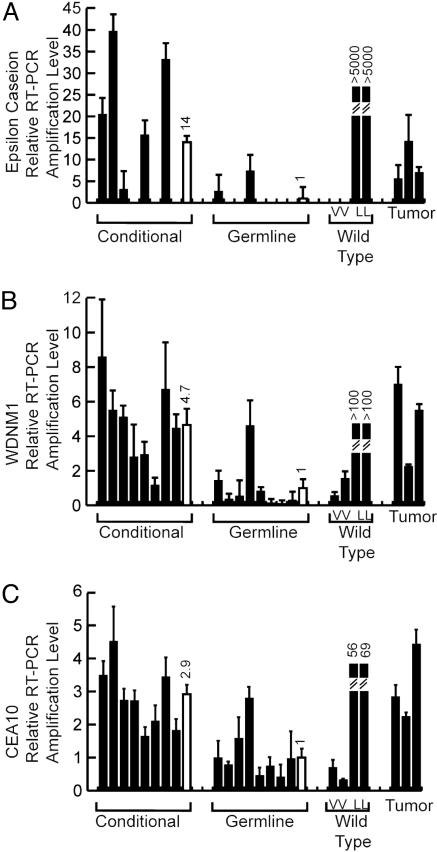
Confirmation of the expression analysis. To confirm the gene expression data, quantitative RT-PCR was performed for three target genes. ε casein (A), WDNM1 (B), and CEA10 (C) were tested for expression, and the results of three repeats standardized to GAPDH are shown for each of eight samples for both the conditional and germ-line expression of the activated erbB2 allele (black bars). The average of these samples is shown with the open bar and is stated above the bar. These data are also compared to the virgin (V) and lactating (L) wild-type controls in addition to the conditional tumor control.

References

    1. Slamon, D. J., Clark, G. M., Wong, S. G., Levin, W. J., Ullrich, A. & McGuire, W. L. (1987) Science 235, 177-182. - PubMed
    1. Slamon, D. J., Godolphin, W., Jones, L. A., Holt, J. A., Wong, S. G., Keith, D. E., Levin, W. J., Stuart, S. G., Udove, J., Ullrich, A. & Press, M. F. (1989) Science 244, 707-712. - PubMed
    1. Dankort, D. L. & Muller, W. J. (2000) Oncogene 19, 1038-1044. - PubMed
    1. Bouchard, L., Lamarre, L., Tremblay, P. J. & Jolicoeur, P. (1989) Cell 57, 931-936. - PubMed
    1. Guy, C. T., Cardiff, R. D. & Muller, W. J. (1996) J. Biol. Chem. 271, 7673-7678. - PubMed

Publication types

LinkOut - more resources