Immunization coverage and Medicaid managed care in New Mexico: a multimethod assessment
- PMID: 15053278
- PMCID: PMC1466632
- DOI: 10.1370/afm.100
Immunization coverage and Medicaid managed care in New Mexico: a multimethod assessment
Abstract
Background: We wanted to examine the association between Medicaid managed care (MMC) and changing immunization coverage in New Mexico, a predominantly rural, poor, and multiethnic state.
Methods: As part of a multimethod assessment of MMC, we studied trends in quantitative data from the National Immunization Survey (NIS) using temporal plots, Fisher's exact test, and the Cochran-Armitage trend test. To help explain changes in immunization rates in relation to MMC, we analyzed qualitative data gathered through ethnographic observations at safety net institutions: income support (welfare) offices, community health centers, hospital emergency departments, private physicians' offices, mental health institutions, managed care organizations, and agencies of state government.
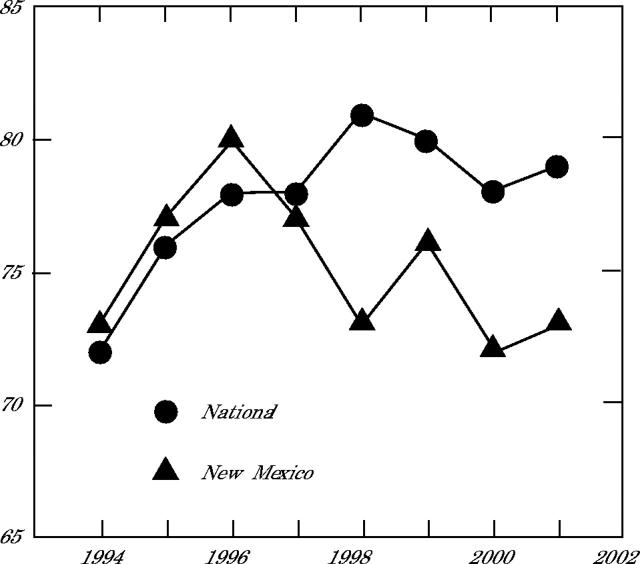
Results: Immunization coverage decreased significantly after implementation of MMC, from 80% in 1996 to 73% in 2001 for the 4:3:1 vaccination series (Fisher's exact test, P = .031). New Mexico dropped in rank among states from 30th for this vaccination series in 1996 to 50th in 2001. A significant decreasing trend (Cochran-Armitage P = .025) in coverage occurred between 1996 and 2001. Findings from the ethnographic study revealed conditions that might have contributed to decreased immunization coverage: (1) reduced funding for immunizations at public health clinics, and difficulties in gaining access to MMC providers; (2) informal referrals from managed care organizations and contracting physicians to community health centers and state-run public health clinics; and (3) increased workloads and delays at community health centers, linked partly to these informal referrals for immunizations.
Conclusions: Medicaid reform in New Mexico did not improve immunization coverage, which declined significantly to among the lowest in the nation. Reduced funding for public health clinics and informal referrals may have contributed to this decline. These observations show how unanticipated and adverse consequences can result from policy interventions in complex insurance systems.
Figures
Comment in
-
Mixed methods studies: a foundation for primary care research.Ann Fam Med. 2004 Jan-Feb;2(1):4-6. doi: 10.1370/afm.111. Ann Fam Med. 2004. PMID: 15053276 Free PMC article. No abstract available.
References
-
- Impact of vaccines universally recommended for children — United States, 1990–1998. MMMR Morb Mortal Wkly Rep. 1999;48:243–248. - PubMed
-
- U.S. Census Bureau. Statistical abstract of the United States: 2001. Washington, DC: Government Printing Office; 2001. Available at: http://www.census.gov/prod/2002pubs/01statab/stat-ab01.html. Accessed December 1, 2002.
-
- Profile of general demographic characteristics. Available at: http://www.edd.state.nm.us/FACTBOOK/WORKFORCE/NMProfile.pdf. Accessed September 1, 2003. New Mexico Human Services Department. Monthly all children eligibility report. Available at: http://www.state.nm.us/hsd/mad/pdf_files/Reports/AllChildDistributionbyC.... Accessed September 1, 2003.
-
- Freed GL, Clark SJ, Cowan AE. State-level perspectives on immunization policies, practices, and program financing in the 1990s. Am J Prev Med. 2000;19:32–44. - PubMed
-
- Vivier PM, Alario AJ, O’Haire C, Dansereau LM, Jakum EB, Peter G. The impact of outreach efforts in reaching underimmunized children in a Medicaid managed care practice. Arch Ped Adol Med. 2000;154: 1243–1247. - PubMed
Publication types
MeSH terms
Grants and funding
LinkOut - more resources
Full Text Sources
Medical