


Human ability to scale and discriminate forces typical of those occurring during grasp and manipulation
- PMID: 15056719
- PMCID: PMC6730021
- DOI: 10.1523/JNEUROSCI.4822-03.2004
Human ability to scale and discriminate forces typical of those occurring during grasp and manipulation
Abstract
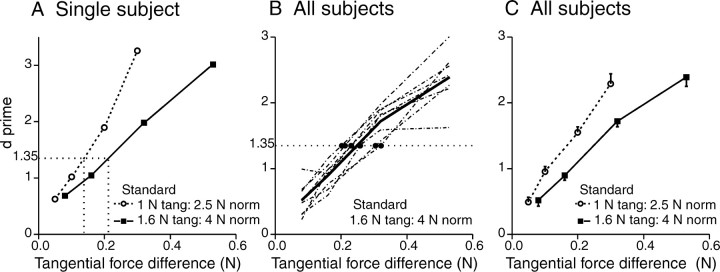
When humans manipulate objects, the sensorimotor system coordinates three-dimensional forces to optimize and maintain grasp stability. To do this, the CNS requires precise information about the magnitude and direction of load force (tangential to skin surface) plus feedback about grip force (normal to skin). Previous studies have shown that there is rapid, precise coordination between grip and load forces that deteriorates with digital nerve block. Obviously, mechanoreceptive afferents innervating fingerpad skin contribute essential information. We quantify human capacity to scale tangential and normal forces using only cutaneous information. Our paradigm simulated natural manipulations (a force tangential to the skin superimposed on an indenting force normal to the skin). Precisely controlled forces were applied by a custom-built stimulator to an immobilized fingerpad. Using magnitude estimation, subjects (n = 8) scaled the magnitude of tangential force (0.25-2.8 N) in two experiments (normal force, 2.5 and 4 N, respectively). Performance was unaffected by normal force magnitude and tangential force direction. Moreover, when both normal (2-4 N) and tangential forces were varied in a randomized-block factorial design, the relationship between applied and perceived tangential force remained near linear, with a minor but statistically significant nonlinearity. Our subjects could also discriminate small differences in tangential force, and this was the case for two different reference stimuli. In both cases, the Weber fraction was 0.16. Finally, scaling functions for magnitude estimates of normal force (1-5 N) were also approximately linear. These data show that the cutaneous afferents provide a wealth of precise information about both normal and tangential force.
Figures


References
-
- Augurelle AS, Smith AM, Lejeune T, Thonnard JL (2003) Importance of cutaneous feedback in maintaining a secure grip during manipulation of hand-held objects. J Neurophysiol 89: 665–671. - PubMed
-
- Bisley JW, Goodwin AW, Wheat HE (2000) Slowly adapting type I afferents from the sides and end of the finger respond to stimuli on the center of the fingerpad. J Neurophysiol 84: 57–64. - PubMed
-
- Cadoret G, Smith AM (1996) Friction, not texture, dictates grip forces used during object manipulation. J Neurophysiol 75: 1963–1969. - PubMed
Publication types
MeSH terms
LinkOut - more resources
Full Text Sources
Other Literature Sources
