


Methamphetamine increases dopamine transporter higher molecular weight complex formation via a dopamine- and hyperthermia-associated mechanism
- PMID: 15056723
- PMCID: PMC6730025
- DOI: 10.1523/JNEUROSCI.0387-04.2004
Methamphetamine increases dopamine transporter higher molecular weight complex formation via a dopamine- and hyperthermia-associated mechanism
Abstract
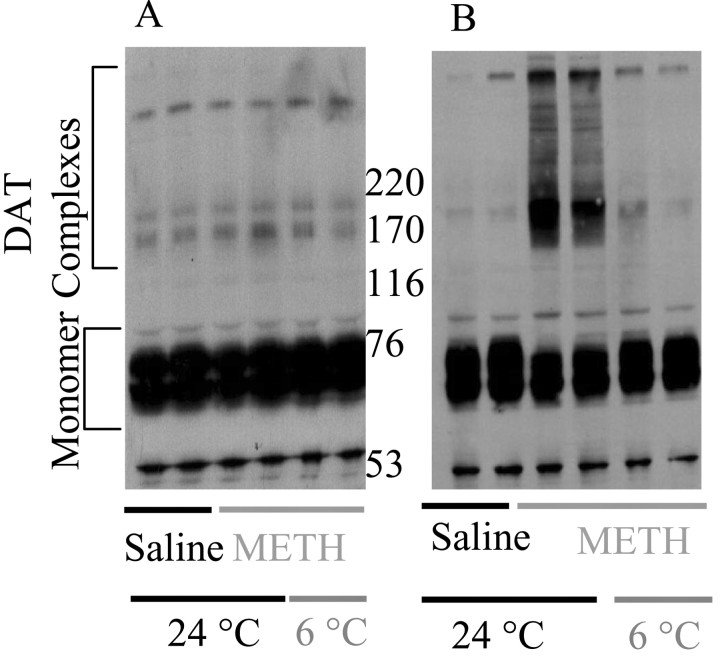
Multiple high-dose administrations of methamphetamine (METH) both rapidly (within hours) decrease plasmalemmal dopamine (DA) uptake and cause long-term deficits in DA transporter (DAT) levels and other dopaminergic parameters persisting weeks to months in rat striatum. In contrast, either a single administration of METH or multiple administrations of methylenedioxymethamphetamine (MDMA) cause less of an acute reduction in DA uptake and little or no persistent dopaminergic deficits. The long-term dopaminergic deficits caused by METH have been suggested, in part, to involve the DAT. Hence, this study assessed the impact of METH and MDMA administration on the DAT protein per se. Results revealed that multiple administrations of METH promoted formation of higher molecular weight (>170 kDa) DAT-associated protein complexes 24-48 hr after treatment. This increase was attenuated by either preventing hyperthermia or pretreatment with the tyrosine hydroxylase inhibitor alpha-methyl-p-tyrosine; notably, each of these manipulations has also been demonstrated previously to prevent the persistent deficits in dopaminergic function caused by METH treatment. In contrast, either a single injection of METH or multiple injections of MDMA caused little or no formation of these DAT complexes. The addition of the reducing agent beta-mercaptoethanol to samples prepared from METH-treated rats diminished the intensity of these complexes. Taken together, these data are the first to demonstrate higher molecular weight DAT complex formation in vivo and that such formation can be altered by both pharmacological and physiological manipulations. The implications of this phenomenon with regard to the neurotoxic potential of these stimulants are discussed.
Figures




References
-
- Albers DS, Sonsalla PK (1995) Methamphetamine-induced hyperthermia and dopaminergic neurotoxicity in mince: pharmacological profile of protective and nonprotective agents. J Pharmacol Exp Ther 275: 1104–1114. - PubMed
-
- Axt KJ, Commins DL, Vosmer G, Seiden LS (1990) Alpha-methyl-p-tyrosine pretreatment partially prevents methamphetamine-induced endogenous neurotoxin formation. Brain Res 515: 269–276. - PubMed
-
- Bakhit C, Gibb JW (1981) Methamphetamine-induced depression of tryptophan hydroxylase: recovery following acute treatment. Eur J Pharmacol 76: 229–233. - PubMed
-
- Battaglia G, Yeh SY, O'Hearn E, Molliver ME, Kuhar MJ, De Souza EB (1987) 3,4-Methylenedioxymethamphetamine and 3,4-methylenedioxyamphetamine destroy serotonin terminals in rat brain: quantification of neurodegeneration by measurement of [3H]paroxetine-labeled serotonin uptake sites. J Pharmacol Exp Ther 242: 911–916. - PubMed
-
- Berger SP, Farrell K, Conant D, Kempner ES, Paul SM (1994) Radiation inactivation studies of the dopamine reuptake transporter protein. Mol Pharmacol 46: 726–731. - PubMed
Publication types
MeSH terms
Substances
Grants and funding
LinkOut - more resources
Full Text Sources
Medical
Molecular Biology Databases
