Automated whole-genome multiple alignment of rat, mouse, and human
- PMID: 15060011
- PMCID: PMC383314
- DOI: 10.1101/gr.2067704
Automated whole-genome multiple alignment of rat, mouse, and human
Abstract
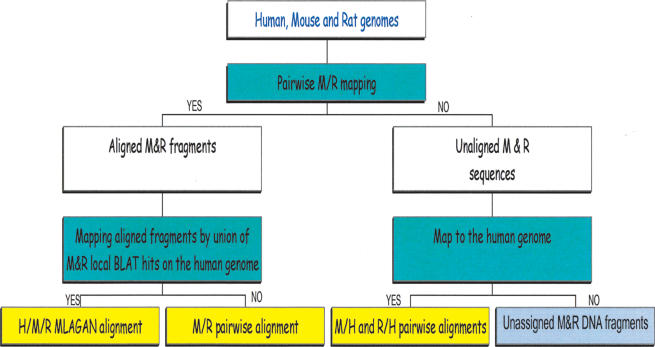
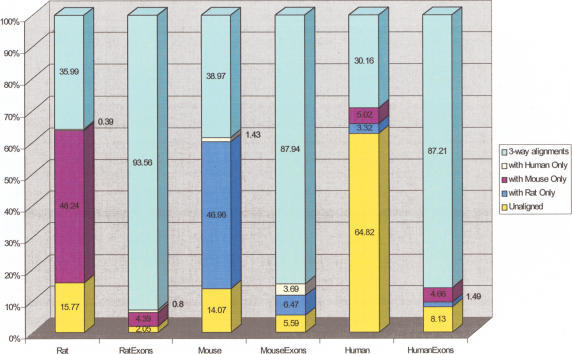
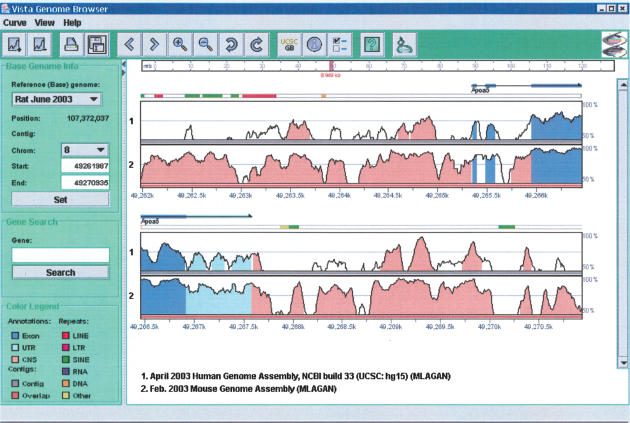
We have built a whole-genome multiple alignment of the three currently available mammalian genomes using a fully automated pipeline that combines the local/global approach of the Berkeley Genome Pipeline and the LAGAN program. The strategy is based on progressive alignment and consists of two main steps: (1) alignment of the mouse and rat genomes, and (2) alignment of human to either the mouse-rat alignments from step 1, or the remaining unaligned mouse and rat sequences. The resulting alignments demonstrate high sensitivity, with 87% of all human gene-coding areas aligned in both mouse and rat. The specificity is also high: <7% of the rat contigs are aligned to multiple places in human, and 97% of all alignments with human sequence >100 kb agree with a three-way synteny map built independently, using predicted exons in the three genomes. At the nucleotide level <1% of the rat nucleotides are mapped to multiple places in the human sequence in the alignment, and 96.5% of human nucleotides within all alignments agree with the synteny map. The alignments are publicly available online, with visualization through the novel Multi-VISTA browser that we also present.
Figures
References
-
- Boffelli, D., McAuliffe, J., Ovcharenko, D., Lewis, K.D., Ovcharenko, I., Pachter, L., and Rubin, E.M. 2003. Phylogenetic shadowing of primate sequences to find functional regions of the human genome. Science 299: 1391-1394. - PubMed
-
- Brudno, M., Malde, S., Poliakov, A., Do, C.B., Couronne, O., Dubchak, I., and Batzoglou, S. 2003b. Glocal alignment: Finding rearrangements during alignment. Bioinformatics 19: 54i-62i. - PubMed
WEB SITE REFERENCES
-
- http://pipeline.lbl.gov/; Comparative analysis pipeline gateway at Lawrence Berkeley National Laboratory.
-
- http://lagan.stanford.edu/; LAGAN Toolkit Web site.
-
- http://genome.ucsc.edu/; University of California, Santa Cruz, Web site from which the human, mouse, and rat genome assemblies used in this study were downloaded.
-
- http://pipeline.lbl.gov/downloads.shtml; Download page for whole genome alignments and other materials.
-
- http://www.softberry.com/berry.phtml?topic=human-mouse-rat; Three-way gene-based synteny.
Publication types
MeSH terms
LinkOut - more resources
Full Text Sources
Other Literature Sources
Research Materials