. 2004 Apr;186(8):2240-52.
doi: 10.1128/JB.186.8.2240-2252.2004.

Transcriptional organization and posttranscriptional regulation of the Bacillus subtilis branched-chain amino acid biosynthesis genes

Affiliations

Transcriptional organization and posttranscriptional regulation of the Bacillus subtilis branched-chain amino acid biosynthesis genes

Ulrike Mäder et al. J Bacteriol. 2004 Apr.

Abstract

In Bacillus subtilis, the genes of the branched-chain amino acids biosynthetic pathway are organized in three genetic loci: the ilvBHC-leuABCD (ilv-leu) operon, ilvA, and ilvD. These genes, as well as ybgE, encoding a branched-chain amino acid aminotransferase, were recently demonstrated to represent direct targets of the global transcriptional regulator CodY. In the present study, the transcriptional organization and posttranscriptional regulation of these genes were analyzed. Whereas ybgE and ilvD are transcribed monocistronically, the ilvA gene forms a bicistronic operon with the downstream located ypmP gene, encoding a protein of unknown function. The ypmP gene is also directly preceded by a promoter sharing the regulatory pattern of the ilvA promoter. The ilv-leu operon revealed complex posttranscriptional regulation: three mRNA species of 8.5, 5.8, and 1.2 kb were detected. Among them, the 8.5-kb full-length primary transcript exhibits the shortest half-life (1.2 min). Endoribonucleolytic cleavage of this transcript generates the 5.8-kb mRNA, which lacks the coding sequences of the first two genes of the operon and is predicted to carry a stem-loop structure at its 5' end. This processing product has a significantly longer half-life (3 min) than the full-length precursor. The most stable transcript (half-life, 7.6 min) is the 1.2-kb mRNA generated by the processing event and exonucleolytic degradation of the large transcripts or partial transcriptional termination. This mRNA, which encompasses exclusively the ilvC coding sequence, is predicted to carry a further stable stem-loop structure at its 3' end. The very different steady-state amounts of mRNA resulting from their different stabilities are also reflected at the protein level: proteome studies revealed that the cellular amount of IlvC protein is 10-fold greater than that of the other proteins encoded by the ilv-leu operon. Therefore, differential segmental stability resulting from mRNA processing ensures the fine-tuning of the expression of the individual genes of the operon.


Figures
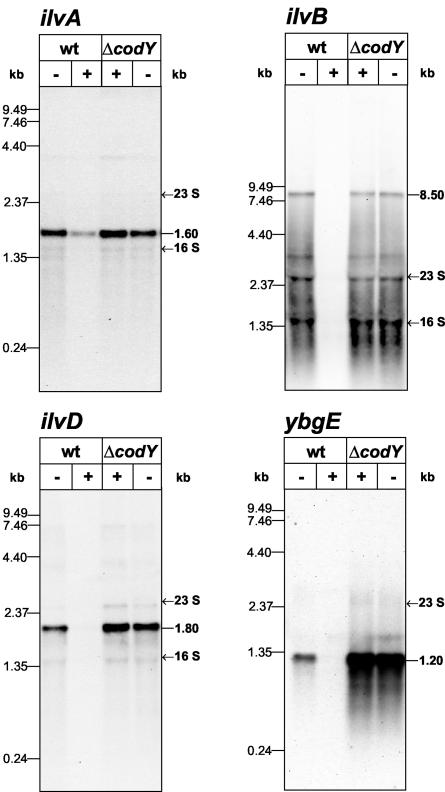
FIG. 1.
FIG. 1.
Northern analysis of ilvA, ilvB, ilvD, and ybgE in PS29 (wt) and PS37 (ΔcodY). RNA was prepared from cells growing exponentially in minimal medium in the presence (+) or absence (−) of CAA (0.2%). Electrophoretic separation of the RNA (5 μg per lane) was performed using 1.2% (ilvA, ilvD, and ybgE) or 0.6% (ilvB) agarose gels.
FIG. 2.
FIG. 2.
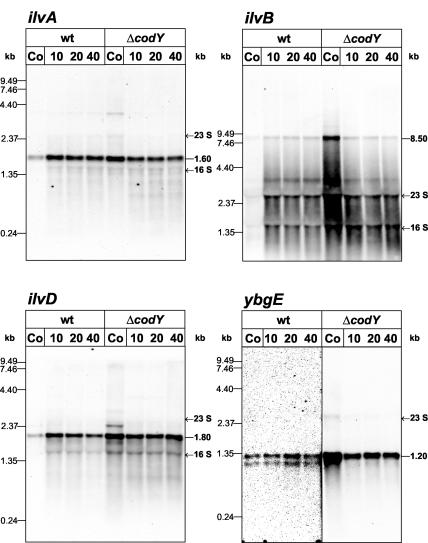
Northern analysis of ilvA, ilvB, ilvD, and ybgE under conditions of GTP depletion. PS29 (wt) and PS37 (ΔcodY) were grown in minimal medium in the presence of CAA (0.2%). After the culture reached an OD500 of 0.5, mycophenolic acid (Sigma) was added to a final concentration of 100 μM. RNA was prepared from cells harvested before (Co [control]) and at the indicated times (10, 20, and 40 min) after the addition of mycophenolic acid. Electrophoretic separation of the RNA (5 μg per lane) was performed using 1.2% (ilvA, ilvD, and ybgE) or 0.6% (ilvB) agarose gels. Note that in the case of the ybgE luminograph, different exposure times for the wild-type and ΔcodY strains were used. Whereas a long exposure time was necessary to detect the wild-type bands, the very strong signals in the ΔcodY strain required a short exposure time to avoid overexposition.
FIG. 3.
FIG. 3.
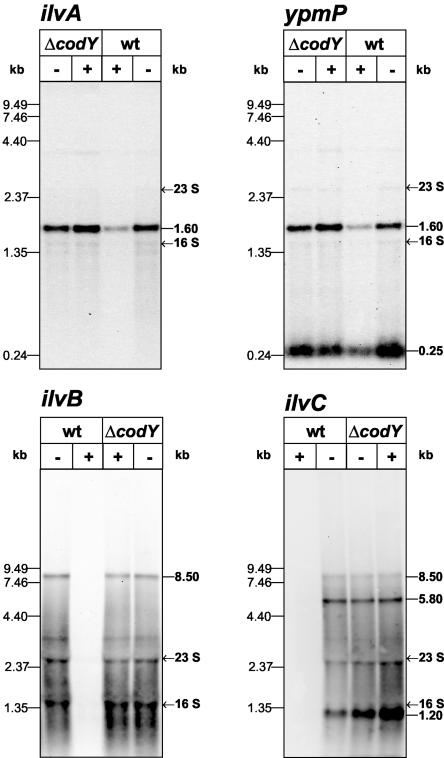
Northern analysis of ilvA, ypmP, ilvB, and ilvC in PS29 (wt) and PS37 (ΔcodY). RNA was prepared from cells growing exponentially in minimal medium in the presence (+) or absence (−) of CAA (0.2%). Electrophoretic separation of the RNA (5 μg per lane) was performed using 1.2% (ilvA and ypmP) or 0.6% (ilvB and ilvC) agarose gels.
FIG. 4.
FIG. 4.
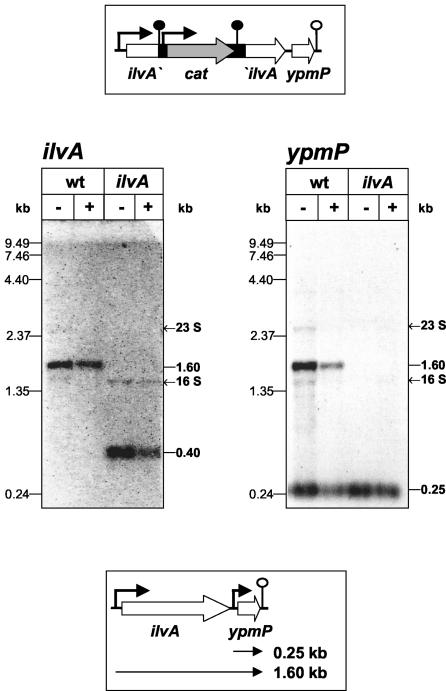
Northern analysis of the ilvA::cat mutant strain UM101. RNA was prepared from UM101 (ilvA) and B. subtilis 168 (wt) growing exponentially in minimal medium supplemented with 1 mM isoleucine in the presence (+) or absence (−) of CAA (0.2%). RNA electrophoresis (5 μg per lane) was performed using 1.2% agarose gels. Hybridization was carried out using ilvA- and ypmP-specific probes. The top drawing shows the chromosomal organization of the ilvA-ypmP locus in UM101. The detected transcriptional organization of the wild-type locus is depicted in the bottom drawing.
FIG. 5.
FIG. 5.
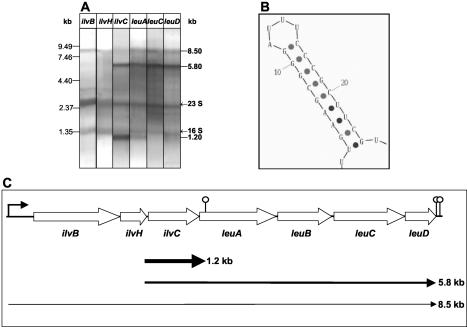
Detection of mRNAs specified by the ilv-leu operon. (A) Northern analysis. RNA was prepared from B. subtilis 168 growing exponentially in minimal medium. Six slots of a 0.6% RNA gel were loaded in parallel with 5 μg of this preparation. After electrophoresis and blotting, the membrane was cut into six strips, which were subsequently hybridized to probes with specifity for ilvB, ilvH, ilvC, leuA, leuC, and leuD. The reassembled chemiluminographs are shown. (B) Secondary structure (ΔG = −16 kcal/mol) in the 5′-terminal region of leuA as predicted by the Zuker algorithm (43). (C) Transcriptional organization of the ilv-leu operon as derived from the Northern analysis. The lengths of the different transcripts are indicated. The thickness of the arrows reflects the abundance of the transcripts.
FIG. 6.
FIG. 6.
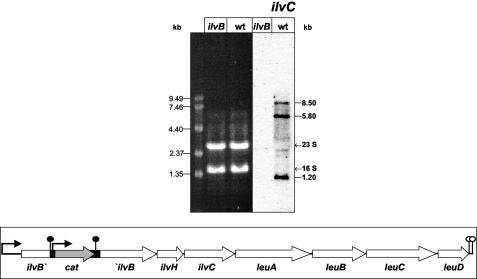
Northern analysis of the ilvB::cat mutant strain UM102. RNA was prepared from UM102 (ilvB) and B. subtilis 168 (wt) growing exponentially in minimal medium in the presence of CAA (0.2%). This RNA preparation (5 μg per lane) was electrophoretically separated in a 0.6% agarose gel, which is shown on the left side. The corresponding chemiluminograph after hybridization of the blotted RNA with an ilvC probe is depicted on the right side. The drawing shows the chromosomal organization of the ilv-leu locus in UM102.
FIG. 7.
FIG. 7.
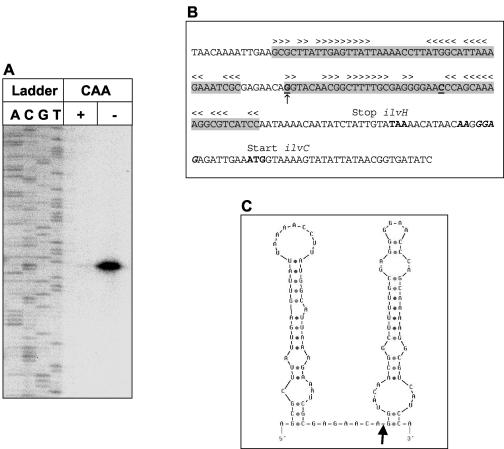
Mapping of the mRNA-processing site upstream of ilvC. (A) Primer extension analysis. The reactions were performed using 5 μg of RNA prepared from B. subtilis 168 growing exponentially in minimal medium in the presence (+) or absence (−) of CAA (0.2%). Lanes A, C, G, and T show the dideoxy sequencing ladder obtained with the same primer as used for the primer extension reactions. (B) Sequence of the chromosomal region surrounding the mapped processing site. Regions predicted to specify secondary structures on the mRNA level are highlighted in grey, and stem-loop structures are depicted as arrowheads. The C residue absent in the published genome sequence is underlined and in boldface, and the G residue representing the mapped 5′ end is marked by an arrow. The ilvH stop codon and the ilvC start codon are shown in boldface, and the ilvC ribosome-binding site is shown in italic. (C) Secondary-structure prediction for the mRNA surrounding the processing site according to the Zuker algorithm (43). The mapped mRNA cleavage site is indicated by an arrow.
FIG. 8.
FIG. 8.
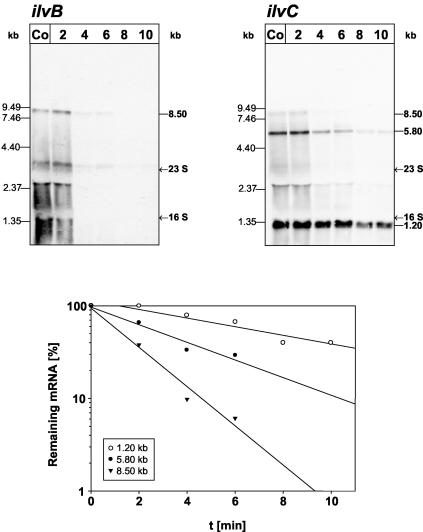
Half-life determination of the different mRNAs of the ilv-leu operon. RNA (5 μg per lane) was prepared from B. subtilis 168 growing exponentially in minimal medium before (Co) and at different times (given in minutes) after the addition of rifampin. After RNA electrophoresis in 0.6% agarose gels and blotting, the membranes were hybridized to ilvB- and ilvC-specific probes. The half-lifes of the 8.5-, 5.8-, and 1.2-kb mRNA were determined by linear regression analysis plots of the percentage of remaining mRNA versus the time. The half-life data were obtained from three experiments using independently prepared RNA.
FIG. 9.
FIG. 9.
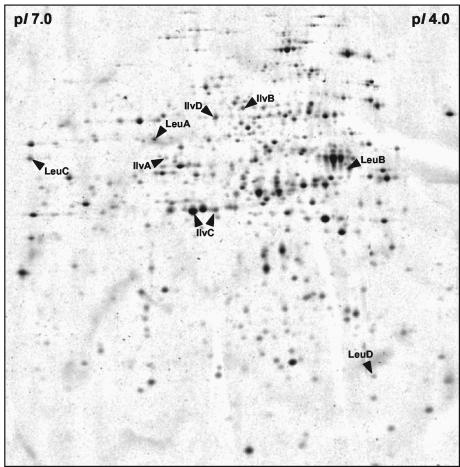
SYPRO ruby-stained cytosolic proteins of B. subtilis 168 separated by 2-D protein gel electrophoresis. The protein extract (100 μg) prepared from cells growing exponentially in minimal medium was separated in a pH gradient of 4 to 7. The labeled spots represent proteins involved in the biosynthesis of branched-chain amino acids.
FIG. 10.
FIG. 10.
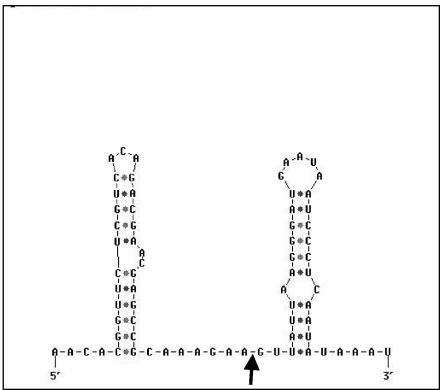
The mRNA secondary structures surrounding the processing site mapped in the gapA operon (27). The mapped mRNA cleavage site is indicated by an arrow.

References

    1. Aganostopoulos, C., and I. Spizizen. 1961. Requirements for transformation in Bacillus subtilis. J. Bacteriol. 81:741-746. - PMC - PubMed
    1. Atkinson, M. R., L. V. Wray, Jr., and S. H. Fisher. 1990. Regulation of histidine and proline degradation enzymes by amino acid availability in Bacillus subtilis. J. Bacteriol. 172:4758-4765. - PMC - PubMed
    1. Belasco, J. G., J. T. Beatty, C. W. Adams, A. von Gabain, and S. N. Cohen. 1985. Differential expression of photosynthesis genes in R. capsulata results from segmental differences in stability within the polycistronic rxcA transcript. Cell 40:171-181. - PubMed
    1. Biou, V., R. Dumas, C. Cohen-Addad, R. Douce, D. Job, and E. Pebay-Peyroula. 1997. The crystal structure of plant acetohydroxy acid isomeroreductase complexed with NADPH, two magnesium ions and a herbicidal transition state analog determined at 1.65 A resolution. EMBO J. 16:3405-3415. - PMC - PubMed
    1. Büttner, K., J. Bernhardt, C. Scharf, R. Schmid, U. Mäder, C. Eymann, H. Antelmann, A. Völker, U. Völker, and M. Hecker. 2001. A comprehensive two-dimensional map of cytosolic proteins of Bacillus subtilis. Electrophoresis 22:2908-2935. - PubMed

Publication types

MeSH terms

LinkOut - more resources