


Identification of a phosphotransferase system of Escherichia coli required for growth on N-acetylmuramic acid
- PMID: 15060041
- PMCID: PMC412175
- DOI: 10.1128/JB.186.8.2385-2392.2004
Identification of a phosphotransferase system of Escherichia coli required for growth on N-acetylmuramic acid
Abstract
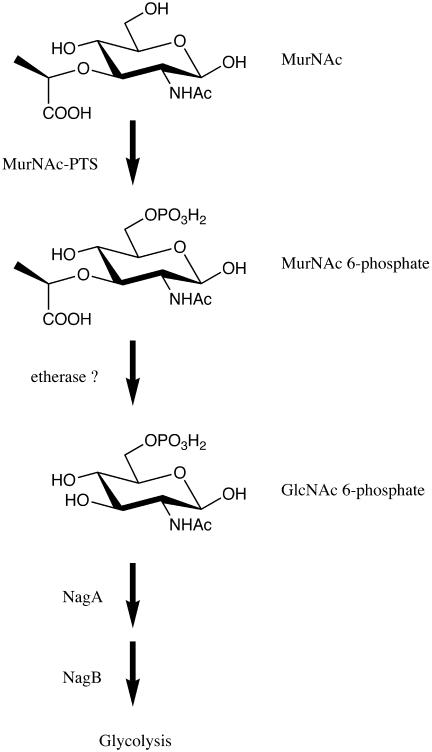
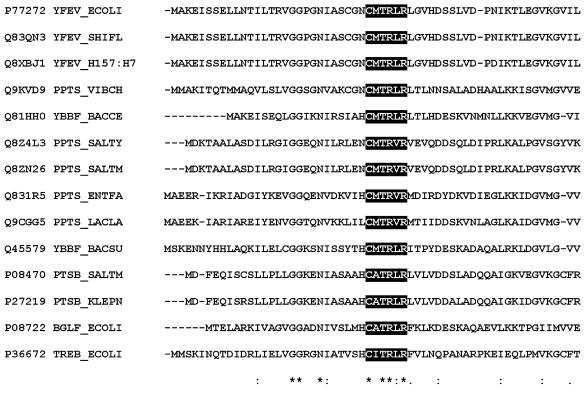
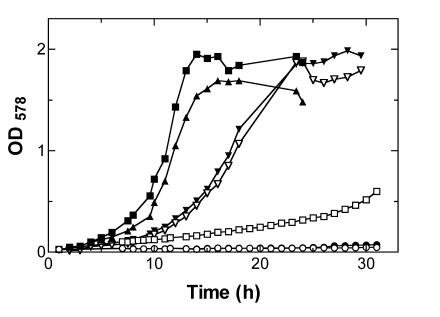
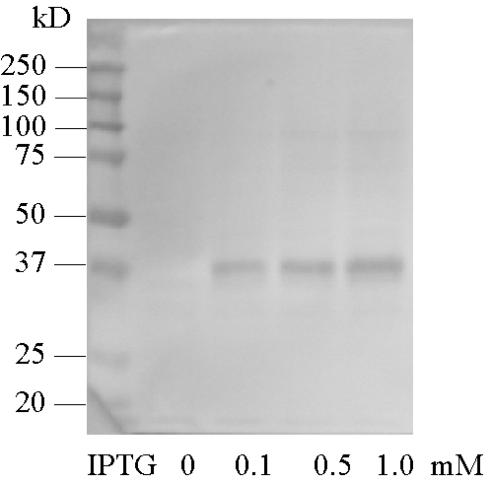
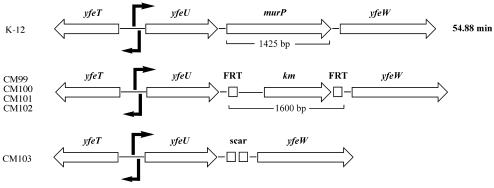
We report here that wild-type Escherichia coli grows on N-acetylmuramic acid (MurNAc) as the sole source of carbon and energy. Analysis of mutants defective in N-acetylglucosamine (GlcNAc) catabolism revealed that the catabolic pathway for MurNAc merges into the GlcNAc pathway on the level of GlcNAc 6-phosphate. Furthermore, analysis of mutants defective in components of the phosphotransferase system (PTS) revealed that a PTS is essential for growth on MurNAc. However, neither the glucose-, mannose/glucosamine-, nor GlcNAc-specific PTS (PtsG, ManXYZ, and NagE, respectively) was found to be necessary. Instead, we identified a gene at 55 min on the E. coli chromosome that is responsible for MurNAc uptake and growth. It encodes a single polypeptide consisting of the EIIB and C domains of a so-far-uncharacterized PTS that was named murP. MurP lacks an EIIA domain and was found to require the activity of the crr-encoded enzyme IIA-glucose (EIIA(Glc)), a component of the major glucose transport system for growth on MurNAc. murP deletion mutants were unable to grow on MurNAc as the sole source of carbon; however, growth was rescued by providing murP in trans expressed from an isopropylthiogalactopyranoside-inducible plasmid. A functional His(6) fusion of MurP was constructed, isolated from membranes, and identified as a polypeptide with an apparent molecular mass of 37 kDa by sodium dodecyl sulfate-polyacrylamide gel electrophoresis and Western blot analysis. Close homologs of MurP were identified in the genome of several bacteria, and we believe that these organisms might also be able to utilize MurNAc.
Figures
References
-
- Blattner, F. R., G. Plunkett III, C. A. Bloch, N. T. Perna, V. Burland, M. Riley, J. Collado-Vides, J. D. Glasner, C. K. Rode, G. F. Mayhew, J. Gregor, N. W. Davis, H. A. Kirkpatrick, M. A. Goeden, D. J. Rose, B. Mau, and Y. Shao. 1997. The complete genome sequence of Escherichia coli K-12. Science 277:1453-1474. - PubMed
-
- Canonaco, F., T. A. Hess, S. Heri, T. Wang, T. Szyperski, and U. Sauer. 2001. Metabolic flux response to phosphoglucose isomerase knock-out in Escherichia coli and impact of overexpression of the soluble transhydrogenase UdhA. FEMS Microbiol. Lett. 204:247-252. - PubMed
-
- Casadaban, M. J. 1976. Transposition and fusion of the lac genes to selected promoters in Escherichia coli using bacteriophage lambda and Mu. J. Mol. Biol. 104:541-555. - PubMed
Publication types
MeSH terms
Substances
LinkOut - more resources
Full Text Sources
Molecular Biology Databases
