. 2004 Apr 1;32(6):1967-72.
doi: 10.1093/nar/gkh508. Print 2004.

Selective inhibition of the DNA-dependent protein kinase (DNA-PK) by the radiosensitizing agent caffeine

Affiliations

Selective inhibition of the DNA-dependent protein kinase (DNA-PK) by the radiosensitizing agent caffeine

Wesley D Block et al. Nucleic Acids Res. .

Abstract

Caffeine inhibits cell cycle checkpoints, sensitizes cells to ionizing radiation-induced cell killing and inhibits the protein kinase activity of two cell cycle checkpoint regulators, Ataxia-Telangiectasia mutated (ATM) and ATM- and Rad3-related (ATR). In contrast, caffeine has been reported to have little effect on the protein kinase activity of the DNA-dependent protein kinase (DNA-PK), which is essential for the repair of DNA double-strand breaks. Previously, we reported that DNA-PK phosphorylates Thr21 of the 32 kDa subunit of replication protein A (RPA32) in response to camptothecin. In this report we demonstrate that the camptothecin-induced phosphorylation of RPA32 on Thr21 is inhibited by 2 mM caffeine. In addition, we show that caffeine inhibits immunoprecipitated and purified DNA-PK, as well as DNA-PK in cell extracts, with an IC50 of 0.2-0.6 mM. Caffeine inhibited DNA-PK activity through a mixed non-competitive mechanism with respect to ATP. In contrast, 10-fold higher concentrations of caffeine were required to inhibit DNA-PK autophosphorylation in vitro and caffeine failed to inhibit DNA-PKcs dependent double-strand break repair in vivo. These data suggest that while DNA-PK does not appear to be the target of caffeine-induced radiosensitization, caffeine cannot be used to differentiate between ATM, ATR and DNA- PK-dependent substrate phosphorylation in vivo.


Figures
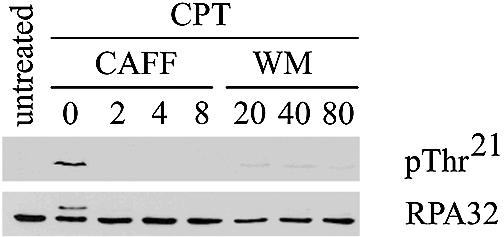
Figure 1
Figure 1
CPT-induced RPA32 phosphorylation is inhibited by wortmannin and caffeine. DNA-PKcs-proficient ATM-deficient lymphoblastoid cells (L3) were either untreated or treated with 1 µM CPT, after pretreatment with caffeine [CAFF] (mM) or wortmannin [WM] (µM) as indicated. Extracts were enriched for RPA using Affi-gel blue pulldowns and RPA32 was visualized by western blotting with either a RPA32 Thr21-phospho- specific antibody [pThr21] or an RPA32 antibody [RPA32].
Figure 2
Figure 2
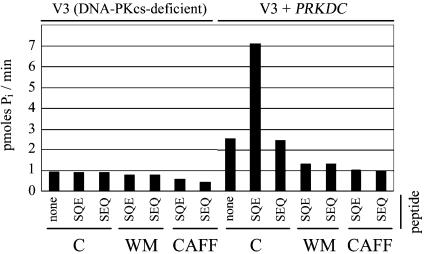
Inhibition of DNA-PK substrate phosphorylation in cell extracts by caffeine. Extracts from V3 [DNA-PKcs-deficient] cells or V3 cells complemented with a copy of the human PRKDC cDNA [V3 + PRKDC] were assayed for DNA-PK protein kinase activity towards a DNA-PK substrate peptide [SQE] or a mock substrate peptide [SEQ] in the presence or absence of 1 µM WM or 10 mM CAFF. DNA-PK protein kinase activity was expressed as the picomoles of phosphate incorporated into the peptide substrate per minute.
Figure 3
Figure 3
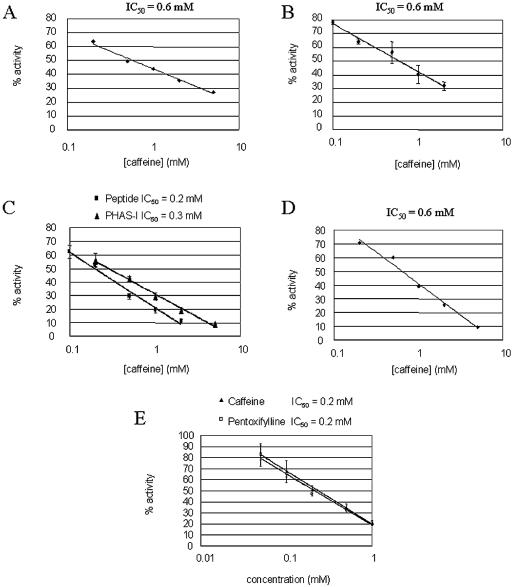
Inhibition of DNA-PK protein kinase activity in vitro. (A) Extracts from PRKDC-complemented V3 cells were assayed for DNA-PK protein kinase activity towards a DNA-PK substrate peptide [SQE] in the presence of increasing concentrations of caffeine. Assays were done in duplicate and averaged. IC50s are as indicated. (B) Highly purified DNA-PK was assayed towards heterotrimeric RPA (tRPA) in the presence of increasing concentrations of caffeine. Samples were fractionated on SDS–polyacrylamide gels and RPA32 was excised from the gel and 32P was quantitated by Cerenkov counting. Assays were done in triplicate and averaged. Error bars are ± 1 standard error of the mean (SEM). (C) Highly purified DNA-PK was assayed towards either the DNA-PK substrate peptide or PHAS-I in the presence of increasing concentrations of caffeine. Assays were done in triplicate and averaged. (D) DNA-PKcs was immunoprecipitated from L3 cells using a rabbit polyclonal DNA-PKcs antibody (DPK-1) and assayed for activity towards PHAS-I in the presence of increasing concentrations of caffeine. Assays were done in duplicate and averaged. (E) Highly purified DNA-PK was assayed towards the DNA-PK substrate peptide in the presence of increasing concentration of caffeine (second supplier) and pentoxifylline.
Figure 4
Figure 4
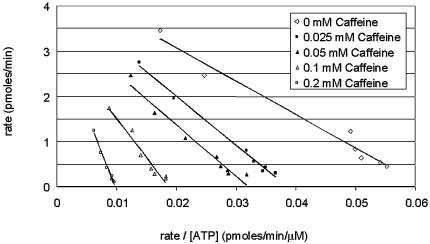
Mixed non-competitive inhibition of DNA-PK by caffeine. Purified DNA-PK was used to phosphorylate the SQE peptide in the presence of [γ-32P]ATP and varied ATP concentrations (8.3, 10, 12.5, 16.7, 25, 50, 100 or 200 µM) with varied concentrations of caffeine (0, 0.025, 0.05, 0.1 or 0.2 mM). The 32P:(pmol of unlabeled ATP) ratio for each ATP concentration was calculated and used to quantitate the rate of phosphate incorporated into the SQE peptide. Each point represents an average of duplicates.
Figure 5
Figure 5
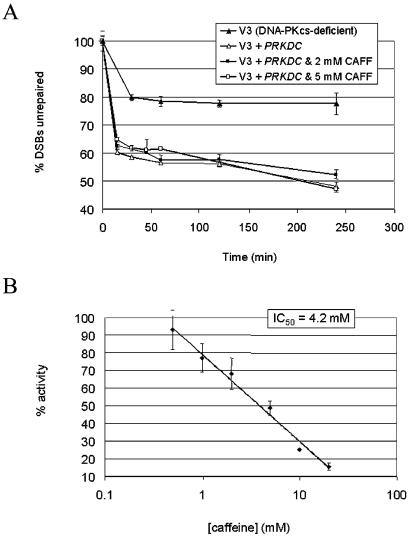
Caffeine has minimal effect on DNA-PK autophosphorylation in vitro and DNA-PK-dependent DSB repair. (A) V3 (DNA-PKcs-deficient) or PRKDC-complemented V3 cells were embedded in agarose plugs (containing caffeine where indicated), treated with 40 Gy of IR and allowed to recover. Plugs were electrophoresed in the presence of ethidium bromide. The percent of unrepaired DSBs was calculated as described in Materials and Methods. (B) Purified DNA-PK was incubated under autophosphorylation conditions in the presence of increasing concentrations of caffeine. Phosphorylation was quantitated as in Figure 3B.

References

    1. Zhou B.B. and Elledge,S.J. (2000) The DNA damage response: putting checkpoints in perspective. Nature, 408, 433–439. - PubMed
    1. Jackson S.P. (2002) Sensing and repairing DNA double-strand breaks. Carcinogenesis, 23, 687–696. - PubMed
    1. Goodarzi A.A., Block,W.D. and Lees-Miller,S.P. (2003) The roles of ATM and ATR in DNA damage-induced cell cycle control. In Meijer,L., Jezequel,A. and Roberge,M. (eds), Progress in Cell Cycle Research. Life in Progress, Roscoff, France, pp. 393–412. - PubMed
    1. Abraham R.T. (2001) Cell cycle checkpoint signaling through the ATM and ATR kinases. Genes Dev., 15, 2177–2196. - PubMed
    1. Sarkaria J.N., Busby,E.C., Tibbetts,R.S., Roos,P., Taya,Y., Karnitz,L.M. and Abraham,R.T. (1999) Inhibition of ATM and ATR kinase activities by the radiosensitizing agent, caffeine. Cancer Res., 59, 4375–4382. - PubMed

Publication types