. 2004;31(1):47-60.

Memento for René Favaloro

Affiliations

Memento for René Favaloro

Gabriella Captur. Tex Heart Inst J. 2004.

Abstract

Rene G. Favaloro moved to the Cleveland Clinic in 1962 and with him came a wind of change that was to reshape cardiac surgery forever. With his cherished colleagues, Effler, Sones, Proudfit, Groves, Sheldon, and countless others, he contributed to the double internal mammary artery-myocardial implantation by the Vineberg method, and, subsequently, in May 1967, he reconstructed the right coronary artery by saphenous vein graft interposition. These milestones set the stage for aortocoronary saphenous vein bypass grafting in October 1967. Several other breakthroughs rapidly followed: the application of the bypass technique to the left coronary artery, the combination of coronary artery bypass grafting with left ventricular reconstruction and valve repair or replacement, and finally, by December 1967, a double bypass to the right coronary artery and the anterior descending branch of the left coronary artery. Emergency coronary artery bypass grafting in patients with acute myocardial infarction soon became Favaloro's next focus. In 1970, he was influenced by the work of George Green in New York City and began using the direct mammary-coronary anastomosis with a few modifications, which popularized it. In June 1971, Favaloro decided to leave the Cleveland Clinic and return to Argentina, where he created a medical center, a teaching unit, a research department, and, finally, an Institute of Cardiology and Cardiovascular Surgery. To all these medical achievements, add integrity, courage, honesty, and humility, and the result is a man who will never be forgotten.


Figures

None
Fig. 1 Dr. René Gerónimo Favaloro (1923–2000). This photograph was taken at a symposium held in Cleveland, sponsored by the Clinic's Thoracic & Cardiovascular Surgery Department on 12–13 November 1992 to celebrate the 25th anniversary of Dr. Favaloro's pioneering coronary artery bypass graft at the Cleveland Clinic. (Photo courtesy of the Cleveland Clinic Foundation.)
None
Fig. 10 Left: Application of the bypass vein graft to the left coronary artery follows 2 basic indications: a major occlusion at the ostium of the left main coronary artery or at the origin of the left anterior descending coronary artery. Right: Bypass graft technique applied to the left coronary artery. (From: Effler DB, et al. Reproduced with permission from Elsevier.)
None
Fig. 11 A) The exterior of the Institute of Cardiology and Cardiovascular Surgery, founded by Dr. Favaloro in Buenos Aires. B) Main entrance to the Institute of Cardiology and Cardiovascular Surgery. (Photos courtesy of the Favaloro Foundation.)
None
Fig. 2 René Favaloro and his wife, Mar'a Antonia, preparing an “asado,” the typical Argentine barbecue, while they lived in Cleveland. (Photo courtesy of the Favaloro Foundation.)
None
Fig. 3 The Cleveland Clinic, 22 August 1949. Its appearance from this perspective was essentially the same when Dr. Favaloro joined the Clinic in 1962. (Photo courtesy of the Cleveland Clinic Foundation.)
None
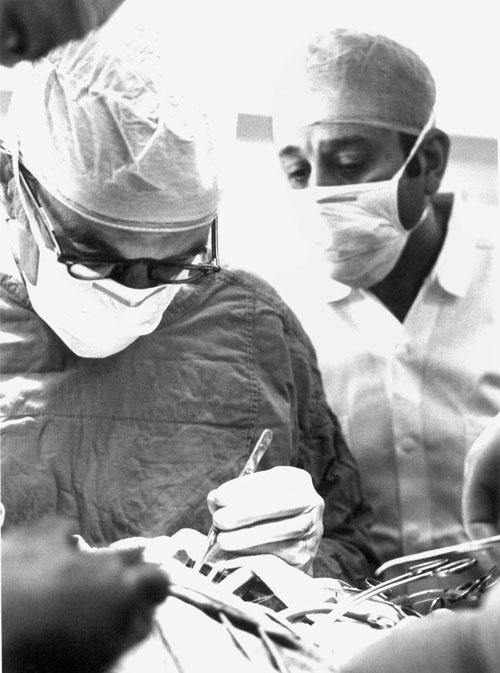
Fig. 4 Drs. Favaloro (at right) and Effler in the operating room. Dr. Effler donated this photograph to Dr. Favaloro after the latter submitted his resignation from Cleveland Clinic in 1971. He added a dedication to the photo, which read, “We have taught each other many things.” (Photo courtesy of the Cleveland Clinic Foundation.)
None
Fig. 5 Dr. Favaloro (left) with Dr. Sones in the cardiac catheterization laboratory circa 1982, during one of Favaloro's visits to the Cleveland Clinic. (Photo courtesy of the Cleveland Clinic Foundation.)
None
Fig. 6 Dr. Favaloro (left) with Dr. Proudfit at the Clinic's alumni reunion in October 1999. (Photo courtesy of the Cleveland Clinic Foundation.)
None
Fig. 7 The Favaloro retractor was designed to lift the left side of the sternum, giving good exposure of the left mammary artery. (From: Favaloro RG. Reproduced courtesy of the Cleveland Clinic Foundation.)
None
Fig. 8 Drawing shows pericardial patch-graft being secured with fine arterial silk sutures. (From: Effler DB, et al. Reproduced courtesy of Lippincott Williams & Wilkins.)
None
Fig. 9 Schematic illustrations demonstrate the principles of the bypass saphenous vein graft as applied to the dominant right coronary artery. Left: The first bypass vein grafts in the Cleveland Clinic series used a distal end-to-end vein-to-artery graft. The right coronary artery was transected, but the proximal marginal branches were not disturbed. Right: This illustrates the bypass vein graft with end-to-side vein-to-artery anastomosis. (From: Effler DB, et al. Reproduced with permission from Elsevier.)

References

    1. Hernandez J. The gaucho Martin Fiero. Translation by Walter Owen. Buenos Aires, Argentina: Distribuidora Quevedo de Ediciones; 1997.
    1. Favaloro R. A revival of Paul Dudley White: An overview of present medical practice and of our society. Circulation 1999;99:1525–37. - PubMed
    1. Pichel RH. Dr. Rene G. Favaloro: a biographical note. Clin Cardiol 1992;15:58–60. - PubMed
    1. Favaloro RG. Landmarks in the development of coronary artery bypass surgery. Circulation 1998;98:466–78. - PubMed
    1. Favaloro RG. Science, education and development. Cornerstone Laying Ceremony of the Gitter-Smolarz Building for the Library of Life Sciences and Medicine. Tel Aviv, Israel: Tel Aviv University; May 1995. Lecture.

Personal name as subject