


Modeling patients' acceptance of provider-delivered e-health
- PMID: 15064290
- PMCID: PMC436070
- DOI: 10.1197/jamia.M1475
Modeling patients' acceptance of provider-delivered e-health
Abstract
Objective: Health care providers are beginning to deliver a range of Internet-based services to patients; however, it is not clear which of these e-health services patients need or desire. The authors propose that patients' acceptance of provider-delivered e-health can be modeled in advance of application development by measuring the effects of several key antecedents to e-health use and applying models of acceptance developed in the information technology (IT) field.
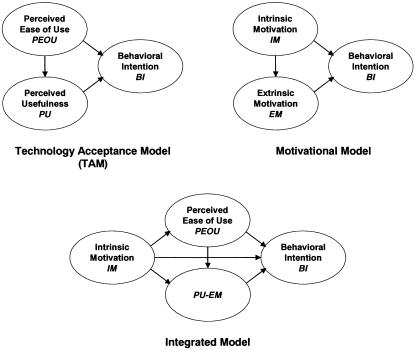
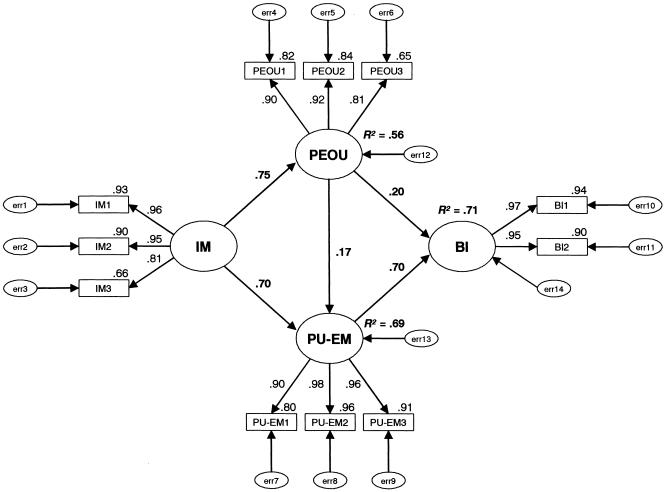
Design: This study tested three theoretical models of IT acceptance among patients who had recently registered for access to provider-delivered e-health.
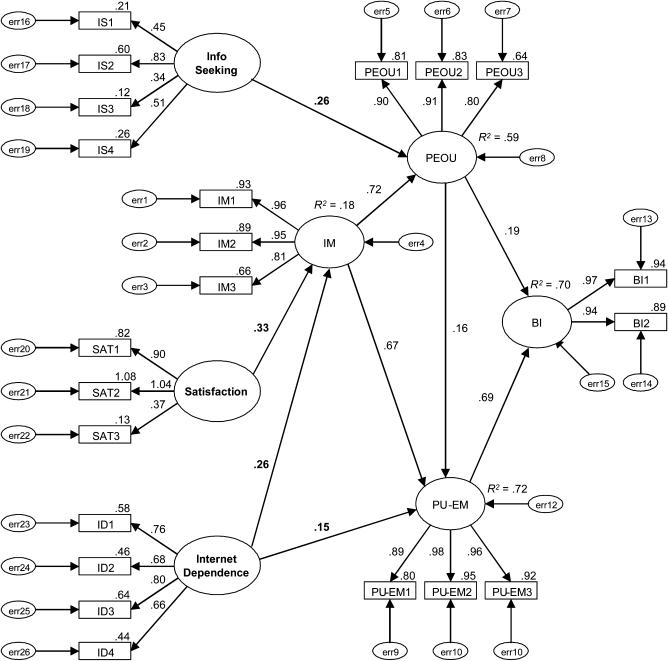
Measurements: An online questionnaire administered items measuring perceptual constructs from the IT acceptance models (intrinsic motivation, perceived ease of use, perceived usefulness/extrinsic motivation, and behavioral intention to use e-health) and five hypothesized antecedents (satisfaction with medical care, health care knowledge, Internet dependence, information-seeking preference, and health care need). Responses were collected and stored in a central database.
Results: All tested IT acceptance models performed well in predicting patients' behavioral intention to use e-health. Antecedent factors of satisfaction with provider, information-seeking preference, and Internet dependence uniquely predicted constructs in the models.
Conclusion: Information technology acceptance models provide a means to understand which aspects of e-health are valued by patients and how this may affect future use. In addition, antecedents to the models can be used to predict e-health acceptance in advance of system development.
Figures
References
-
- Maheu MM, Whitten P, Allen A. E-health, Telehealth, and Telemedicine. San Francisco, CA: Jossey-Bass, 2001.
-
- Wilson EV. Asynchronous health care communication. Commun ACM. 2003;46:79–84.
-
- Lazarus IR. Separating myth from reality in e-health initiatives. Managed Healthc Exec. 2001;Jun:33–6.
MeSH terms
LinkOut - more resources
Full Text Sources
Medical
