Structural ecosystems therapy for HIV-seropositive African American women: effects on psychological distress, family hassles, and family support
- PMID: 15065962
- PMCID: PMC1480817
- DOI: 10.1037/0022-006X.72.2.288
Structural ecosystems therapy for HIV-seropositive African American women: effects on psychological distress, family hassles, and family support
Abstract
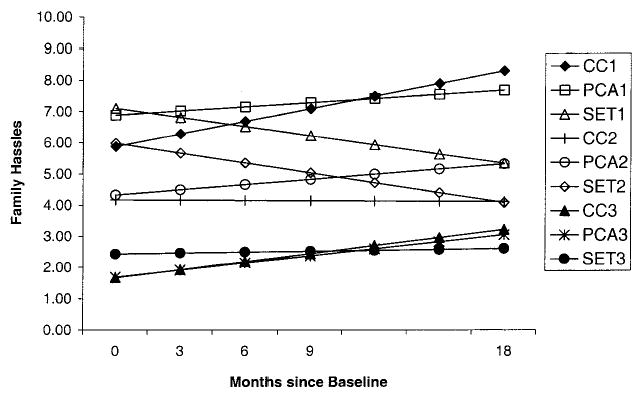
This study tests the efficacy of Structural Ecosystems Therapy (SET), a family-ecological intervention, in improving psychosocial functioning when compared with an attention-comparison person-centered condition and a community control condition. A sample of 209 HIV-seropositive, urban, low-income, African American women was randomized into 1 of the 3 conditions. Results of growth curve analyses over 5 time points revealed that SET was more efficacious than either of the control conditions in reducing psychological distress and family-related hassles. However, contrary to hypotheses, SET was not more efficacious in increasing family support. Latent growth mixture modeling analyses indicated that SET was most efficacious for women who, on average, were at or near the clinical threshold for psychological distress and for women with high levels of family hassles. Implications for further intervention development are discussed.
Figures
References
-
- Aléman, J., Kloser, P., Kreibick, T., Steiner, G. L., & Boyd-Franklin, N. (1995). Women and HIV/AIDS. In N. Boyd-Franklin, G. L. Steiner, & M. G. Boland (Eds.), Children, families, and HIV/AIDS: Psychosocial and therapeutic issues (pp. 90–111). New York: Guilford Press.
-
- American Psychiatric Association. (1987). Diagnostic and statistical manual of mental disorders (3rd ed., rev.). Washington, DC: Author.
-
- Antoni MH, Cruess DG, Cruess S, Lutgendorf S, Kumar M, Ironson G, et al. Cognitive–behavioral stress management intervention effects on anxiety, 24-hr urinary norepinephrine output, and t-cytotoxic/suppressor cells over time among symptomatic HIV-infected gay men. Journal of Consulting and Clinical Psychology. 2000;68:31–45. - PubMed
-
- Baron RM, Kenny DA. The moderator–mediator variable distinction in social psychological research: Conceptual, strategic, and statistical considerations. Journal of Personality and Social Psychology. 1986;51:1173–1182. - PubMed
-
- Belsky J, Crnic K, Gable S. The determinants of coparenting in families with toddler boys: Spousal differences and daily hassles. Child Development. 1995;66:629–642. - PubMed