


Direct quantification of Campylobacter jejuni and Campylobacter lanienae in feces of cattle by real-time quantitative PCR
- PMID: 15066825
- PMCID: PMC383034
- DOI: 10.1128/AEM.70.4.2296-2306.2004
Direct quantification of Campylobacter jejuni and Campylobacter lanienae in feces of cattle by real-time quantitative PCR
Abstract
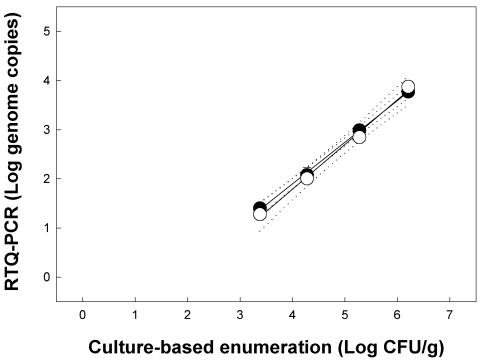
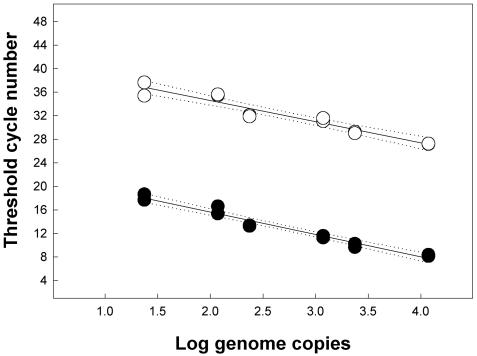
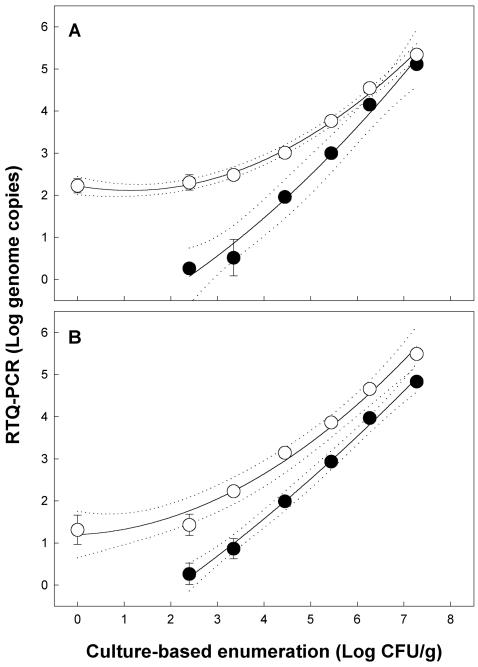
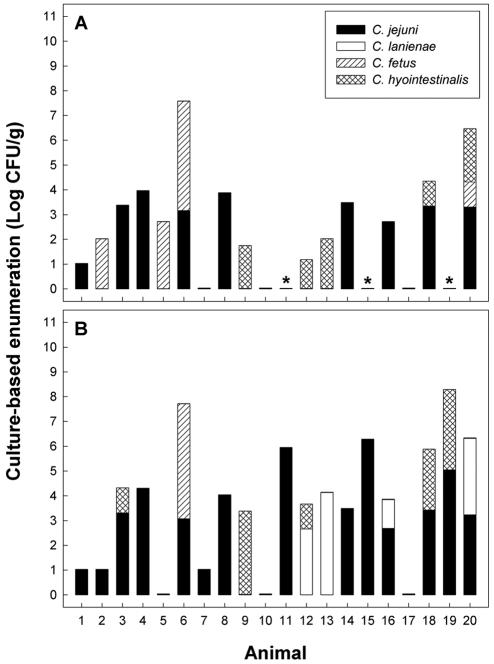
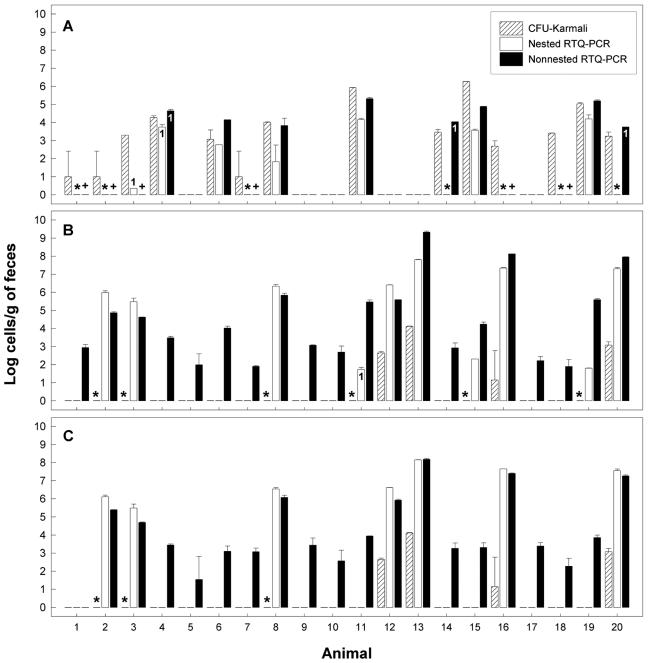
Campylobacter species are fastidious to culture, and the ability to directly quantify biomass in microbiologically complex substrates using real-time quantitative (RTQ) PCR may enhance our understanding of their biology and facilitate the development of efficacious mitigation strategies. This study reports the use of nested RTQ-PCR to directly quantify Campylobacter jejuni and Campylobacter lanienae in cattle feces. For C. jejuni, the single-copy mapA gene was selected. For C. lanienae, the three-copy 16S rRNA gene was targeted. RTQ-PCR primers were tested alone or they were nested with species-specific primers, and amplification products were detected using the intercalating dye SYBR Green. Nesting did not increase the specificity or sensitivity of C. jejuni quantification, and the limit of quantification was 19 to 25 genome copies ( approximately 3 x 10(3) CFU/g of feces). In contrast, nested RTQ-PCR was necessary to confer specificity on C. lanienae by targeting the 16S rRNA gene. The limit of quantification was 1.8 genome copies ( approximately 250 CFU/g of feces), and there was no discernible difference between the two C. lanienae secondary primer sets evaluated. Detection and quantification of C. jejuni in naturally infested cattle feces by RTQ-PCR were comparable to the results of culture-based methods. In contrast, culturing did not detect C. lanienae in 6 of 10 fecal samples positive for the bacterium and substantially underestimated cell densities relative to nested RTQ-PCR. The results of this study illustrate that RTQ-PCR can be used to directly quantify campylobacters, including very fastidious species, in a microbiologically and chemically complex substrate. Furthermore, targeting of a multicopy universal gene provided highly sensitive quantification of C. lanienae, but nested RTQ-PCR was necessary to confer specificity. This method will facilitate subsequent studies to elucidate the impact of this group of bacteria within the gastrointestinal tracts of livestock and studies of the factors that influence colonization success and shedding.
Figures
References
-
- Atabay, H. I., and J. E. L. Corry. 1998. The isolation and prevalence of campylobacters from dairy cattle using a variety of methods. J. Appl. Microbiol. 84:733-740. - PubMed
-
- Baylis, C. L., S. MacPhee, K. W. Martin, T. J. Humphrey, and R. P. Betts. 2000. Comparison of three enrichment media for the isolation of Campylobacter spp. from foods. J. Appl. Microbiol. 89:884-891. - PubMed
-
- Denis, M., C. Soumet, K. Rivoal, G. Ermel, D. Blivet, G. Salvat, and P. Colin. 1999. Development of a m-PCR assay for simultaneous identification of Campylobacter jejuni and C. coli. Lett. Appl. Microbiol. 29:406-410. - PubMed
-
- Haff, L. A. 1994. Improved quantitative PCR using nested primers. PCR Methods Appl. 3:332-337. - PubMed
Publication types
MeSH terms
Substances
LinkOut - more resources
Full Text Sources
Other Literature Sources
Medical
Molecular Biology Databases
