. 2004 Apr 20;101(16):6009-14.
doi: 10.1073/pnas.0307565101. Epub 2004 Apr 6.

Receptor-mediated regulation of the TRPM7 channel through its endogenous protein kinase domain

Affiliations

Receptor-mediated regulation of the TRPM7 channel through its endogenous protein kinase domain

Ryuichi Takezawa et al. Proc Natl Acad Sci U S A. .

Abstract

TRPM7 is a ubiquitously expressed and constitutively active divalent cation-selective ion channel, whose basal activity is regulated by intracellular levels of Mg(2+) and Mg.ATP. We have investigated receptor-mediated mechanisms that may actively regulate TRPM7 activity. We here report that TRPM7 currents are suppressed by intracellular GTPgammaS, suggesting the involvement of heterotrimeric G proteins. TRPM7 currents are also inhibited by stimulating endogenous muscarinic receptors, which is mediated by G(i) because the inhibitory effect is blunted by pertussis toxin. Conversely, stimulation of endogenous G(s)-coupled beta-adrenergic receptors potentiates TRPM7 currents, whereas G(q)-coupled thrombin receptors have little effect. Consistent with the involvement of G(s)/G(i) in controlling adenylyl cyclase activity, elevations of intracellular cAMP levels enhance TRPM7 activity and prevent receptor-mediated modulation of TRPM7 activity by muscarinic and adrenergic agonists. This cAMP-dependent effect requires the functional integrity of both protein kinase A (PKA) and the endogenous kinase domain of TRPM7 because cAMP-mediated effects are abolished when treating cells with the PKA inhibitors H89 or KT5720 as well as in cells expressing phosphotransferase-deficient TRPM7 constructs. These mutant channels are also much less susceptible to GTPgammaS-mediated inhibition, suggesting that the main regulatory effect occurs through G(i)- and G(s)-mediated changes in cAMP. Taken together, our results demonstrate that TRPM7 activity is up- and down-regulated through its endogenous kinase in a cAMP- and PKA-dependent manner.


Figures
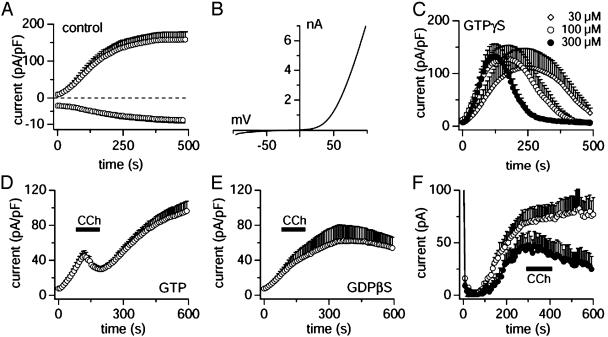
Fig. 1.
Fig. 1.
TRPM7 is modulated by G protein-coupled receptors. Whole-cell currents were recorded in HEK-293 cells induced to overexpress murine TRPM7 (AE), except for F, which depicts uninduced HEK-293 cells. (A) Average inward and outward currents carried by TRPM7 at –80 and +80 mV, respectively (n = 5; note the different y axis scaling). Cells were perfused with standard internal solution (i.e., with no added Mg·ATP). (B) Representative current-voltage (I/V) relationship for fully activated TRPM7, derived from a high-resolution current record in response to a voltage ramp of 50 ms duration that ranged from –100 to +100 mV. (C) Cells were perfused with standard internal solution containing various concentrations of GTPγS as indicated in the legend (n = 5–11). (D) Cells were perfused with standard internal solution containing 0.3 mM GTP (n = 6). The bar indicates the time of application of the CCh-containing standard external solution (100 μM). (E) Cells were perfused with standard internal solution containing 0.5 mM GDPβS and stimulated by CCh as in D (n = 5). (F) Cells were perfused with standard internal solution as in D and stimulated by CCh (•, n = 6) or not (○, n = 5). MagNuM was inhibited by CCh in 6 of 13 cells (46% of cells).
Fig. 2.
Fig. 2.
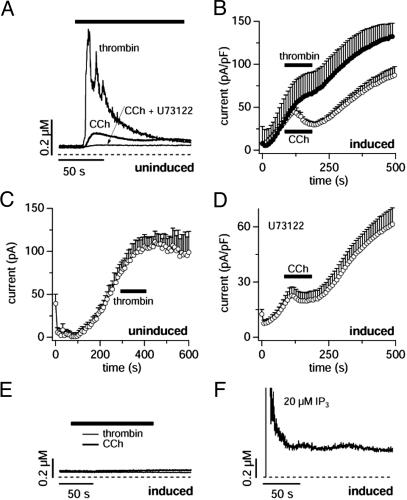
Receptor-mediated calcium signals do not correlate with TRPM7 regulation. (A) Average calcium signals evoked by CCh (100 μM, n = 10) and thrombin (20 units/ml, n = 10) in intact, uninduced HEK-293 cells. Cells that did not respond with a change in [Ca2+]i were omitted. Preincubation of cells with the PLC inhibitor U73122 (10 μM, n = 10) abolished CCh responses. (B) Current amplitudes evoked by the standard ramp protocol recorded at +80 mV in HEK-293 cells overexpressing TRPM7. The bar indicates the time of application of either thrombin (20 units/ml) or CCh (100 μM). Thrombin has only mild inhibitory effects on TRPM7 currents (•, n = 9) as compared with CCh (○, same data as in Fig. 1C). (C) Current amplitudes evoked by the standard ramp protocol recorded at +80 mV in uninduced HEK-293 cells as in Fig. 1F. The bar indicates the time of application of thrombin (20 units/ml), with no significant effect on MagNuM (n = 10). (D) Current amplitudes evoked by the standard ramp protocol recorded at +80 mV in HEK-293 cells overexpressing TRPM7 and preincubated with U73122 (10 μM, n = 11). The bar indicates the time of application of CCh (100 μM). Note that the PLC inhibitor did not suppress the CCh-mediated inhibition of TRPM7. (E) Average calcium signals evoked by CCh (100 μM, n = 10) and thrombin (20 units/ml, n = 10) in intact, tetracycline-induced HEK-293 cells overexpressing TRPM7. Note the complete absence of calcium release with either agonist. (F) Average calcium signals evoked by intracellular InsP3 (20 μM, n = 3) in intact, tetracycline-induced HEK-293 cells overexpressing TRPM7. Note that InsP3-induced calcium release and subsequent store-operated Ca2+ influx is not compromised.
Fig. 3.
Fig. 3.
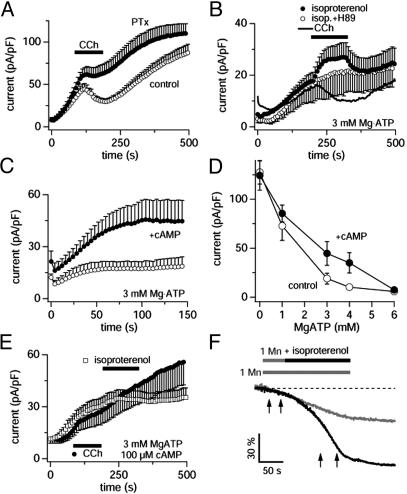
TRPM7 is inhibited by Gi and facilitated by cAMP. Data are derived from whole-cell outward currents recorded at +80 mV in HEK-293 cells overexpressing TRPM7. (A) Cells were pretreated with 1 μg/ml PTX for 4–7h, perfused with standard internal solution containing 0.3 mM GTP, and stimulated by 100 μM CCh (•, n = 7). The currents measured in PTX-untreated cells are shown as control (○, same data as in Fig. 1D). (B) Average whole-cell currents in cells perfused with 3 mM Mg·ATP and stimulated with 100 μM CCh (line plot, n = 5) as well as 300 μM isoproterenol in the presence (○, n = 5) or absence (•, n = 5) of 10 μM H89 in the internal solution. Note that H89 completely abolishes isoproterenol-mediated facilitation of TRPM7. The H89 data have been shifted by –8pA/pF for display purposes. (C) Average whole-cell currents in cells perfused with intracellular solutions containing 3 mM Mg·ATP alone (○, n = 8) or additionally 100 μM cAMP (•, n = 8). Note the strong facilitation of TRPM7 currents by cAMP. (D) Data points correspond to averaged and normalized current amplitudes measured at +80 mV after 300 s of whole-cell recording, plotted as a function of intracellular Mg·ATP concentrations (n = 7–15). Current amplitudes evoked in the absence (○) and presence (•) of 100 μM intra-pipette cAMP. The data points at 3 and 4 mM Mg·ATP are statistically significant with P < 0.03 as determined by Student's paired t test. (E) Average whole-cell currents in cells perfused with intracellular solutions containing 3 mM Mg·ATP and 100 μM cAMP. Extracellular application of either 100 μM CCh (•, n = 11) or 300 μM isoproterenol (□, n = 8) now fail to modulate TRPM7 currents. (F) Typical examples of fluorescence quench of fura-2 fluorescence induced by Mn2+ in HEK-293 cells overexpressing TRPM7 in the absence (gray trace) or additional presence of 300 μM isoproterenol. The rate of Mn2+-induced quench of fura-2 during the time indicated by the first pair of arrows was 32 ± 8%/min (n = 5), and cells that were exposed to isoproterenol had average rates of 76 ± 6%/min (n = 5) during the time indicated by the second set of arrows.
Fig. 4.
Fig. 4.
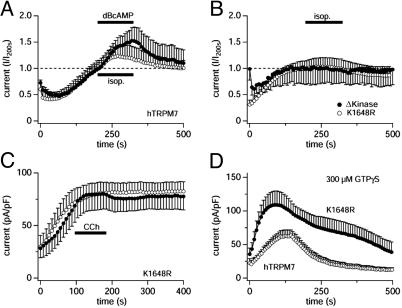
Receptor-mediated regulation of TRPM7 is mediated by the kinase domain. Data are from HEK-293 cells overexpressing various constructs of human TRPM7. (A) Normalized average whole-cell currents at +80 mV (current amplitudes at 200 s were set to 1) in cells overexpressing WT hTRPM7 perfused with intracellular solutions containing 3 mM Mg·ATP (plus 0.3 mM GTP in the case of receptor stimulation) and stimulated by 300 μM isoproterenol (○, n = 6) or exposed to extracellular solution containing 5 mM dibutyryl-cAMP (•, n = 5). Note that both stimuli induce facilitation in hTRPM7. (B) Normalized average whole-cell currents at +80 mV (current amplitudes at 200 s were set to 1) in HEK-293 cells overexpressing phosphotransferase-deficient constructs caused by either a single point mutation of hTRPM7 (K1648R) or C-terminal truncation of the kinase domain of hTRPM7 (Δ-kinase) and stimulated by 300 μM isoproterenol. K1648 cells were perfused with intracellular solutions containing 3 mM Mg·ATP and 0.3 mM GTP (○, n = 5). Δ-Kinase cells were perfused with intracellular solutions with reduced free MgCl2 (calculated free Mg2+ of 216 μM) containing 3 mM Na·ATP, 0.3 mM GTP, and free [Ca2+]i buffered to 100 nM (•, n = 5). Note that isoproterenol-induced facilitation is abolished in both phosphotransferase-deficient constructs. (C) Currents recorded from K1648R cells with the same experimental protocol as in A and stimulated with 100 μM CCh (•; n = 7) or not (○; n = 4). Note that CCh-induced inhibition normally observed in TRPM7 WT (see Fig. 1D) is almost completely abolished in the K1648R mutant. (D) Same experimental protocol as in Fig. 1 A. K1648R-overexpressing HEK-293 cells were perfused with the standard internal solution containing 300 μM GTPγS(•, n = 5). For comparison, the graph also plots WT human TRPM7 perfused with the same solution (○, n = 6). Note that inhibitory effects of GTPγS are greatly reduced in the K1648R mutant.

References

    1. Clapham, D. E., Runnels, L. W. & Strubing, C. (2001) Nat. Rev. Neurosci. 2, 387–396. - PubMed
    1. Harteneck, C., Plant, T. D. & Schultz, G. (2000) Trends Neurosci. 23, 159–166. - PubMed
    1. Montell, C., Birnbaumer, L., Flockerzi, V., Bindels, R. J., Bruford, E. A., Caterina, M. J., Clapham, D. E., Harteneck, C., Heller, S., Julius, D., et al. (2002) Mol. Cell 9, 229–231. - PubMed
    1. Montell, C., Birnbaumer, L. & Flockerzi, V. (2002) Cell 108, 595–598. - PubMed
    1. Nadler, M. J., Hermosura, M. C., Inabe, K., Perraud, A. L., Zhu, Q., Stokes, A. J., Kurosaki, T., Kinet, J. P., Penner, R., Scharenberg, A. M., et al. (2001) Nature 411, 590–595. - PubMed

Publication types

MeSH terms

LinkOut - more resources