


Zinc sulfate as an adjunct to methylphenidate for the treatment of attention deficit hyperactivity disorder in children: a double blind and randomized trial [ISRCTN64132371]
- PMID: 15070418
- PMCID: PMC400741
- DOI: 10.1186/1471-244X-4-9
Zinc sulfate as an adjunct to methylphenidate for the treatment of attention deficit hyperactivity disorder in children: a double blind and randomized trial [ISRCTN64132371]
Abstract
Background: Attention-deficit hyperactivity disorder is an early-onset, clinically heterogenous disorder of inattention, hyperactivity, and impulsiveness. The diagnosis and treatment of attention-deficit hyperactivity disorder continues to raise controversy, and, there is also an increase in treatment options. In this 6-week double blind, placebo controlled-trial, we assessed the effects of zinc plus methylphenidate in the treatment of children with attention deficit hyperactivity disorder. To the best of our knowledge, this study is the first double blind and placebo controlled clinical trial assessing the adjunctive role of zinc in ADHD.
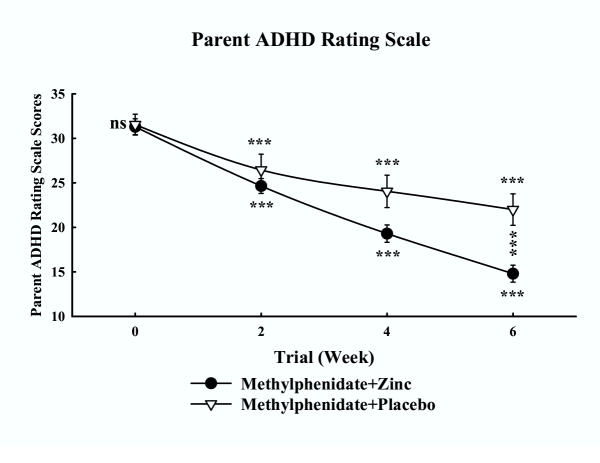
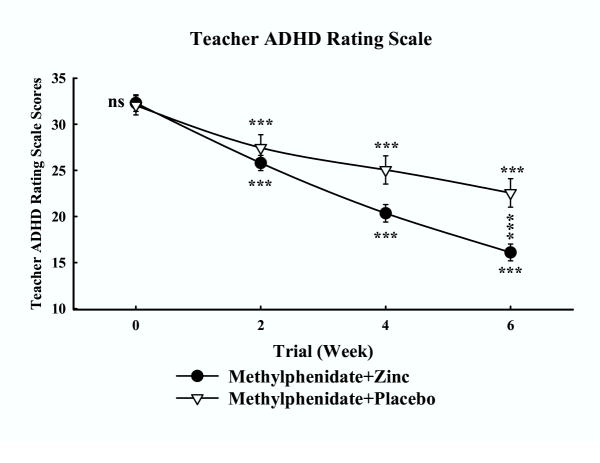
Methods: Our subjects were 44 outpatient children (26 boys and 18 girls) between the ages of 5-11 (mean +/- SD was 7.88 +/- 1.67) who clearly met the DSM IV diagnostic criteria for attention-deficit hyperactivity disorder and they were randomized to methylphenidate 1 mg/kg/day + zinc sulfate 55 mg/day (with approximately 15 mg zinc element) (group 1) and methylphenidate 1 mg/kg/day + placebo (sucrose 55 mg) (group 2) for a 6 week double blind clinical trial. The principal measure of the outcome was the Teacher and Parent ADHD Rating Scale. Patients were assessed by a child psychiatrist at baseline, 14, 28 and 42 days after the medication started.
Results: The present study shows the Parent and Teacher Rating Scale scores improved with zinc sulfate over this 6-week, double blind and placebo controlled trial. The behavior of the two treatments was not homogeneous across the time. The difference between the two protocols was significant as indicated by the effect on the group, the between-subjects factor (F = 4.15, d.f. = 1, P = 0.04; F = 4.50, d.f. = 1, P = 0.04 respectively). The difference between the two groups in the frequency of side effects was not significant.
Conclusions: This double-blind, placebo-controlled study demonstrated that zinc as a supplementary medication might be beneficial in the treatment of children with attention-deficit hyperactivity disorder. However, further investigations and different doses of zinc are required to replicate these findings in children with ADHD.
Figures
References
-
- Mercuglioano M. What is attention-deficit/hyperactivity disorder? Pediatr Clin North Am. 1999;46:831–43. - PubMed
-
- American Psychiatric Association . American Psychiatric Association, Washington, DC. 4 1994. Diagnostic and Statistical Manual of Mental Disorders, (DSM-IV)
-
- Wilens TE, Biederman J. The stimulants. Psychiatr Clin North Am. 1992;15:191–222. - PubMed
-
- Gillberg C, Melander H, Knorring A. Long-term stimulant treatment of children with attention-deficit hyperactivity disorder symptoms. Arch Gen Psychiat. 1997;54:857–864. - PubMed
Publication types
MeSH terms
Substances
Associated data
LinkOut - more resources
Full Text Sources
Other Literature Sources
Medical
Miscellaneous
