. 2004 Mar 30;101(13):4519-24.
doi: 10.1073/pnas.0400843101. Epub 2004 Mar 18.

Tying synaptonemal complex initiation to the formation and programmed repair of DNA double-strand breaks

Affiliations

Tying synaptonemal complex initiation to the formation and programmed repair of DNA double-strand breaks

Kiersten A Henderson et al. Proc Natl Acad Sci U S A. .

Abstract

During meiosis, homologous chromosomes recombine and become closely apposed along their lengths within the synaptonemal complex (SC). In part because Spo11 is required both to make the double-strand breaks (DSBs) that initiate recombination and to promote normal SC formation in many organisms, it is clear that these two processes are intimately coupled. The molecular nature of this linkage is not well understood, but it has been proposed that SC formation initiates locally at the sites of ongoing recombination and in particular at the subset of sites that will eventually give rise to crossovers. To test this hypothesis, we examined further the relationship between DSBs and SC formation in Saccharomyces cerevisiae. SCs were monitored in a series of spo11 missense mutants with varying DSB frequencies. Alleles that blocked DSB formation gave SC phenotypes indistinguishable from a deletion mutant, and partial loss-of-function mutations with progressively more severe DSB defects caused corresponding defects in SC formation. These results strongly correlate SC formation with Spo11 catalytic activity per se. Numbers of Zip3 complexes on chromosomes, thought to represent the sites of SC initiation, also declined when Spo11 activity decreased, but in a markedly nonlinear fashion: hypomorphic spo11 alleles caused larger defects in DSB formation than in Zip3 complex formation. This nonlinear response of Zip3 closely paralleled the response of crossover recombination products. The quantitative relationship between Zip3 foci, SC formation, and crossing over strongly implicates crossover-designated recombination intermediates as the sites of SC initiation.


Figures

Fig. 1.
Fig. 1.
(A) Zip1 staining patterns observed in wild-type and/or spo11 mutants. Meiotic chromosome spreads were analyzed by indirect immunofluorescence with anti-Zip1 antibodies. Examples are shown for (i) partial SC, (ii) extensive SC, (iii) polycomplex, (iv) partial synapsis plus polycomplex, and (v) extensive synapsis plus polycomplex. (Bar, 1 μm.) (B) Kinetics of SC formation in spo11-HA and spo11Δ strains. At least 100 nuclei were scored per time point.
Fig. 2.
Fig. 2.
Synaptic defects in spo11 mutants with reduced DSB levels. Chromosome spreads from the indicated strains were immunostained for Zip1. At least 50 nuclei were scored at each time point. Approximate relative DSB activities (from Table 1) are provided for convenience. (A) Extent of SC formation. (B) Occurrence of nuclei containing polycomplexes (PC), with or without partial or extensive synaptonemal complex.
Fig. 3.
Fig. 3.
DSBs in a SPO11 allelic series. Genomic DNA was prepared at the indicated times from rad50S strains differing in their genotype at the SPO11 locus. DSBs at the his4::LEU2 locus were analyzed by Southern blotting of PstI-digested DNA. Note that the spo11-D290A mutation affects both the level and distribution of DSBs within the hot spot, as described (37).
Fig. 4.
Fig. 4.
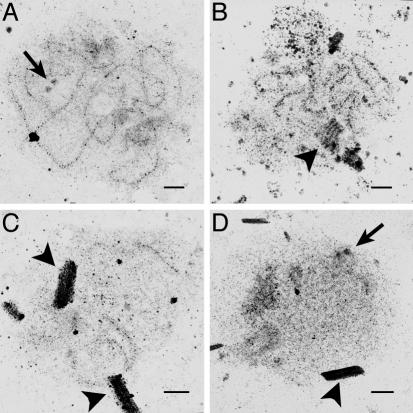
Electron microscopic confirmation of normal and aberrant synaptic structures. Chromosome spreads prepared at 4 h in meiosis were stained with silver and analyzed by electron microscopy. (A) Extensive SC in a spo11-HA nucleus. (B and C) Extensive SC plus polycomplex (B) and partial SC plus polycomplex (C), both from a spo11-Y135F-HA/spo11-HA strain. (D) Polycomplex only, from a spo11Δ nucleus. Arrows, spindle pole bodies; arrowheads, polycomplexes. (Bar, 0.5 μm.)
Fig. 5.
Fig. 5.
Decreased numbers of Zip3 foci form when DSB formation is reduced. (A) Representative nuclear spreads stained for Zip1 (red) and Zip3-GFP foci (green). (Bar, 1 μm.) (B) Zip3 focus counts. For each strain, nuclear spreads were prepared hourly from 2–6 h in meiosis. At least 50 nuclei were selected at random for each time point and grouped according to the extent of SC formation irrespective of the presence of polycomplex, and the Zip3 foci were counted. Bar graphs show the percent of nuclei that contained the indicated number of Zip3 foci (0–9 foci/nucleus in pale yellow, etc.). The number of nuclei in each Zip1 class (n) and the mean number of Zip3 foci (±SD) are given (Right). **, For spo11-D290A-HA, only one nucleus (with 28 Zip3 foci) had extensive SCs. (C) Nonlinear relationship between DSB frequency and the number of SC initiation sites. Relative numbers of Zip3 foci are plotted against relative DSB frequencies for wild-type, spo11-HA, spo11-Y135F-HA/spo11-HA, and spo11-D290A-HA (○). Zip3 numbers are the averages for all nuclei scored as having either partial or extensive SC (from B). The gray line marks the diagonal expected for a linear relationship.

References

    1. Zickler, D. & Kleckner, N. (1999) Annu. Rev. Genet. 33, 603–754. - PubMed
    1. Roeder, G. S. (1997) Genes Dev. 11, 2600–2621. - PubMed
    1. Padmore, R., Cao, L. & Kleckner, N. (1991) Cell 66, 1239–1256. - PubMed
    1. Mahadevaiah, S. K., Turner, J. M. A., Baudat, F., Rogakou, E. P., de Boer, P., Blanco-Rodriguez, J., Jasin, M., Keeney, S., Bonner, W. M. & Burgoyne, P. S. (2001) Nat. Genet. 27, 271–276. - PubMed
    1. Barlow, A. L., Benson, F. E., West, S. C. & Hulten, M. A. (1997) EMBO J. 16, 5207–5215. - PMC - PubMed

Publication types