


A Ca2+/calmodulin-dependent protein kinase required for symbiotic nodule development: Gene identification by transcript-based cloning
- PMID: 15070781
- PMCID: PMC384810
- DOI: 10.1073/pnas.0400595101
A Ca2+/calmodulin-dependent protein kinase required for symbiotic nodule development: Gene identification by transcript-based cloning
Abstract
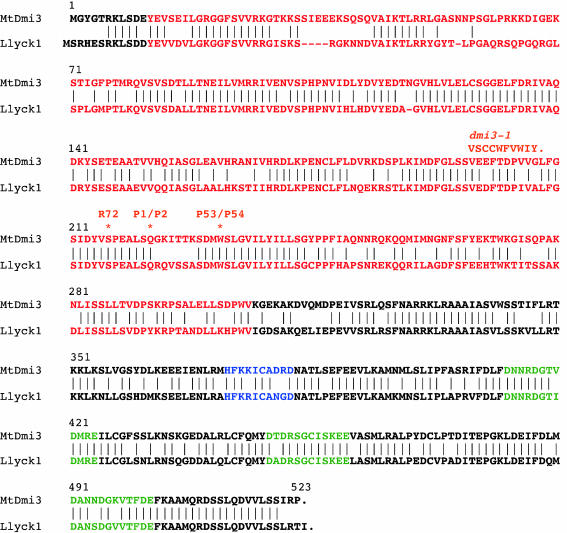
In the establishment of the legume-rhizobial symbiosis, bacterial lipochitooligosaccharide signaling molecules termed Nod factors activate the formation of a novel root organ, the nodule. Nod factors elicit several responses in plant root hair cells, including oscillations in cytoplasmic calcium levels (termed calcium spiking) and alterations in root hair growth. A number of plant mutants with defects in the Nod factor signaling pathway have been identified. One such Medicago truncatula mutant, dmi3, exhibits calcium spiking and root hair swelling in response to Nod factor, but fails to initiate symbiotic gene expression or cell divisions for nodule formation. On the basis of these data, it is thought that the dmi3 mutant perceives Nod factor but fails to transduce the signal downstream of calcium spiking. Additionally, the dmi3 mutant is defective in the symbiosis with mycorrhizal fungi, indicating the importance of the encoded protein in multiple symbioses. We report the identification of the DMI3 gene, using a gene cloning method based on transcript abundance. We show that transcript-based cloning is a valid approach for cloning genes in barley, indicating the value of this technology in crop plants. DMI3 encodes a calcium/calmodulin-dependent protein kinase. Mutants in pea sym9 have phenotypes similar to dmi3 and have alterations in this gene. The DMI3 class of proteins is well conserved among plants that interact with mycorrhizal fungi, but it is less conserved in Arabidopsis thaliana, which does not participate in the mycorrhizal symbiosis.
Figures
Comment in
-
Unraveling the mystery of Nod factor signaling by a genomic approach in Medicago trunactula.Proc Natl Acad Sci U S A. 2004 Mar 30;101(13):4339-40. doi: 10.1073/pnas.0400961101. Epub 2004 Mar 22. Proc Natl Acad Sci U S A. 2004. PMID: 15070718 Free PMC article. Review. No abstract available.
References
-
- Spaink, H. P. (2000) Annu. Rev. Microbiol. 54, 257-288. - PubMed
-
- Ehrhardt, D. W., Wais, R. & Long, S. R. (1996) Cell 85, 673-681. - PubMed
-
- Lerouge, P., Roche, P., Faucher, C., Maillet, F., Truchet, G., Prome, J. C. & Dénarié, J. (1990) Nature 344, 781-784. - PubMed
-
- Journet, E. P., El-Gachtouli, N., Vernoud, V., de Billy, F., Pichon, M., Dedieu, A., Arnould, C., Morandi, D., Barker, D. G. & Gianinazzi-Pearson, V. (2001) Mol. Plant-Microbe Interact 14, 737-748. - PubMed
Publication types
MeSH terms
Substances
Associated data
- Actions
- Actions
LinkOut - more resources
Full Text Sources
Other Literature Sources
Molecular Biology Databases
Miscellaneous
