


Significance of amplified fragment length polymorphism in identification and epidemiological examination of Candida species colonization in children undergoing allogeneic stem cell transplantation
- PMID: 15071024
- PMCID: PMC387556
- DOI: 10.1128/JCM.42.4.1673-1679.2004
Significance of amplified fragment length polymorphism in identification and epidemiological examination of Candida species colonization in children undergoing allogeneic stem cell transplantation
Abstract
Candida albicans and non-C. albicans Candida species are increasingly being isolated from patients in high-risk categories, most notably, those who have undergone stem cell transplantation (SCT). Identification of the presence of non-C. albicans Candida species early in the course of the transplant procedure is important, as these species exhibit different sensitivities to the available antifungal treatments and cause mortality at rates that vary from those for C. albicans. Amplified fragment length polymorphism (AFLP) analysis has been shown to be a reliable method of reproducibly identifying medically important Candida species. We investigated the use of serial AFLP analysis of 54 routine surveillance cultures for the identification and epidemiological examination of Candida sp. colonization in five consecutive children undergoing allogeneic SCT. One child became colonized with a C. albicans strain and remained colonized with this strain during the whole admission period. Another child had persistent colonization with a C. albicans strain with striking variations in its AFLP patterns over time, which was considered indicative of microevolution. Candida dubliniensis, Candida lusitaniae, and Saccharomyces cerevisiae were identified in the three remaining patients, with two children being simultaneously and transiently colonized with different species. These findings show that colonization with yeasts during transplantation is a complex and dynamic interaction between the host and the organism(s). In our study three strains from eight separate time points were incorrectly identified as C. albicans by a rapid enzyme test. AFLP analysis of surveillance cultures allowed more accurate and informative epidemiological evaluations of pathogenic yeasts in children during transplantation.
Figures
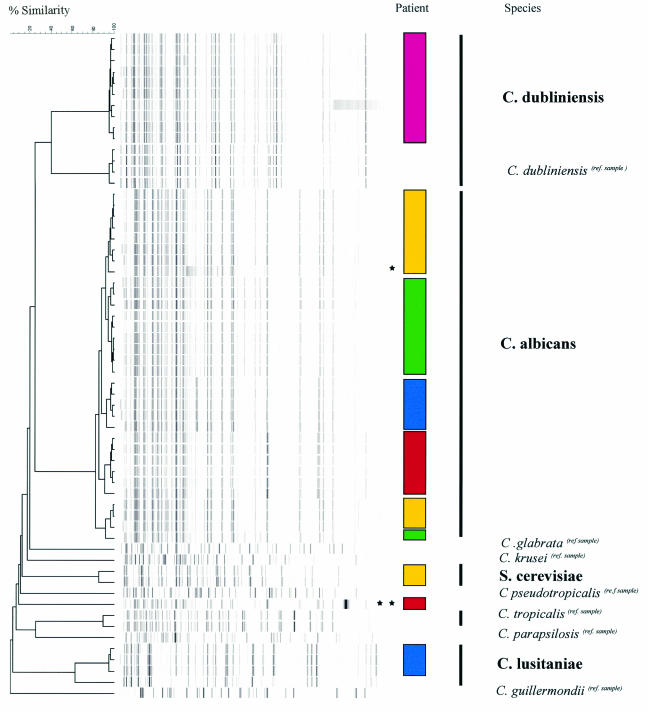
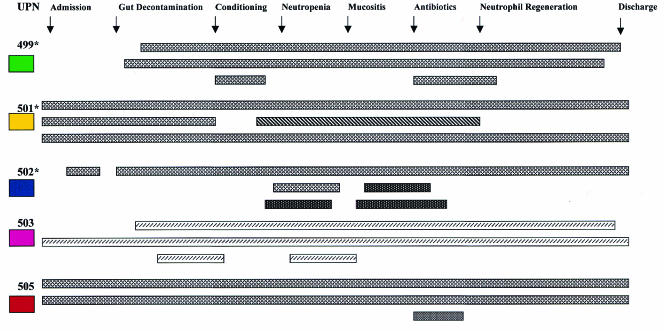
 ; S. cerevisiae, ▧; C. lusitaniae,
  ; C. dubliniensis, ▨. UPN, patient number.
References
-
- Campbell, C. K., A. D. Holmes, K. G. Davey, A. Szekely, and D. W. Warnock. 1998. Comparison of a new chromogenic agar with the germ tube method for presumptive identification of Candida albicans. Eur. J. Clin. Microbiol. Infect. Dis. 17:367-368. - PubMed
-
- Climolai, N., J. Davis, and C. Trombley. 2002. Candida dubliniensis fungaemia and vascular access infection. J. Pediatr. Hematol. Oncol. 24:237-239. - PubMed
-
- Damjanovic, V., C. M. Connolly, H. K. van Saene, R. W. Cook, J. A. Corkhill, A. van Belkum, and D. van Velzen. 1993. Selected decontamination with nystatin for control of a candida outbreak in a neonatal intensive care unit. J. Hosp. Infect. 24:245-259. - PubMed
Publication types
MeSH terms
Substances
LinkOut - more resources
Full Text Sources
Medical
