. 2004 Apr 8:4:4.
doi: 10.1186/1472-6785-4-4.

Collecting, archiving and processing DNA from wildlife samples using FTA databasing paper

Affiliations

Collecting, archiving and processing DNA from wildlife samples using FTA databasing paper

L M Smith et al. BMC Ecol. .

Abstract

Background: Methods involving the analysis of nucleic acids have become widespread in the fields of traditional biology and ecology, however the storage and transport of samples collected in the field to the laboratory in such a manner to allow purification of intact nucleic acids can prove problematical.

Results: FTA databasing paper is widely used in human forensic analysis for the storage of biological samples and for purification of nucleic acids. The possible uses of FTA databasing paper in the purification of DNA from samples of wildlife origin were examined, with particular reference to problems expected due to the nature of samples of wildlife origin. The processing of blood and tissue samples, the possibility of excess DNA in blood samples due to nucleated erythrocytes, and the analysis of degraded samples were all examined, as was the question of long term storage of blood samples on FTA paper. Examples of the end use of the purified DNA are given for all protocols and the rationale behind the processing procedures is also explained to allow the end user to adjust the protocols as required.

Conclusions: FTA paper is eminently suitable for collection of, and purification of nucleic acids from, biological samples from a wide range of wildlife species. This technology makes the collection and storage of such samples much simpler.


Figures
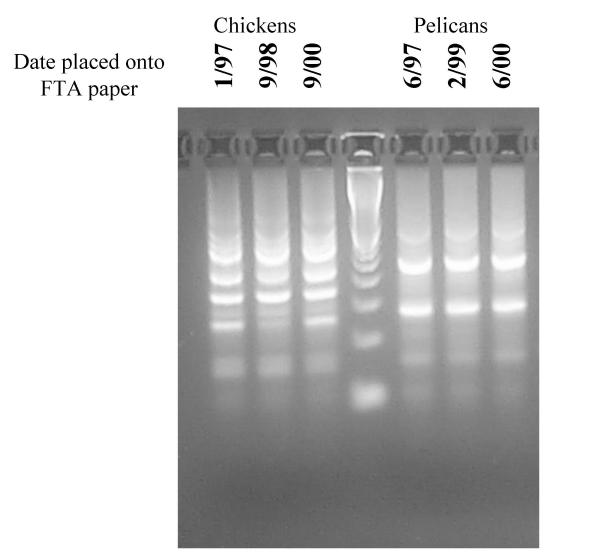
Figure 1
Figure 1
PCR amplification of DNA purified from archived avian blood. Blood samples were dried onto FTA paper on the dates indicated, and DNA purified and PCR amplified on 23/8/00. All samples still yield amplifiable DNA.
Figure 2
Figure 2
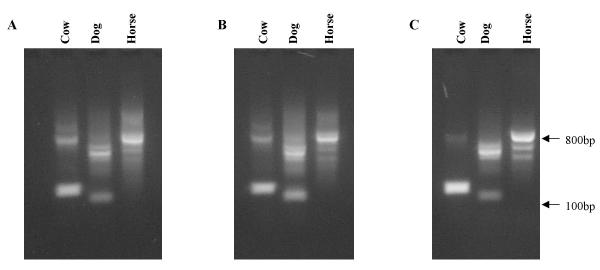
ILRC PCR products from mammalian blood samples, purified on FTA paper using A) method #1 (SDS wash) B) method #2 (NaOH wash) and C) method #3 (phenol wash). All methods yielded amplifiable DNA.
Figure 3
Figure 3
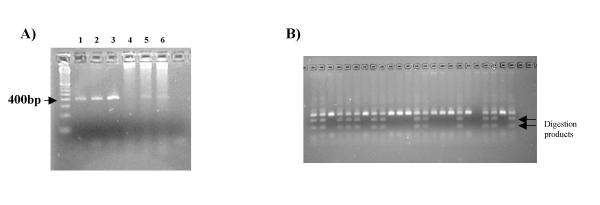
Processing pelican blood samples on FTA paper. A) PCR on DNA eluted from FTA paper (1–3) and directly on a 1 mm punch (4–6). B) Sexing of pelicans by PCR (processed on FTA paper and DNA eluted), followed by HaeIII restriction digestion. Digestion products (2 smaller bands) indicate heterogametic sex (female = ZW, male = ZZ).
Figure 4
Figure 4
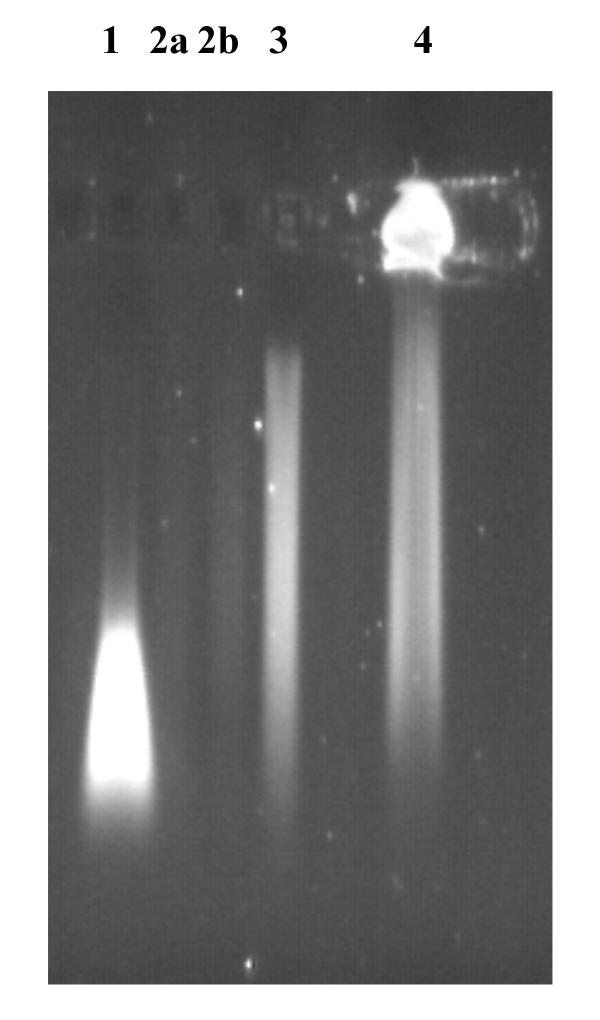
DNA release from FTA paper. After complete digestion with multiple restriction enzymes DNA was spin eluted from the paper (Lane 1). The paper was washed and spin eluted twice with TE (Lanes 2a and b), heated to 90°C in water (Lane 3), and sealed in the well of the agarose gel before electrophoresis (Lane 4). Some residual large DNA fragments are retained on the paper
Figure 5
Figure 5
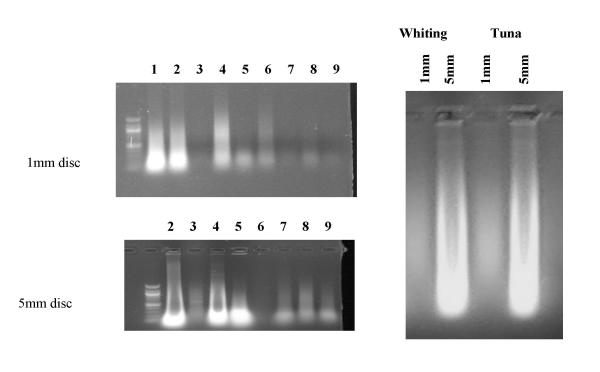
Digestion of DNA from blood (1–4) and tissue (5–9) samples on FTA paper. Samples were crested pigeon (1), chicken (2), cow (3), sleepy lizard (4), Mallee fowl (5), frog (6), yabbie (7), abalone (8) and blue crab (9). Samples were processed, and digested overnight with AluI Fish blood samples. 1 mm and 5 mm discs from King George Whiting blood and tuna blood were processed, and digested overnight with AluI. A 1 mm disc yields less DNA than in birds, and a 5 mm disc yields incompletely digested DNA.
Figure 6
Figure 6
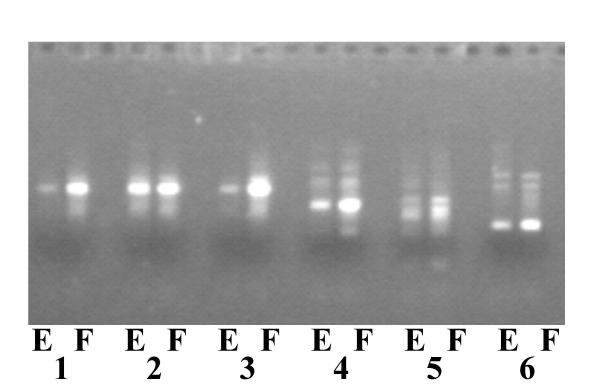
PCR amplification of mammalian ILRCs either on eluted DNA (E) or directly on 1 mm disc of FTA paper (F). Species used (all blood samples): Human (1,2,3), Cat (4), Dog (5), Mouse (6).
Figure 7
Figure 7
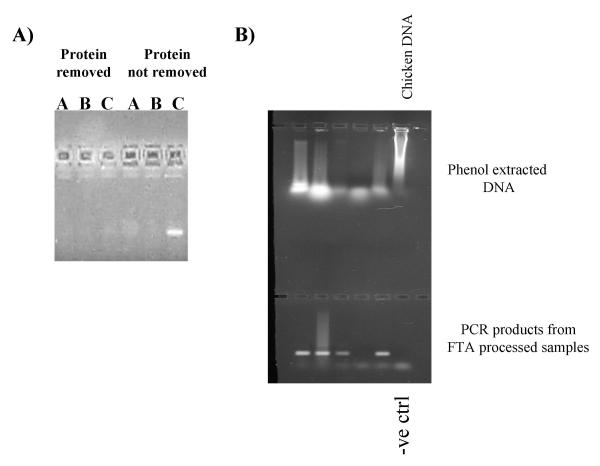
Degraded blood samples were placed onto FTA paper. A) Samples were processed with (TP) and without (NGP) a deproteinising wash, and the paper placed directly into a PCR reaction. PCR was performed for 30 (A), 40 (B) or 50 (C) cycles. B) Phenol extracted DNA from degraded samples and PCR amplification after purification using FTA paper.

References

    1. Vanek D, Hradil R, Budowle B. Czech population data on 10 short tandem repeat loci of SGM Plus system kit using DNA purified in FTA cards. Forensic Science International. 2001;119:107. doi: 10.1016/S0379-0738(00)00384-4. - DOI - PubMed
    1. Hsiao KM, Lin HM, Pan H, Li TC, Chen SS, Jou SB, Chiu YL, Wu MF, Lin CC, Li SY. Application of FTA® Sample Collection and DNA Purification System on the Determination of CTG Trinucleotide Repeat Size by PCR-Based Southern Blotting. Journal of Clinical Laboratory Analysis. 1999;13:188–193. doi: 10.1002/(SICI)1098-2825(1999)13:4<188::AID-JCLA8>3.0.CO;2-G. - DOI - PMC - PubMed
    1. Griffiths R, Double MC, Orr K, Dawson RJ. A DNA test to sex most birds. Molecular Ecology. 1998;7:1071–1075. doi: 10.1046/j.1365-294x.1998.00389.x. - DOI - PubMed
    1. Smith LM, Burgoyne LA. Species identity: conserved inverted LINE repeat clusters (ILRC) in the vertebrate genome as indicators of population boundaries. Gene. 2001;271:273–283. doi: 10.1016/S0378-1119(01)00507-8. - DOI - PubMed
    1. Seah LH, Burgoyne LA. DNA data-basing on FTA® paper :Biological assault and techniques for measuring photogenic damage. In: GF Sensabaugh, PJ Lincoln, OB, editor. Progress in Forensic Genetics. Vol. 8 2000.

MeSH terms

LinkOut - more resources