. 2004 Apr 1;18(7):739-44.
doi: 10.1101/gad.1180104.

Distinct aerobic and hypoxic mechanisms of HIF-alpha regulation by CSN5

Affiliations

Distinct aerobic and hypoxic mechanisms of HIF-alpha regulation by CSN5

Lynne Bemis et al. Genes Dev. .

Abstract

Mammalian oxygen homeostasis is dependent on the HIF family of transcription factors. The CSN subunit, CSN5, binds both the CODD of HIF-1 alpha and the pVHL tumor suppressor. High CSN5 expression generates a pVHL-independent form of CSN5 that stabilizes HIF-1 alpha aerobically by inhibiting HIF-1 alpha prolyl-564 hydroxylation. Aerobic CSN5 association with HIF-1 alpha occurs independently of the CSN holocomplex, leading to HIF-1 alpha stabilization independent of Cullin 2 deneddylation. CSN5 weakly associates with HIF-1 alpha under hypoxia, but is required for optimal hypoxia-mediated HIF-1 alpha stabilization. These results indicate that CSN5 regulates aerobic as well as hypoxic HIF-1 alpha stability by different mechanisms during oncogenesis.


Figures
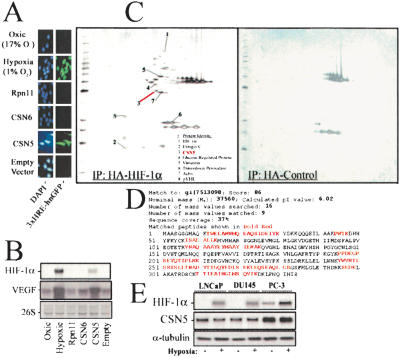
Figure 1.
Figure 1.
(A) Functional screen for activators of HIF activity. U-251 cells stably expressing three tandomly linked hypoxia-response elements (3xHRE) driving hnGFP gene expression were used to screen retroviral expression libraries. Highly fluorescent clones (aerobic) were FACS sorted and expanded, and the expressed cDNA was isolated. CSN5 was identified in 3 of 13 clones expressing aerobic hnGFP. Shown is the positive control of HIF-mediated transcription (hypoxia 1% O2) and negative control (17% O2). U-251 (3xHRE) cell lines containing Rpn11 (CSN5 paralog and negative control), CSN6 (CSN cofactor and negative control), or CSN5 are shown in the lower three panels. (B) Protein and mRNA from U-251 cellular lysates were detected by Western blot (anti-HIF-1α, top panel) or HIF-regulated gene expression assessed by increased VEGF in Northern blots (lower panel). (C) Proteomic identification of CSN5 as an HIF-1α binding protein. LNCaP cells were retrovirally infected with pLXSN-HA-HIF-1α or the empty pLXSN-HA vector. Forty-eight hours postinfection, HA-HIF-1α and HA-complexed proteins were isolated by using anti-HA affinity chromatography under native lysis conditions. Protein complexes were washed, separated by two-dimensional electrophoresis, and silver stained. Proteins differentially associated with HA-HIF-1α and not the HA-epitope alone were excised, proteolytically digested, and subjected to MALDI-MS for mass peptide fingerprinting. CSN5 was one of the most prominently stained spots (red arrow). (D) The MASCOT Search results for the CSN5 MS spectrum. (E) CSN5 is expressed at higher levels in prostate cancer cells containing deregulated (aerobic) HIF-1α stabilization. LNCaP, DU145, and PC-3 cell lines were subjected to 17% O2 (-) or 1% O2 (+) for 12 h, and the proteins blotted for HIF-1α or CSN5.
Figure 2.
Figure 2.
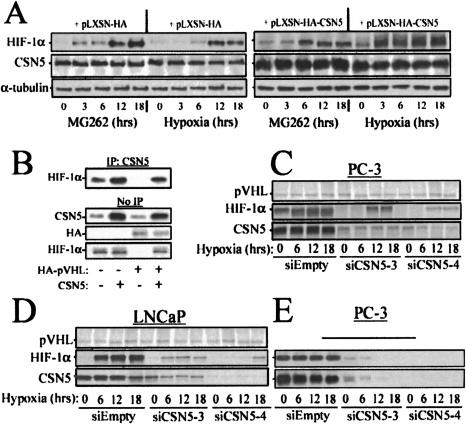
CSN5 mediates HIF-1α stabilization upstream of the 26S proteosome and is additive to hypoxia-induced HIF-1α stabilization. (A) LNCaP were infected with HA-CSN5 or an HA-vector retrovirus, incubated 36 h, and placed under hypoxia (1% pO2) or treatment with 500 nM MG262 for the indicated durations. The cells were lysed at the indicated times and the protein blotted with anti-HIF-1α, CSN5, and α-tubulin. (B) Aerobic CSN5-induced HIF-1α stabilization is not significantly enhanced by loss of pVHL. RCC4 cells lacking wild-type pVHL and expressing aerobic HIF-1α were stably transfected with HA-pVHL and/or CSN5. Cell lysates were prepared and immunoblots performed to examine the levels of total CSN5, HA (wild-type pVHL), and HIF-1α (bottom three panels). Alternatively, cell lysates were immunoprecipitated by using anti-CSN5 and immunoblots performed to examine HIF-1α associated with the CSN5 immunoprecipitates (top panel). Aerobic HIF-1α stabilization is prevented and hypoxic HIF-1α stabilization is delayed by CSN5 RNAi knockdown. PC-3 (C,E) and LNCaP (D) cells were infected with siRNA-CSN5 or control retroviruses. The cell lines were incubated for 36 h before incubation under hypoxia (1% pO2; C,D) or aerobic conditions (E). The cells were lysed at the indicated times and the protein blotted with anti-HIF-1α, pVHL, and CSN5.
Figure 3.
Figure 3.
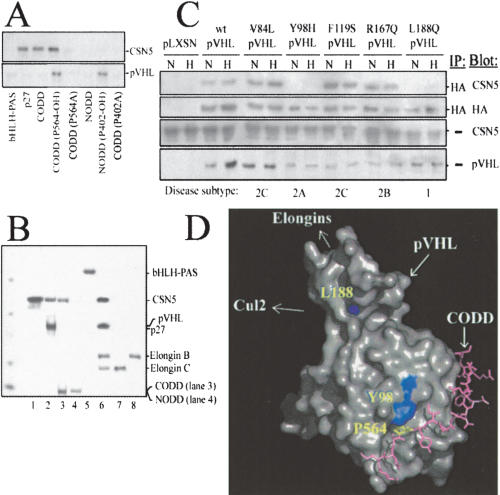
CSN5 binds wild-type pVHL (but not specific clinically manifested mutants) in addition to the CODD, irrespective of P564-hydroxylation. (A) Recombinant His6-tagged bHLH-PAS, p27, or His6-tagged synthesized CODD, CODD(P564A), CODD(hydroxyl-P564), NODD, NODD (P402A), and NODD(hydroxyl-P402) were bound to individual NTA columns and incubated with either recombinant CSN5 (upper panel) or VCB (lower panel; 4 h at 4°C). Elutions were separated by SDS-PAGE and visualized by Coomassie stain. (B) Recombinant His6-tagged proteins (CSN5 [1], p27 [2], CODD [3], NODD [4], bHLH-PAS [5], “VCB” [6], Elongin C [7], Elongin B [8]) were bound to individual NTA columns. Recombinant CSN5 was loaded and incubated on the columns (4 h at 4°C) and washed thoroughly, and the His6-fusion proteins were proteolytically eluted. Elutions were separated by SDS-PAGE and visualized by Coomassie stain. (C) 786-0 cells expressing wild-type HA-pVHL or indicated mutants under hypoxic (H) or aerobic (N) conditions were immunoprecipitated with anti-HA and blotted as indicated with anti-HA, anti-pVHL, and anti-CSN5. (D) Crystal structure of the HIF-1α CODD (pink) complexed to pVHL (gray; Hon et al. 2002). pVHL residues that alter CSN5 binding are highlighted in yellow (pVHL L188 and Y98; and HIF-1α P564).
Figure 4.
Figure 4.
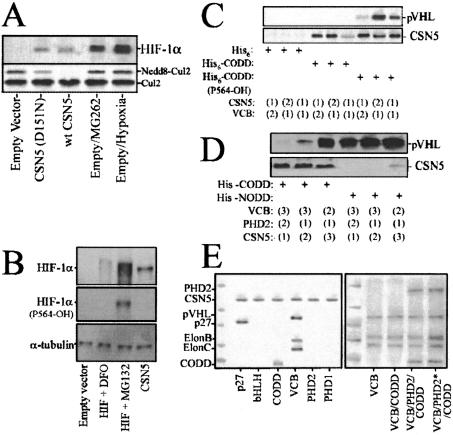
(A) Expression of CSN5 mutants incapable of cullin deneddylation stabilize HIF-1α. LNCaP were retrovirally infected with empty vector (lanes 1,4,5), pLXSN-HA-CSN5 (lane 2), or pLXSN-HA-CSN5(D151N; lane 3). At 36 h postinfection, some of the cells were treated with 500 nM MG262 for 6 h (lane 4) or placed under hypoxia (1% pO2 for 12 h, lane 5). The cellular lysates were blotted for HIF-1α, Cul2, and pVHL. (B) CSN5 expression results in an inhibition of HIF-1α proline 564 hydroxylation. HKO cells were transiently transfected with full-length human HIF-1α, CSN5, or empty vector and treated with DFO (100 μM; 4 h) or MG132 (10 μM; 1 h). Total cell lysates were prepared and immunoblots were performed to examine the levels of total HIF-1α, hydroxylated proline 564 of HIF-1α, and α-tubulin. (C) CSN5 sterically prevents PHD hydroxylation of HIF-1α (P564) and pVHL binding. Synthesized His6-tagged CODD or CODD(hydroxyl-P564) were bound to individual NTA columns and incubated with either recombinant CSN5 or VCB in the order indicated for 4 h at 4°C [(1)/(1) denotes coincubation]. Elutions were blotted as indicated. (D) Recombinant His6-tagged CODD or NODD were bound to individual NTA columns and incubated with recombinant PHD2, CSN5, or VCB in the order indicated for 4 h at 4°C. Elutions were blotted as indicated. (E) CSN5 does not directly bind PHD1 or PHD2 or modulate their activity. In the left panel, recombinant His6-tagged CSN5 was bound to individual NTA columns and incubated with recombinant p27, bHLH, CODD, VCB, PHD2, or PHD1 for 4 h at 4°C. In the right panel, recombinant His6-tagged VCB complexes were bound to individual NTA columns (lanes 25). Recombinant HA-tagged PHD2 bound to anti-HA agarose was incubated with recombinant CSN5 (PHD2*) for 4 h at 4°C, washed, and eluted by using HA peptide. Recombinant HIF-1α CODD was incubated in buffer alone, untreated PHD2, or PHD2* for 4 h at 4°C and added to the His6-tagged VCB columns as indicated (lanes 35, respectively) and incubated for 2 h at 4°C. The columns were extensively washed, and the proteolytic elutions were separated by SDS-PAGE and visualized by Coomassie (left panel) or Fast Blue (right panel) stain.
Figure 5.
Figure 5.
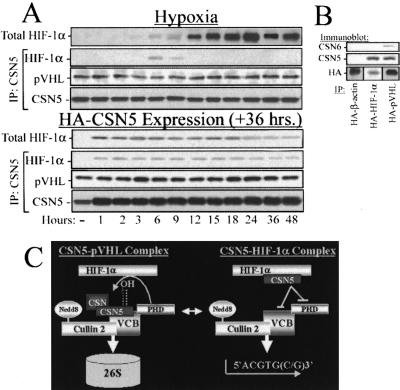
CSN5 is transiently associated with HIF-1α at the onset of hypoxia-induced HIF-1α stabilization. (A) LNCaP were treated for the indicated durations at 1% O2 (top panels) or by using transient retroviral HA-HIF-1α expression (bottom panels) followed by native lysis; CSN5 IP; and blotting with anti-CSN5, anti-HIF-1α, or anti-pVHL. Whole lysates were blotted with HIF-1α as well to indicate HIF-1α stabilization (top panel). CSN-independent CSN5 is associated with HIF-1α, whereas the CSN holocomplex is associated with the pVHL E3 ligase. (B) 786-0 cells lacking wild-type pVHL or wild-type HIF-1α expression were retrovirally infected with HA-β-actin (lane 1), HA-HIF-1α (lane 2), or HA-pVHL (lane 3). At 36 h postinfection, the cells were lysed using native protocols, immunoprecipitated, and subjected to Western blotting as indicated. (C) A model of CSN5 regulation of HIF-1α stability when in differential CSN5–HIF-1α or CSN5–VCB complexes.

References

    1. Bae M.K., Ahn, M.Y., Jeong, J.W., Bae, M.H., Lee, Y.M., Bae, S.K., Park, J.W., Kim, K.R., and Kim, K.W. 2002. Jab1 interacts directly with HIF-1alpha and regulates its stability. J. Biol. Chem. 277: 9-12. - PubMed
    1. Chan D.A., Sutphin, P.D., Denko, N.C., and Giaccia, A.J. 2002. Role of prolyl hydroxylation in oncogenically stabilized hypoxia-inducible factor-1alpha. J. Biol. Chem. 277: 40112-40117. - PubMed
    1. Denko N.C., Fontana, L.A., Hudson, K.M., Sutphin, P.D., Raychaudhuri, S., Altman, R., and Giaccia, A.J. 2003. Investigating hypoxic tumor physiology through gene expression patterns. Oncogene 22: 5907-5914. - PubMed
    1. Devroe E. and Silver, P.A. 2002. Retrovirus-delivered siRNA. BMC Biotechnol. 2: 15. - PMC - PubMed
    1. Hoffman M.A., Ohh, M., Yang, H., Klco, J.M., Ivan, M., and Kaelin Jr., W.G. 2001. von Hippel-Lindau protein mutants linked to type 2C VHL disease preserve the ability to downregulate HIF. Hum. Mol. Genet. 10: 1019-1027. - PubMed

Publication types

MeSH terms

Substances

LinkOut - more resources