Comparative Study
. 2004 Apr;19(2):234-44.
doi: 10.3346/jkms.2004.19.2.234.

Ultrastructural studies of gastrointestinal stromal tumors

Affiliations
Comparative Study

Ultrastructural studies of gastrointestinal stromal tumors

Sung-Hye Park et al. J Korean Med Sci. 2004 Apr.

Abstract

Gastrointestinal stromal tumors (GISTs) are the most common mesenchymal tumors in the gastrointestinal tract (GIT). Although interstitial cells of Cajal has been suggested as origin of this tumor, the cytological and ultrastructural features of GISTs are heterogeneous and unclear. A total 10 cases of normal gastrointestinal tissue (control), 13 GISTs of the stomach (8), small intestine (3), mesocolon (1) and liver (1), and 2 gastrointestinal autonomic nervous tumor (GANT) of small intestine were ultrastructurally studied. Normal interstitial cells of Cajal (ICC) were abundantly present around the myenteric plexuses or individually scattered through the wall of GIT. ICC was characterized by slender cytoplasmic processes, well-developed endoplasmic reticulum (ER), mitochondria, Golgi apparatus, caveolae and intermediate filaments. The GISTs and GANTs had overlapping ultrastructures. The most common and important ultrastructural features of GISTs were rich villous cytoplasmic processes, dispersed intermediate filaments and abundant SER, and those of GANTs were neurosecretory granules and skenoid fibers. Compared with ICC, the GISTs and GANTs had remarkably reduced caveolae and gap junctions. Our study suggested that ultrastructural analysis gives much information to investigate lineage differentiation of neoplastic cells and make a differential diagnosis of these tumors from other mesenchymal tumors and between GISTs and GANTs.


Figures
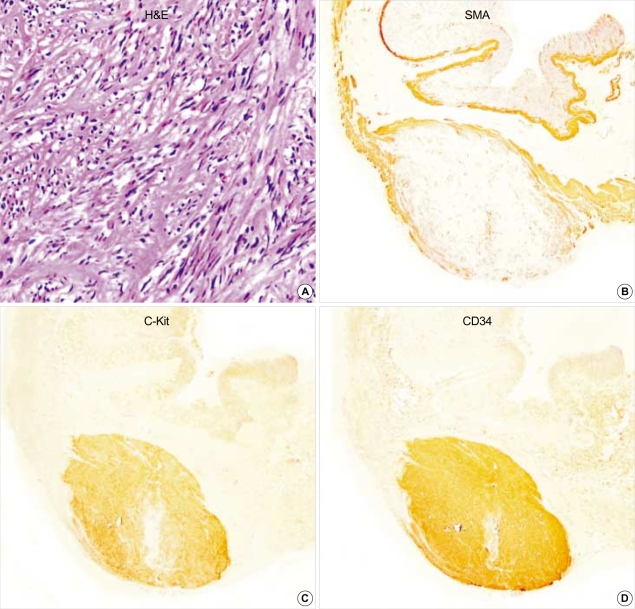
Fig. 1
Fig. 1
Gastric GIST (case 1). The tumor is composed of interlacing fascicles of spindle cells with eosinophilic cytoplasm. The tumor cells show patch immunopositivity for SMA, and express c-Kit and CD34, strongly and diffusely. (A: H&E,×200, B: SMA, ×40, C: c-Kit, ×40, D: CD34 immunostaining, ×40).
Fig. 2
Fig. 2
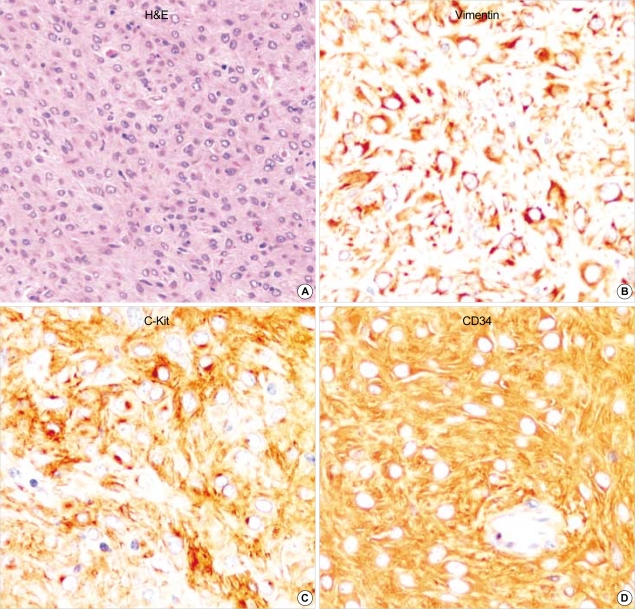
Epithelioid GIST shows sheets of polygonal neoplastic cells with eosinophilic cytoplasm. This tumor reveals diffuse and strong immunoreactivity for vimentin, c-Kit and CD34. (A: H&E, ×200, B: Vimentin, ×400, C: c-Kit, ×400, D: CD34 immunostaining, ×400).
Fig. 3
Fig. 3
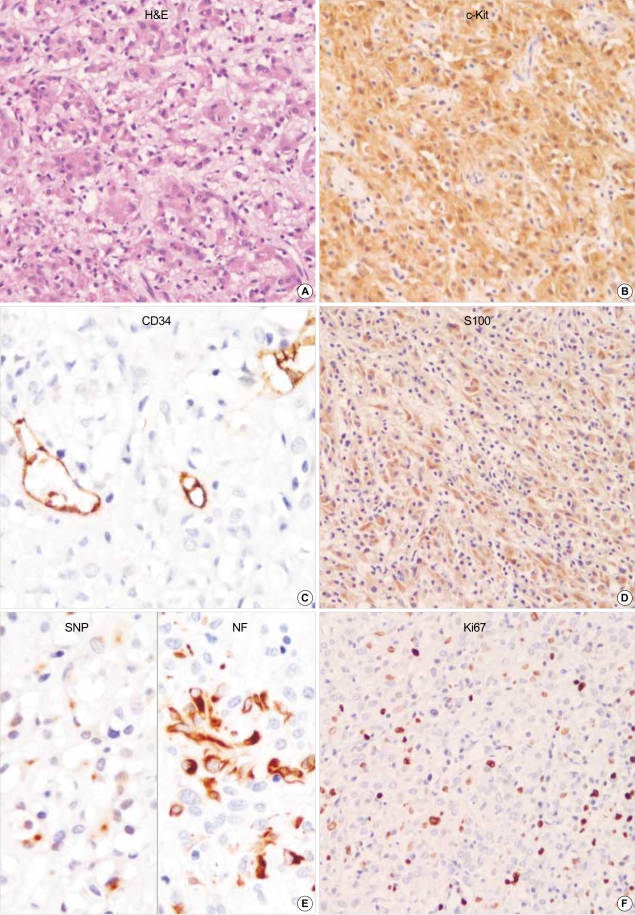
GANT reveals mainly epithelioid feature. Focal cytoplasmic vacuolization is seen. The tumor cells are robustly positive for CD117 (c-kit) but negative for CD34. S-100 protein, synaptophysin and NF are partially positive in neoplastic cells. Ki67 labelling index is high. (A: H&E, ×200, B: c-Kit, ×200, C: CD34, ×400, D: S100, ×200, E: left: Synaptophysin, right: Neurofilaments, ×400, F: Ki67 immunostaining, ×200).
Fig. 4
Fig. 4
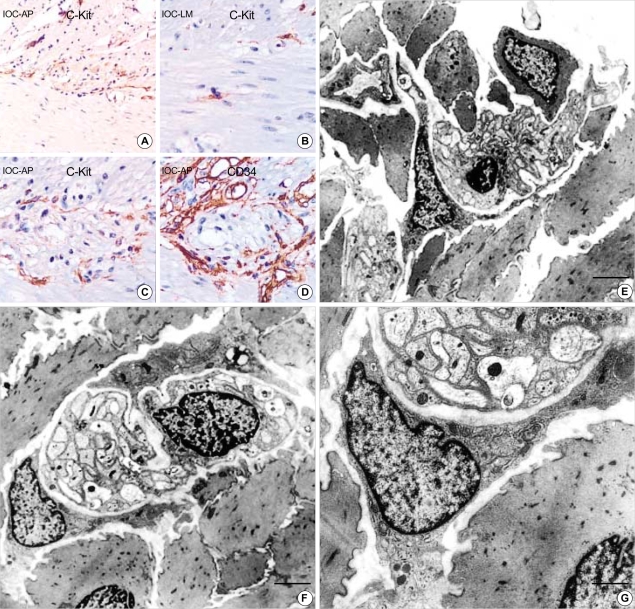
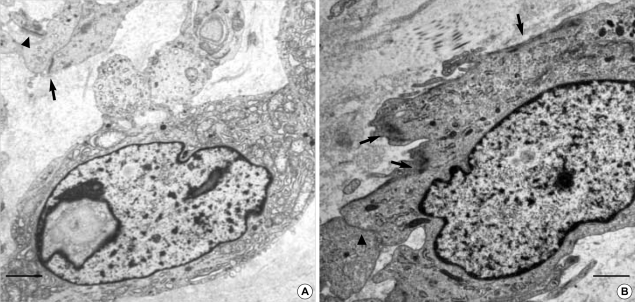
(A) Normal adult (M/45 yr) small intestine. (A-D) The immunohistochemical staining for c-Kit and CD34 shows immunoreactive interstitial cell of Cajal in myenteric plexus (A: c-Kit, ×200, B: ×400, C: ×400, D: CD34, ×400). (E-G) Ultrastructure of the interstitial cell of Cajal in normal stomach. It has slender cytoplasmic processes and the nucleus is heterochromatic and lobulated in apprearance. Two interstitial cell of Cajal hug the myenteric plexuses composed of many well-delineated peripheral nerves surrounded by Schwann cell cytoplasm and continuous external lamina (F). The cytoplasm of ICC has well-defined organelles such as rough endoplasmic reticulum, mitochondria, Golgi apparatus and caveolae. Gap junctions (arrows) are present but no external lamina is noted (G). (uranyl acetate and lead citrate stain E-F: bar: 2 µm, G: bar: 1 µm, E: ×2,500, F: ×3,000, G: ×8,000).
Fig. 5
Fig. 5
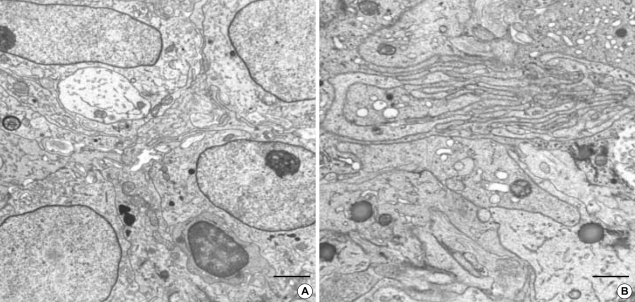
The Epithelioid GIST shows euchromatic nuclei and have prominent skein appearing nucleolus with rich filopodia-like cytoplasmic processes. The cytoplasmic processes are interdigitating each other. Electron dense cytoplasmic granules, favor lysosomes, are frequently seen, which may be confused with neurosecretory granules. (uranyl acetate and lead citrate stain, A: bar: 2 µm, B: bar: 1 µm, A: ×4,000, B: ×6,000).
Fig. 6
Fig. 6
(A) Spindle cell GIST also shows cytoplasmic processes but do not have much villous processes. The neoplastic cells have a nuclear pseudoinclusion and rich organelles including electron dense lysosomal granules. There are hemidesmosome-like junctions (arrowheads) as well as a few gap junctions (arrow). Incontinuous external lamina is seen. (B) Ultrastructual differentiation toward smooth muscle, such as cytoplasmic myofilaments are seen (arrows) (uranyl acetate and lead citrate stain, bar: 2 µm, A: ×5,000, B: ×6,000).
Fig. 7
Fig. 7
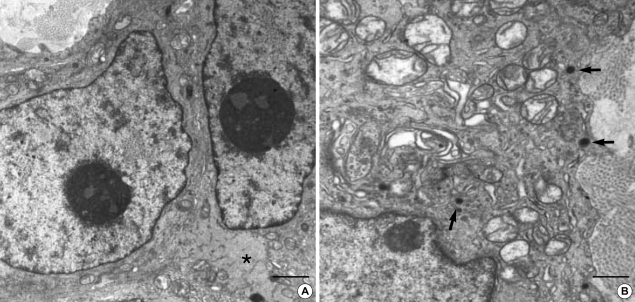
The GANT have oval to irregular generally heterochromatic nuclei with prominent nucleolus. There are also abundant and evenly dispersed wavy intermediate filaments (asteric mark). The tumor cells are closely apposed except some areas having intercellular collagenous tissue. Small round neurosecretory granules (arrows) are observed, measuring 40-150 nm (uranyl acetate and lead citrate stain, A: bar: 1 µm, B: bar: 500 nm, A: ×6,000, B: ×10,000).
Fig. 8
Fig. 8
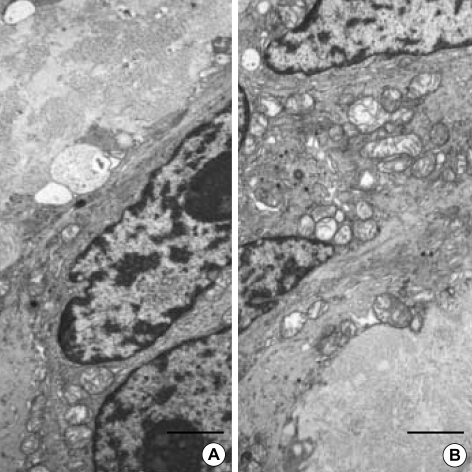
Both cases of GANTs have characteristic extracellular skenoid fibers. (inlet: high power view of skenoid fibers). (uranyl acetate and lead citrate stain, A, B: bars: 1 µm, A, B: ×4,000).

References

    1. Chan JK. Mesenchymal tumors of the gastrointestinal tract: a paradise for acronyms (STUMP, GIST, GANT, and now GIPACT), implication of c-kit in genesis, and yet another of the many emerging roles of the interstitial cell of Cajal in the pathogenesis of gastrointestinal diseases? Adv Anat Pathol. 1999;6:19–40. - PubMed
    1. Kindblom LG, Remotti HE, Aldenborg F, Meis-Kindblom JM. Gastrointestinal pacemaker cell tumor (GIPACT): gastrointestinal stromal tumors show phenotypic characteristics of the interstitial cells of Cajal. Am J Pathol. 1998;152:1259–1269. - PMC - PubMed
    1. Eyden B, Chorneyko KA, Shanks JH, Menasce LP, Banerjee SS. Contribution of electron microscopy to understanding cellular differentiation in mesenchymal tumors of the gastrointestinal tract: a study of 82 tumors. Ultrastruct Pathol. 2002;26:269–285. - PubMed
    1. Yantiss RK, Rosenberg AE, Selig MK, Nielsen GP. Gastrointestinal stromal tumors: an ultrastructural study. Int J Surg Pathol. 2002;10:101–113. - PubMed
    1. Liu P, Na J, Wang Y, He Q, Zhang Y, Tang X, Zou W. Study of gastrointestinal stromal tumors by light microscopy, electron microscopy and immunohistochemistry. Zhonghua Bing Li Xue Za Zhi. 2002;31:199–203. - PubMed

Publication types

MeSH terms

Substances